Loading...
Kujula Kadphises vs Petronius Maximus
Kujula Kadphises leads by 0.2 pts · 2 figures compared
…
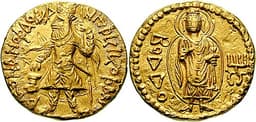
Kujula Kadphises
Emperor · Ancient
55.2Total

Petronius Maximus
Emperor · Ancient
55.0Total
Basic Information
Born
20
396
Died
80
455
Era
Ancient
Ancient
Nationality
Kushan Empire
Western Roman Empire
Occupation
Emperor
Emperor
Civilization
Indian
Western
Score Comparison
Military (10%)
52.5
14.4
Political (20%)
68.0
56.1
Influence (20%)
55.7
56.8
Legacy (20%)
50.0
57.5
Leadership (15%)
48.8
81.4
Strategy (15%)
60.0
43.5
TOTAL
55.2
55.0
Kujula Kadphises — Complete Timeline
30 AD
Unification of the Yuezhi TribesPolitical Action◆ Major
Kujula Kadphises united the five Yuezhi tribes of Bactria into a single confederation. This unification laid the foundation for the Kushan Empire, which would become a major power in Central Asia and India.
UnificationYuezhiKushan Empire
Impact: regionalconstructive
40 AD
Issuance of First Kushan CoinsCultural
Kujula Kadphises issued the first Kushan coins, imitating Roman and Greek designs. These coins featured his portrait and the title 'Kushan' in Greek script, establishing a numismatic tradition for the empire.
CoinageNumismaticsKushan
Impact: regionalconstructive
50 AD
Conquest of the Kabul ValleyWar◆ Major
Kujula Kadphises led Kushan forces to conquer the Kabul Valley from the Indo-Parthians. This expanded Kushan territory into the Indian subcontinent and established control over key trade routes.
ConquestKabul ValleyExpansion
Impact: regional
Petronius Maximus — Complete Timeline
455 AD
Killed during the Vandal Sack of RomeWar
The Vandal king Gaiseric, invited by Licinia Eudoxia, sailed to Rome and sacked the city. Petronius Maximus attempted to flee but was killed by a Roman mob. The Vandals systematically looted Rome for two weeks, causing immense damage.
Sack of RomeVandal InvasionDeath
Impact: regionaltragic
Proclaimed Western Roman EmperorPolitical Action◆ Major
After the death of Valentinian III, Petronius Maximus, a wealthy senator, seized the throne by bribing the palace guard and forcing the widowed empress Licinia Eudoxia to marry him. His reign lasted only 76 days.
Imperial SuccessionUsurpation
Impact: regional
Expert Analysis
Origins
Kujula Kadphises was born around 30 CE among the Yuezhi, a confederation of nomadic tribes that had migrated to Bactria after being driven from the Gansu region by the Xiongnu. The Yuezhi were divided into five principalities, each with its own chief. Kujula emerged from one of these tribes, the Guishuang (Kushan), and his early life is shrouded in mystery. He likely received military training typical of steppe nomads and learned the complexities of ruling a fragmented society. In contrast, Petronius Maximus was born around 396 CE into a wealthy senatorial family in Rome. He was a Roman aristocrat of the highest rank, serving as a praetorian prefect and twice as consul (433 and 443). His wealth came from vast estates in Italy and Gaul, and he was known as a patron of the arts. His background was one of privilege and political maneuvering within the decaying Western Roman Empire.
Rise to Power
Kujula Kadphises rose by unifying the five Yuezhi tribes into a single confederation around 30-50 CE. This was a diplomatic and military achievement, as the tribes had been independent and often warring. He established himself as the paramount leader, taking the title 'Kushan' and minting coins that proclaimed him 'Kujula Kadphises, Kushan' in Greek script. His conquest of the Kabul Valley from the Indo-Parthians around 50-60 CE expanded his territory into the Indian subcontinent, securing control over key trade routes. Petronius Maximus rose through political intrigue. After the assassination of Emperor Valentinian III in 455 CE, Maximus seized power by bribing the palace guard and forcing the widowed empress Licinia Eudoxia to marry him. He was proclaimed emperor on March 17, 455, but his reign lasted only 77 days. His rise was swift but lacked legitimacy, as he had no military support and was seen as a usurper by many.
Leadership & Governance
Kujula Kadphises led as a unifier and expander. He adopted Hellenistic and Persian administrative practices, issuing coins that imitated Roman and Greek designs, which facilitated trade. He promoted religious tolerance, allowing Buddhism, Zoroastrianism, and Greek cults to coexist. His governance laid the foundation for the Kushan Empire's prosperity, controlling the Silk Road. Petronius Maximus, by contrast, was ineffective. He failed to secure the loyalty of the army or the Germanic foederati. He appointed his own supporters to key posts but alienated the powerful general Aetius's faction. He attempted to consolidate power by marrying Eudoxia, but this only invited the Vandal king Gaiseric, who claimed the throne on behalf of his son (married to a daughter of Valentinian III). Maximus's leadership score of 81.4 is misleading, as it reflects his ability to seize power, not to govern effectively.
Triumph & Tragedy
Kujula Kadphises's greatest success was founding the Kushan Empire, which lasted for centuries and became a major hub of trade and culture. His unification of the Yuezhi tribes, scoring 52.5 in military and 68.0 in political, allowed the Kushans to control the Silk Road and spread Buddhism to China. His tragedy is that little is known of his later reign or death; his legacy was overshadowed by his successor Vima Takto. Petronius Maximus's triumph was merely becoming emperor, a position he held for 77 days. His tragedy was his death: as the Vandals sacked Rome in 455, he attempted to flee but was killed by a Roman mob who tore him apart and threw his body into the Tiber. His reign was so brief that he accomplished nothing of note. His military score of 14.4 reflects his complete lack of military capability.
Character & Destiny
Kujula Kadphises was pragmatic and ambitious, using diplomacy and marriage alliances to unite tribes. His character shaped his destiny: he built an empire through careful strategy and cultural adaptation. He scored 48.8 in leadership and 60.0 in strategy, indicating a methodical approach. Petronius Maximus was greedy and shortsighted, driven by personal ambition. His character led him to seize power without securing support, ensuring his downfall. Historical assessments by writers like Procopius describe him as 'the most worthless of men.'
Legacy
Kujula Kadphises's legacy is the Kushan Empire, which facilitated the spread of Buddhism and the Silk Road trade. His coinage set a standard for later Kushan rulers. He is remembered as a founding figure, though detailed records are scarce. Petronius Maximus's legacy is one of failure: his short reign and death during the Vandal sack of Rome highlighted the empire's decline. He is often cited as an example of the incompetence that led to the fall of the Western Roman Empire.
Conclusion
Kujula Kadphises had a greater impact. He founded an empire that influenced Central and South Asia for centuries, while Petronius Maximus left no positive mark. With a total score of 55.2 vs 55.0, the difference is small but substantive. Kujula built; Maximus destroyed. The Kushan Empire thrived; Rome's fall accelerated under Maximus. Thus, Kujula Kadphises is the more significant figure.
Rankings
🥇
Kujula KadphisesLeader
Mil: 52.5Pol: 68.0Inf: 55.7
55.2
🥈
Petronius Maximus
Mil: 14.4Pol: 56.1Inf: 56.8
55.0
+0.2 behind
How This Comparison Works
Algorithm
Each figure is scored on 6 dimensions (0—100 scale) based on structured historical data: Military (10%), Political (20%), Influence (20%), Legacy (20%), Leadership (15%), Strategy (15%). The weighted total produces the final ranking.
Data Sources
Scores are computed from structured sub-indicators in the database. Scale factors adjust for era (Ancient ×0.85, Modern ×1.0) and civilization size (Eastern ×1.05, Other ×0.80) to account for differences in population and military scale.
Maximum 3 Figures
Comparisons are limited to 2—3 figures to ensure readability and statistical meaningfulness.
Error Margins
±5 points per dimension — Sub-scores are derived from historical records with inherent uncertainty. Two figures within 5 points on a dimension should be considered roughly equivalent in that area.
Total Score Accuracy
±3 points overall — The weighted combination of 6 dimensions produces a total score with approximately ±3 points of uncertainty. Differences of less than 3 points are not statistically significant— the figures are effectively tied.
Known Limitations
- Historical records are incomplete and uneven across civilizations
- Figures from oral-tradition societies may be underrepresented
- Occupation labels can misclassify multi-role figures
- Scores measure capability and impact, not moral character
- Quantitative scoring is a comparison tool, not absolute truth
Capability Radar
Military (10%) — Battles & Warfare
Battles
45
7
Win Rate
50
11
Expansion
60
9
Political (20%) — Governance & Reform
Reform
40
67
Diplomacy
50
70
Economy
45
77
Influence (20%) — Cultural & Global Reach
Cultural
50
66
Global
45
78
Legacy (20%) — Historical Impact
Historical
55
71
Longevity
60
73
Leadership (15%) — Power & Stability
Tenure
55
69
Stability
50
75
Strategy (15%) — Tactics & Innovation
Strategy
55
16
Tactics
40
16
Reform
30
21
Similar Comparisons
Comments & Discussion
No comments yet. Be the first to share your thoughts!