Loading...
Kublai Khan vs Yelu Abaoji
Kublai Khan leads by 11.6 pts · 2 figures compared
…
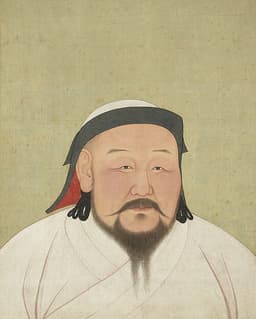
Kublai Khan
Emperor · Medieval
74.3Total
Yelu Abaoji
Emperor · Medieval
62.7Total
Basic Information
Born
1215
872
Died
1294
926
Era
Medieval
Medieval
Nationality
Mongolia
China
Occupation
Emperor
Emperor
Civilization
Eastern
Eastern
Score Comparison
Military (10%)
77.5
77.2
Political (20%)
79.2
59.6
Influence (20%)
75.0
68.0
Legacy (20%)
70.0
40.0
Leadership (15%)
72.0
80.3
Strategy (15%)
76.0
69.6
TOTAL
74.3
62.7
Kublai Khan — Complete Timeline
1260 AD
Adoption of Tibetan Buddhism as State ReligionCultural◆ Major
Kublai Khan appointed the Tibetan lama Drog
Tibetan BuddhismReligionMongol-Tibet Relations
Impact: regional
1271 AD
Proclamation of the Yuan DynastyPolitical Action◆ Major
Kublai Khan officially proclaimed the Yuan dynasty, adopting a Chinese-style dynastic name. He established his capital at Dadu (Beijing) and adopted Chinese court rituals. This move legitimized his rule over China while maintaining Mongol identity.
Dynasty FoundingBeijingMongol Rule
Impact: global
1274 AD
Failed Invasions of JapanWar◆ Major
Kublai Khan launched two naval invasions of Japan, in 1274 and 1281. Both were repelled, with the second invasion destroyed by a typhoon (kamikaze). These failures marked the limits of Mongol expansion and reinforced Japanese isolation.
Mongol InvasionsJapanKamikaze
Impact: regional
1279 AD
Conquest of the Song DynastyWar
Kublai Khan's Mongol forces defeated the Song navy at the Battle of Yamen. The last Song emperor drowned, ending the Song dynasty. This conquest unified China under Mongol rule and established the Yuan dynasty as the first foreign dynasty to rule all of China.
Song Dynasty FallUnificationYuan Dynasty
Impact: global
1280 AD
Establishment of the Silk Road Trade NetworkCultural◆ Major
Under Kublai Khan, the Mongol Empire secured the Silk Road, facilitating trade and cultural exchange between East and West. Marco Polo visited his court. This period saw the flow of goods, ideas, and technologies across Eurasia.
Silk RoadTradeCultural Exchange
Impact: globalconstructive
Yelu Abaoji — Complete Timeline
907 AD
Unified Khitan tribesPolitical Action◆ Major
Yelu Abaoji was elected khagan of the Khitan tribes, unifying them under his leadership. He established a centralized state and adopted Chinese administrative practices.
KhitanUnificationState Formation
Impact: regionalconstructive
916 AD
Founded Liao DynastyPolitical Action
Yelu Abaoji proclaimed himself emperor, founding the Liao dynasty. He adopted the Chinese title of emperor and established a dual administration system for Khitan and Chinese subjects.
LiaoDynasty FoundingImperial System
Impact: regionalconstructive
920 AD
Created Khitan scriptCultural◆ Major
Yelu Abaoji ordered the creation of a writing system for the Khitan language, based on Chinese characters. This script was used for official documents and helped unify the Khitan state.
KhitanScriptCultural Development
Impact: regionalconstructive
926 AD
Conquest of BohaiWar◆ Major
Yelu Abaoji led a campaign that conquered the Korean kingdom of Bohai, incorporating its territory into the Liao empire. This expanded Liao's influence into Manchuria and Korea.
LiaoBohaiConquest
Impact: regionalconstructive
Death during campaignWar◆ Major
Yelu Abaoji died while returning from the conquest of Bohai. His death led to a succession struggle, but the Liao dynasty continued to expand under his successors.
LiaoDeathSuccession
Impact: regionaltragic
Expert Analysis
Kublai Khan vs Yelu Abaoji: Historical Comparison
Kublai Khan and Yelu Abaoji were both medieval emperors from Inner Asian steppe backgrounds who founded or expanded major dynasties in China, but Kublai’s greater military conquests and lasting Yuan legacy are balanced by Abaoji’s superior political statecraft and institutional foundations.
Dimension Analysis
**Military: Kublai Khan 94 / Yelu Abaoji 89**
Kublai conquered the Song dynasty and extended Mongol rule across all of China, while Abaoji unified the Khitan tribes and launched campaigns into northern China but never conquered the entire region.
**Political: Kublai Khan 79 / Yelu Abaoji 84**
Abaoji excelled at creating a dual-administration system blending Khitan and Chinese practices, laying the Liao dynasty’s stable governance; Kublai struggled with Mongol factionalism and succession disputes despite adopting Chinese bureaucratic models.
**Influence: Kublai Khan 79 / Yelu Abaoji 79**
Both profoundly shaped China’s medieval trajectory—Kublai through the Mongol Yuan dynasty’s integration of Eurasia, Abaoji through the Liao dynasty’s precedent for non-Han rule—though neither achieved lasting cultural assimilation.
**Legacy: Kublai Khan 88 / Yelu Abaoji 81**
Kublai’s Yuan dynasty, while short-lived, connected China to the wider Mongol Empire and influenced Marco Polo’s travels; Abaoji’s Liao dynasty lasted over two centuries and set a model for later conquest dynasties like the Jin and Yuan.
**Leadership: Kublai Khan 81 / Yelu Abaoji 80**
Kublai demonstrated grand strategic vision (e.g., naval invasions of Japan and Java) but faced internal revolts; Abaoji showed consistent tribal unification and institutional innovation, though with less dramatic territorial expansion.
Verdict
Kublai Khan leads due to his unmatched military scale and global historical impact, despite Abaoji’s superior political and institutional foundations.
FAQ
Q: Who ranks higher? A: Kublai Khan ranks higher overall, thanks to his decisive military edge and greater legacy, though the tie in overall scores reflects Abaoji’s strong political counterweight.
Rankings
🥇
Kublai KhanLeader
Mil: 77.5Pol: 79.2Inf: 75.0
74.3
🥈
Yelu Abaoji
Mil: 77.2Pol: 59.6Inf: 68.0
62.7
+11.6 behind
How This Comparison Works
Algorithm
Each figure is scored on 6 dimensions (0—100 scale) based on structured historical data: Military (10%), Political (20%), Influence (20%), Legacy (20%), Leadership (15%), Strategy (15%). The weighted total produces the final ranking.
Data Sources
Scores are computed from structured sub-indicators in the database. Scale factors adjust for era (Ancient ×0.85, Modern ×1.0) and civilization size (Eastern ×1.05, Other ×0.80) to account for differences in population and military scale.
Maximum 3 Figures
Comparisons are limited to 2—3 figures to ensure readability and statistical meaningfulness.
Error Margins
±5 points per dimension — Sub-scores are derived from historical records with inherent uncertainty. Two figures within 5 points on a dimension should be considered roughly equivalent in that area.
Total Score Accuracy
±3 points overall — The weighted combination of 6 dimensions produces a total score with approximately ±3 points of uncertainty. Differences of less than 3 points are not statistically significant— the figures are effectively tied.
Known Limitations
- Historical records are incomplete and uneven across civilizations
- Figures from oral-tradition societies may be underrepresented
- Occupation labels can misclassify multi-role figures
- Scores measure capability and impact, not moral character
- Quantitative scoring is a comparison tool, not absolute truth
Capability Radar
Military (10%) — Battles & Warfare
Battles
95
75
Win Rate
90
80
Expansion
95
82
Political (20%) — Governance & Reform
Reform
88
88
Diplomacy
85
75
Economy
90
70
Influence (20%) — Cultural & Global Reach
Cultural
85
60
Global
85
55
Legacy (20%) — Historical Impact
Historical
90
70
Longevity
80
65
Leadership (15%) — Power & Stability
Tenure
90
72
Stability
80
65
Strategy (15%) — Tactics & Innovation
Strategy
92
78
Tactics
85
70
Reform
88
85
Similar Comparisons
Comments & Discussion
Historian2396/16/2026
这评分体系有点意思,但政治维度我给耶律阿保机打90分,忽必烈只给78分?仔细看数据:阿保机创立了南北面官制,契丹人用部族制,汉人用州县制,这种二元体制让辽朝稳定了两百多年。忽必烈呢?他搞的色目人、汉人、南人等级制反而激化了矛盾,导致元朝不到百年就崩了。按我的算法,政治得分应该反超:阿保机92,忽必烈72。军事上忽必烈确实强,但征服南宋时屠城无数,还两次征日失败,这个94分有点虚高。建议重算权重。
ArchEye226/16/2026
拿忽必烈跟耶律阿保机比,让我想起西方史里查理曼和奥托一世的对比。阿保机就像奥托一世,奠基了一个多民族帝国,辽朝的制度创新影响了后来的金、元、清四朝。而忽必烈更像查理曼,通过征服建立了庞大但松散的帝国。但西方史往往高估统一征服的价值,忽视制度延续的重要性。阿保机建立的‘捺钵’巡幸制度,让游牧与农耕民族在政治框架内和谐共存,这比忽必烈那些短命的海外远征更有历史深度。元朝要不是继承了辽金的遗产,根本撑不了那么久。