Loading...
Krishnadevaraya vs Simeon I the Great
Simeon I the Great leads by 1.9 pts · 2 figures compared
…

Krishnadevaraya
Emperor · Medieval
66.5Total
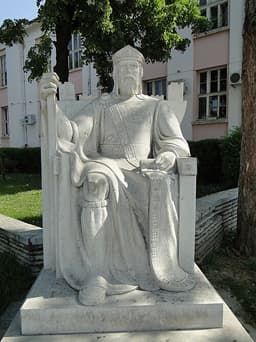
Simeon I the Great
Emperor · Medieval
68.4Total
Basic Information
Born
1471
864
Died
1529
927
Era
Medieval
Medieval
Nationality
India
Bulgaria
Occupation
Emperor
Emperor
Civilization
Indian
Western
Score Comparison
Military (10%)
72.0
79.8
Political (20%)
75.0
62.7
Influence (20%)
65.0
88.0
Legacy (20%)
55.0
40.0
Leadership (15%)
75.0
78.0
Strategy (15%)
68.1
72.7
TOTAL
66.5
68.4
Krishnadevaraya — Complete Timeline
1509 AD
Conquest of the Bahmani SultanateWar◆ Major
Krishnadevaraya led a campaign against the Bahmani Sultanate, capturing the fortress of Gulbarga and expanding Vijayanagara territory. This victory established his military reputation and secured the empire's northern frontier.
Military CampaignExpansion
Impact: regional
1510 AD
Patronage of Telugu LiteratureCultural◆ Major
Krishnadevaraya patronized Telugu poets and scholars, including Allasani Peddana, who composed the epic 'Manucharitram'. His court became a center of Telugu literature, earning him the title 'Andhra Bhoja'.
Cultural PatronageLiterature
Impact: regionalconstructive
1513 AD
Expedition to KalingaWar
Krishnadevaraya led a military expedition to the Kalinga region (modern Odisha), defeating the Gajapati king. This campaign extended Vijayanagara influence eastward and secured tribute from the conquered territories.
Military CampaignExpansion
Impact: regional
1515 AD
Construction of the Vijayanagara CityCultural◆ Major
Krishnadevaraya expanded and beautified the Vijayanagara capital, constructing temples, irrigation works, and public buildings. The city became one of the largest and most prosperous in India at the time.
Urban DevelopmentArchitecture
Impact: regionalconstructive
1520 AD
Battle of RaichurWar◆ Major
Krishnadevaraya defeated the combined forces of the Bijapur and Golconda sultanates at Raichur. This victory secured the Raichur Doab region for Vijayanagara and demonstrated his military prowess.
BattleTerritorial Gain
Impact: regional
Simeon I the Great — Complete Timeline
893 AD
Establishment of the Preslav Literary SchoolCultural◆ Major
Simeon I founded the Preslav Literary School, which became a center of Slavic culture and learning. Scholars translated Greek texts into Old Church Slavonic, developed the Cyrillic script, and produced original works, fostering a golden age of Bulgarian culture.
CultureLiteratureCyrillic
Impact: regionalconstructive
913 AD
Coronation as Emperor of the BulgariansPolitical Action
Simeon I was crowned 'Emperor and Autocrat of all Bulgarians' by the Patriarch of Constantinople, though the title was later disputed. This act asserted Bulgaria's imperial status and challenged Byzantine supremacy in the region.
CoronationEmpireByzantine
Impact: regionalconstructive
917 AD
Battle of AchelousWar◆ Major
Simeon I led Bulgarian forces to a decisive victory over the Byzantine army at the Achelous River. The battle was one of the largest in medieval history, resulting in Byzantine casualties and allowing Simeon to expand his influence over the Balkans.
BattleByzantineBalkans
Impact: regional
924 AD
Siege of ConstantinopleWar◆ Major
Simeon I besieged Constantinople, the Byzantine capital, but failed to capture it. The siege ended with a peace treaty that recognized his imperial title but did not grant him control over the city. This marked the peak of his military campaigns.
SiegeConstantinopleByzantine
Impact: regional
Expert Analysis
Origins
Krishnadevaraya (1471–1529) was born into the Tuluva dynasty of the Vijayanagara Empire in southern India. His father, Tuluva Narasa Nayaka, was a military commander who seized power, but Krishnadevaraya's early life remains obscure. He received training in statecraft and warfare, likely under the regency of his elder brother Vira Narasimha. In contrast, Simeon I (864–927) was the son of Boris I, the Christianizer of Bulgaria. Educated in Constantinople, Simeon was groomed to rule and initially destined for the clergy, but he became prince after his brother's death. Both rulers inherited nascent states and shaped them through ambition.
Rise to Power
Krishnadevaraya ascended the throne in 1509 after his brother's death, inheriting a kingdom threatened by the Bahmani Sultanate. His first major campaign was against the rebellious Ummattur chief, consolidating his rule. He soon launched an expedition to Kalinga (1513), defeating the Gajapati king and expanding Vijayanagara's influence. Simeon I became tsar in 893 after a brief reign by his brother Vladimir. He immediately pursued war with Byzantium, leveraging his education and diplomatic skills. In 913, he marched on Constantinople and forced the Byzantines to recognize his imperial title, a turning point that elevated Bulgaria to a major power. Both rulers used military success to legitimize their rule.
Leadership & Governance
Krishnadevaraya governed through a centralized bureaucracy with provincial governors. He implemented land revenue reforms, encouraging trade and irrigation. His court at Vijayanagara became a hub of Telugu literature, with poets like Allasani Peddana receiving patronage. He also constructed temples and waterworks, boosting agriculture. Simeon I ruled as an autocrat, promoting Orthodox Christianity and Slavic culture. He established the Preslav Literary School, translating Greek texts into Old Church Slavonic, and fostered a distinct Bulgarian identity. While Krishnadevaraya focused on administrative expansion, Simeon prioritized cultural unification. Both scored high in leadership: Krishnadevaraya 75.0, Simeon 78.0.
Triumph & Tragedy
Krishnadevaraya's greatest triumph was the Battle of Raichur (1520), where he defeated a coalition of Bijapur and Golconda, securing the fertile Raichur Doab. His campaigns expanded the empire to its largest extent. However, his failure to permanently subdue the Deccan sultanates left Vijayanagara vulnerable. After his death, the empire declined, culminating in the Battle of Talikota (1565). Simeon I's triumph was the Battle of Achelous (917), a crushing defeat of the Byzantines that made Bulgaria the dominant Balkan power. His tragedy was the failure to capture Constantinople, despite repeated sieges. The Byzantine alliance with the Serbs and Croats checked his ambitions. Both rulers achieved military expansion but left fragile successions.
Character & Destiny
Krishnadevaraya was pragmatic and cultured, known for his justice and patronage. He wrote the Telugu work 'Amuktamalyada' and surrounded himself with intellectuals. His character fostered a golden age of literature but also centralized power, leading to succession disputes. Simeon I was ambitious and ruthless, driven by a desire to be recognized as emperor. His character led to constant warfare, but also to the cultural flourishing of Bulgaria. Historians note that Simeon's obsession with Constantinople diverted resources from internal consolidation. Krishnadevaraya's total score is 66.5, Simeon's 68.4, reflecting Simeon's higher influence (88.0 vs 65.0) but lower legacy (40.0 vs 55.0).
Legacy
Krishnadevaraya's legacy is the Vijayanagara Empire's architectural and literary achievements, including the city of Vijayanagara (Hampi), a UNESCO site. His patronage of Telugu literature shaped South Indian culture. However, his empire collapsed within decades. Simeon I's legacy is the Bulgarian Golden Age: the Preslav Literary School and the Cyrillic script's spread. He is revered as 'Simeon the Great' but his empire also fragmented after his death. Simeon's influence score of 88.0 reflects the lasting impact on Slavic culture, while Krishnadevaraya's legacy of 55.0 indicates limited enduring political power.
Conclusion
Simeon I the Great had a greater overall impact, scoring 68.4 against Krishnadevaraya's 66.5. While Krishnadevaraya expanded his empire and fostered a literary renaissance, his achievements were regional and short-lived. Simeon's cultural and religious influence on the Slavic world endured for centuries, shaping the identity of many nations. His military score of 79.8 and influence of 88.0 demonstrate a broader and more lasting legacy. Therefore, Simeon I the Great emerges as the more significant historical figure.
Rankings
🥇
Simeon I the GreatLeader
Mil: 79.8Pol: 62.7Inf: 88.0
68.4
🥈
Krishnadevaraya
Mil: 72.0Pol: 75.0Inf: 65.0
66.5
+1.9 behind
How This Comparison Works
Algorithm
Each figure is scored on 6 dimensions (0—100 scale) based on structured historical data: Military (10%), Political (20%), Influence (20%), Legacy (20%), Leadership (15%), Strategy (15%). The weighted total produces the final ranking.
Data Sources
Scores are computed from structured sub-indicators in the database. Scale factors adjust for era (Ancient ×0.85, Modern ×1.0) and civilization size (Eastern ×1.05, Other ×0.80) to account for differences in population and military scale.
Maximum 3 Figures
Comparisons are limited to 2—3 figures to ensure readability and statistical meaningfulness.
Error Margins
±5 points per dimension — Sub-scores are derived from historical records with inherent uncertainty. Two figures within 5 points on a dimension should be considered roughly equivalent in that area.
Total Score Accuracy
±3 points overall — The weighted combination of 6 dimensions produces a total score with approximately ±3 points of uncertainty. Differences of less than 3 points are not statistically significant— the figures are effectively tied.
Known Limitations
- Historical records are incomplete and uneven across civilizations
- Figures from oral-tradition societies may be underrepresented
- Occupation labels can misclassify multi-role figures
- Scores measure capability and impact, not moral character
- Quantitative scoring is a comparison tool, not absolute truth
Capability Radar
Military (10%) — Battles & Warfare
Battles
85
85
Win Rate
90
88
Expansion
85
80
Political (20%) — Governance & Reform
Reform
80
85
Diplomacy
85
80
Economy
90
85
Influence (20%) — Cultural & Global Reach
Cultural
85
90
Global
65
65
Legacy (20%) — Historical Impact
Historical
80
85
Longevity
70
70
Leadership (15%) — Power & Stability
Tenure
85
90
Stability
80
75
Strategy (15%) — Tactics & Innovation
Strategy
85
85
Tactics
80
82
Reform
75
75
Similar Comparisons
Comments & Discussion
No comments yet. Be the first to share your thoughts!