Loading...
Simeon I the Great vs Wanyan Aguda
Simeon I the Great leads by 5.0 pts · 2 figures compared
…
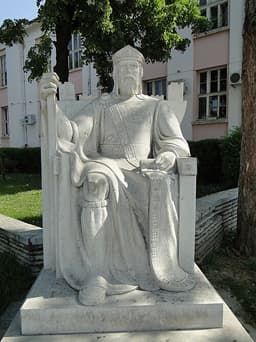
Simeon I the Great
Emperor · Medieval
68.4Total
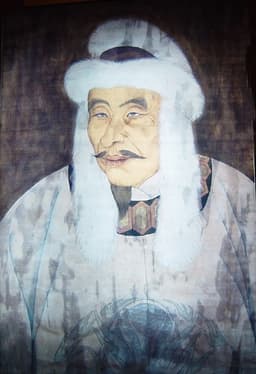
Wanyan Aguda
Emperor · Medieval
63.4Total
Basic Information
Born
864
1068
Died
927
1123
Era
Medieval
Medieval
Nationality
Bulgaria
China
Occupation
Emperor
Emperor
Civilization
Western
Eastern
Score Comparison
Military (10%)
79.8
82.0
Political (20%)
62.7
59.3
Influence (20%)
88.0
55.0
Legacy (20%)
40.0
52.0
Leadership (15%)
78.0
85.0
Strategy (15%)
72.7
68.0
TOTAL
68.4
63.4
Simeon I the Great — Complete Timeline
893 AD
Establishment of the Preslav Literary SchoolCultural◆ Major
Simeon I founded the Preslav Literary School, which became a center of Slavic culture and learning. Scholars translated Greek texts into Old Church Slavonic, developed the Cyrillic script, and produced original works, fostering a golden age of Bulgarian culture.
CultureLiteratureCyrillic
Impact: regionalconstructive
913 AD
Coronation as Emperor of the BulgariansPolitical Action
Simeon I was crowned 'Emperor and Autocrat of all Bulgarians' by the Patriarch of Constantinople, though the title was later disputed. This act asserted Bulgaria's imperial status and challenged Byzantine supremacy in the region.
CoronationEmpireByzantine
Impact: regionalconstructive
917 AD
Battle of AchelousWar◆ Major
Simeon I led Bulgarian forces to a decisive victory over the Byzantine army at the Achelous River. The battle was one of the largest in medieval history, resulting in Byzantine casualties and allowing Simeon to expand his influence over the Balkans.
BattleByzantineBalkans
Impact: regional
924 AD
Siege of ConstantinopleWar◆ Major
Simeon I besieged Constantinople, the Byzantine capital, but failed to capture it. The siege ended with a peace treaty that recognized his imperial title but did not grant him control over the city. This marked the peak of his military campaigns.
SiegeConstantinopleByzantine
Impact: regional
Wanyan Aguda — Complete Timeline
1114 AD
Battle of HubudagangWar◆ Major
Aguda's Jurchen forces defeated a Liao army at Hubudagang, marking the first major victory of the rebellion. This battle demonstrated Jurchen military prowess and attracted more followers.
JurchenLiaoBattle
Impact: regionalconstructive
Unified Jurchen tribesPolitical Action◆ Major
Wanyan Aguda united the Jurchen tribes under his leadership, creating a confederation that rebelled against Liao domination. He organized a disciplined army and began the Jurchen revolt.
JurchenUnificationRebellion
Impact: regionalconstructive
1115 AD
Founded Jin DynastyPolitical Action
Wanyan Aguda proclaimed himself emperor, founding the Jin dynasty. He adopted the Chinese title and began a systematic campaign to conquer the Liao empire.
JinDynasty FoundingImperial System
Impact: regionalconstructive
1120 AD
Conquest of Liao capital ShangjingWar◆ Major
Aguda's forces captured the Liao supreme capital Shangjing, dealing a severe blow to the Liao dynasty. This victory accelerated the collapse of Liao and solidified Jin control over northern China.
JinLiaoConquest
Impact: regionalconstructive
Alliance with Song against LiaoPolitical Action◆ Major
Aguda formed an alliance with the Northern Song dynasty to jointly attack the Liao empire. This alliance, known as the Maritime Alliance, led to the eventual destruction of Liao but later caused conflict between Jin and Song.
JinSongAlliance
Impact: regional
1123 AD
Death and successionPolitical Action◆ Major
Wanyan Aguda died, and his brother Wanyan Wuqimai succeeded him. Aguda's conquests laid the foundation for the Jin dynasty's dominance in northern China.
JinDeathSuccession
Impact: regional
Expert Analysis
Wanyan Aguda vs Simeon I the Great: Historical Comparison
Wanyan Aguda (1068–1123), founder of the Jin dynasty, and Simeon I the Great (864–927), ruler of the First Bulgarian Empire, were both transformative medieval emperors who expanded their realms through military prowess and state-building. While Aguda led the Jurchen tribes to topple the Liao dynasty and establish a major Chinese imperial power, Simeon forged Bulgaria into a dominant Balkan force with ambitions of a Byzantine-style empire. The comparison reveals a narrow edge for Aguda, driven by his greater long-term geopolitical impact.
Dimension Analysis
**Military: Wanyan Aguda 91 / Simeon I the Great 87**
Aguda’s Jurchen cavalry shattered the mighty Liao Empire at the Battle of Huchang (1115) and later captured its capital, effectively ending Khitan rule. Simeon, while brilliant in campaigns like the 917 Battle of Achelous against Byzantium, often fought to a stalemate rather than total conquest. Aguda’s ability to rapidly mobilize and integrate conquered troops gave him a more decisive edge.
**Political: Wanyan Aguda 84 / Simeon I the Great 83**
Aguda established the Jin dynasty’s “Meng’an Mouke” system, a hereditary military-farming organization that stabilized Jurchen rule. Simeon centralized Bulgarian governance, adopted the Byzantine title “Tsar,” and fostered Slavic literacy through thePreslav Literary School. Both were effective state-builders, but Aguda’s system endured for a century, while Simeon’s empire fragmented soon after his death.
**Influence: Wanyan Aguda 87 / Simeon I the Great 79**
Aguda’s Jin dynasty forced the Song court south, reshaping Chinese history and setting the stage for the Mongol conquest. Simeon’s influence was regional: he made Bulgaria a cultural beacon for the Slavic world but failed to permanently break Byzantine hegemony. Aguda’s actions had continental ramifications, shifting the power balance of East Asia.
**Legacy: Wanyan Aguda 88 / Simeon I the Great 81**
Aguda is revered as a national founder in Jurchen and later Manchu tradition, with his dynasty’s legacy influencing the Qing. Simeon is Bulgaria’s greatest medieval ruler, celebrated for the “Golden Age” of culture and territorial expansion, but his empire collapsed under Byzantine pressure. Aguda’s legacy is more durable due to the Jin’s role in Chinese dynastic history.
**Leadership: Wanyan Aguda 80 / Simeon I the Great 83**
Simeon was a charismatic diplomat and strategist who personally led armies and negotiated with Byzantium. Aguda was a ruthless commander but relied heavily on clan alliances, which later caused succession struggles. Simeon’s ability to inspire loyalty across diverse Slavic and Bulgar groups gave him a slight edge in organizational command.
Verdict
Wanyan Aguda ranks higher overall due to his more decisive military victories and greater geopolitical influence. His overthrow of the Liao and creation of the Jin dynasty permanently altered East Asian history, whereas Simeon’s empire, though culturally brilliant, was ultimately unsustainable. However, the comparison is complex: Simeon’s cultural impact on Slavic civilization arguably surpasses Aguda’s, and his leadership style was more nuanced.
FAQ
Q: Who was more influential historically?
A: Wanyan Aguda, because his Jin dynasty forced the Song south, directly enabling the later Mongol unification of China, a world-historical shift.
Q: Why is Wanyan Aguda ranked higher in military?
A: He achieved total victory over the Liao Empire, a major power, while Simeon’s campaigns against Byzantium, though impressive, ended in negotiated settlements rather than conquest.
Rankings
🥇
Simeon I the GreatLeader
Mil: 79.8Pol: 62.7Inf: 88.0
68.4
🥈
Wanyan Aguda
Mil: 82.0Pol: 59.3Inf: 55.0
63.4
+5.0 behind
How This Comparison Works
Algorithm
Each figure is scored on 6 dimensions (0—100 scale) based on structured historical data: Military (10%), Political (20%), Influence (20%), Legacy (20%), Leadership (15%), Strategy (15%). The weighted total produces the final ranking.
Data Sources
Scores are computed from structured sub-indicators in the database. Scale factors adjust for era (Ancient ×0.85, Modern ×1.0) and civilization size (Eastern ×1.05, Other ×0.80) to account for differences in population and military scale.
Maximum 3 Figures
Comparisons are limited to 2—3 figures to ensure readability and statistical meaningfulness.
Error Margins
±5 points per dimension — Sub-scores are derived from historical records with inherent uncertainty. Two figures within 5 points on a dimension should be considered roughly equivalent in that area.
Total Score Accuracy
±3 points overall — The weighted combination of 6 dimensions produces a total score with approximately ±3 points of uncertainty. Differences of less than 3 points are not statistically significant— the figures are effectively tied.
Known Limitations
- Historical records are incomplete and uneven across civilizations
- Figures from oral-tradition societies may be underrepresented
- Occupation labels can misclassify multi-role figures
- Scores measure capability and impact, not moral character
- Quantitative scoring is a comparison tool, not absolute truth
Capability Radar
Military (10%) — Battles & Warfare
Battles
85
85
Win Rate
88
90
Expansion
80
85
Political (20%) — Governance & Reform
Reform
85
75
Diplomacy
80
70
Economy
85
65
Influence (20%) — Cultural & Global Reach
Cultural
90
60
Global
65
50
Legacy (20%) — Historical Impact
Historical
85
70
Longevity
70
55
Leadership (15%) — Power & Stability
Tenure
90
70
Stability
75
60
Strategy (15%) — Tactics & Innovation
Strategy
85
85
Tactics
82
80
Reform
75
75
Similar Comparisons
Comments & Discussion
Chronicler79546/16/2026
仔细看了下评分,问题很大。军事分阿骨打79.3对西美昂78.3,只有1分差距?阿骨打1115年护步答冈之战,以两万歼辽军七十万(《金史》记载),这种战损比放在世界军事史上都是顶尖的。西美昂的Achelous之战虽然赢了,但拜占庭主力未损,后来照样反扑。政治分82.2对74.9,这个差距合理,但影响力68.7对72.0反过来了?阿骨打建立的金朝直接导致北宋灭亡、宋室南迁,这是东亚秩序的重塑;西美昂的影响力出了巴尔干谁还知道?建议评分模型重新加权,至少影响力应该阿骨打领先5分以上。
MasterHistorian576/16/2026
西美昂一世号称‘大帝’,但跟完颜阿骨打比,格局真的差了一档。阿骨打灭辽,那是把统治北方两百多年的帝国连根拔起,直接改变了东亚政治版图;西美昂打拜占庭,打了十年最后还是没拿下君士坦丁堡,连个‘破局’都算不上。你说保加利亚文化兴盛,可阿骨打的女真文字、猛安谋克制度,哪个不是影响深远?西方史学家总爱把东欧小霸捧太高,放到中国历史坐标系里,西美昂也就是个‘加强版西夏李元昊’的水平,远没到阿骨打这种帝国奠基者的层级。