Loading...
This comparison has not been analyzed yet.
One-time AI generation (~1 minute). Scores and timeline are already available below.
Kriangsak Chamanan vs Richmond Turner
Richmond Turner leads by 7.4 pts · 2 figures compared
…
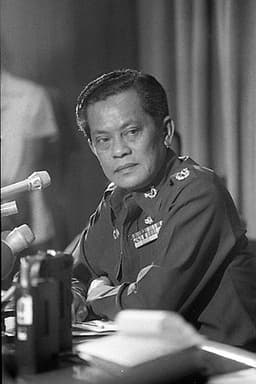
Kriangsak Chamanan
General · Modern
52.3Total

Richmond Turner
General · Modern
59.7Total
Basic Information
Born
1917
1885
Died
2003
1961
Era
Modern
Modern
Nationality
Thailand
United States
Occupation
General
General
Civilization
Eastern
Western
Score Comparison
Military (10%)
25.9
78.0
Political (20%)
72.0
37.9
Influence (20%)
54.9
62.0
Legacy (20%)
46.7
52.0
Leadership (15%)
70.0
64.5
Strategy (15%)
30.3
80.0
TOTAL
52.3
59.7
Kriangsak Chamanan — Complete Timeline
1977 AD
Became Prime Minister of ThailandPolitical Action◆ Major
General Kriangsak Chamanan was appointed Prime Minister after a military coup ousted the civilian government. He led a transitional administration that restored parliamentary democracy and held elections in 1979.
Prime MinisterMilitary RuleDemocracy Transition
Impact: nationalconstructive
1978 AD
Guided the 1978 ConstitutionReform◆ Major
Kriangsak Chamanan oversaw the drafting and promulgation of a new constitution that established a bicameral legislature and paved the way for democratic elections. The constitution remained in effect until 1991.
ConstitutionDemocracyLegal Reform
Impact: nationalconstructive
1979 AD
Held the 1979 General ElectionPolitical Action◆ Major
Under Kriangsak Chamanan's leadership, Thailand held its first general election in three years. The election restored civilian rule, though the military retained significant influence through the appointed Senate.
ElectionDemocracyCivilian Rule
Impact: nationalconstructive
1980 AD
Resigned as Prime MinisterPolitical Action◆ Major
Kriangsak Chamanan resigned as Prime Minister after losing a parliamentary vote of confidence. His resignation allowed for a peaceful transition of power to Prem Tinsulanonda, marking a rare voluntary exit by a military leader.
ResignationPolitical TransitionDemocracy
Impact: national
Richmond Turner — Complete Timeline
1942 AD
Commanded Amphibious Forces at GuadalcanalWar◆ Major
Turner commanded the amphibious task force that landed US Marines on Guadalcanal, the first major US offensive in the Pacific. The operation secured a key airfield and turned the tide in the Solomon Islands campaign.
World War IIGuadalcanalAmphibious Assault
Impact: regional
1943 AD
Led Amphibious Assault on TarawaWar◆ Major
Turner commanded the amphibious forces for the Battle of Tarawa, the first major US assault on a heavily defended Japanese atoll. The high casualties led to improvements in amphibious tactics and equipment.
World War IITarawaAmphibious Assault
Impact: regionaltragic
1945 AD
Commanded Amphibious Forces at Iwo JimaWar◆ Major
Turner commanded the Joint Expeditionary Force for the Battle of Iwo Jima, coordinating the landing of over 70,000 Marines. The operation resulted in one of the bloodiest battles in Marine Corps history.
World War IIIwo JimaAmphibious Assault
Impact: regionaltragic
Commanded Amphibious Forces at OkinawaWar◆ Major
Turner commanded the amphibious forces for the invasion of Okinawa, the largest amphibious assault of the Pacific War. He coordinated the landing of over 180,000 troops and the subsequent logistical support.
World War IIOkinawaAmphibious Assault
Impact: regional
This comparison has not been analyzed yet.
One-time AI generation (~1 minute). Scores and timeline are already available below.
Rankings
🥇
Richmond TurnerLeader
Mil: 78.0Pol: 37.9Inf: 62.0
59.7
🥈
Kriangsak Chamanan
Mil: 25.9Pol: 72.0Inf: 54.9
52.3
+7.4 behind
How This Comparison Works
Algorithm
Each figure is scored on 6 dimensions (0—100 scale) based on structured historical data: Military (10%), Political (20%), Influence (20%), Legacy (20%), Leadership (15%), Strategy (15%). The weighted total produces the final ranking.
Data Sources
Scores are computed from structured sub-indicators in the database. Scale factors adjust for era (Ancient ×0.85, Modern ×1.0) and civilization size (Eastern ×1.05, Other ×0.80) to account for differences in population and military scale.
Maximum 3 Figures
Comparisons are limited to 2—3 figures to ensure readability and statistical meaningfulness.
Error Margins
±5 points per dimension — Sub-scores are derived from historical records with inherent uncertainty. Two figures within 5 points on a dimension should be considered roughly equivalent in that area.
Total Score Accuracy
±3 points overall — The weighted combination of 6 dimensions produces a total score with approximately ±3 points of uncertainty. Differences of less than 3 points are not statistically significant— the figures are effectively tied.
Known Limitations
- Historical records are incomplete and uneven across civilizations
- Figures from oral-tradition societies may be underrepresented
- Occupation labels can misclassify multi-role figures
- Scores measure capability and impact, not moral character
- Quantitative scoring is a comparison tool, not absolute truth
Capability Radar
Military (10%) — Battles & Warfare
Battles
10
85
Win Rate
10
90
Expansion
10
75
Political (20%) — Governance & Reform
Reform
60
20
Diplomacy
55
30
Economy
40
20
Influence (20%) — Cultural & Global Reach
Cultural
30
40
Global
30
60
Legacy (20%) — Historical Impact
Historical
40
70
Longevity
30
50
Leadership (15%) — Power & Stability
Tenure
50
40
Stability
45
30
Strategy (15%) — Tactics & Innovation
Strategy
10
90
Tactics
10
95
Reform
20
85
Similar Comparisons
Comments & Discussion
No comments yet. Be the first to share your thoughts!