Loading...
Kirtivarman II vs Tamar of Georgia
Tamar of Georgia leads by 35.1 pts · 2 figures compared
…

Kirtivarman II
Emperor · Medieval
36.4Total
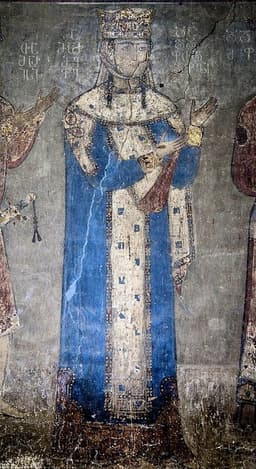
Tamar of Georgia
Emperor · Medieval
71.5Total
Basic Information
Born
746
1160
Died
757
1213
Era
Medieval
Medieval
Nationality
India
Georgia
Occupation
Emperor
Emperor
Civilization
Indian
Western
Score Comparison
Military (10%)
21.2
78.0
Political (20%)
30.7
72.0
Influence (20%)
46.3
82.0
Legacy (20%)
37.5
55.0
Leadership (15%)
33.6
80.0
Strategy (15%)
36.8
66.3
TOTAL
36.4
71.5
Kirtivarman II — Complete Timeline
753 AD
Defeat by DantidurgaWar◆ Major
Kirtivarman II, the last Badami Chalukya king, was defeated by the Rashtrakuta chief Dantidurga. This battle ended the Badami Chalukya dynasty and established Rashtrakuta rule over the Deccan region.
Impact: regionaldestructive
Tamar of Georgia — Complete Timeline
1184 AD
Coronation as Queen RegnantPolitical Action
Tamar was crowned as the first female ruler of Georgia after her father George III's death. Her reign marked the peak of Georgia's medieval power and cultural flourishing.
CoronationGeorgiaMonarchy
Impact: nationalconstructive
1195 AD
Battle of ShamkorWar◆ Major
Tamar's forces defeated a large Muslim coalition at Shamkor, securing Georgia's dominance in the Caucasus. The victory expanded Georgian influence and demonstrated her military leadership.
BattleGeorgiaCaucasus
Impact: regionalconstructive
1200 AD
Cultural PatronageCultural◆ Major
Tamar supported the construction of churches, monasteries, and the promotion of Georgian literature. Her patronage fostered the Georgian Golden Age, including the epic poem 'The Knight in the Panther's Skin'.
CulturePatronageGeorgia
Impact: nationalconstructive
Expert Analysis
Tamar of Georgia vs Kirtivarman II
# The Last King and the Golden Queen: Two Fates in a Single Age
On a dusty battlefield in 753, somewhere in the Deccan plateau of southern India, a Chalukya king watched his world collapse. Kirtivarman II, the last of the Badami Chalukyas, had been outmaneuvered by a Rashtrakuta chieftain named Dantidurga. The war was over before it truly began—a single defeat that erased a dynasty. Four centuries later, on the other side of the world, a queen in the Caucasus mountains faced her own moment of reckoning. In 1195, Tamar of Georgia rode out with her armies against a vast Muslim coalition at Shamkor. She did not lose. She crushed them. And her kingdom entered a golden age that would be remembered for a thousand years.
Why did one ruler end a dynasty while the other built one? The answer lies not in luck, but in the forces that shaped them—and the choices they made.
Origins
Kirtivarman II was born in 746 into a dying empire. The Badami Chalukyas had ruled the Deccan for two centuries, but by his time, the dynasty was fraying at the edges. The Rashtrakutas, once feudatories, had grown restless. Kirtivarman inherited a throne that was already trembling. He was a king born too late, a man whose fate was decided before he drew his first breath.
Tamar, born in 1160, entered a world of promise. Her father, George III, had unified Georgia and crushed internal revolts. She was raised in a court that valued learning, military strength, and Christian faith. As a girl, she was groomed for power—her father had no sons, and he named her heir while still alive. She learned to read the strategies of Byzantine generals and the poetry of Persian mystics. The stage was set for greatness.
The difference in their origins is not merely one of fortune. Kirtivarman was born into a system that had already peaked; Tamar was born into one that was ascending. The arc of history bent with them, not against them.
Rise to Power
Kirtivarman became king around 746, but his rise was a formality. He was the last son of a declining line, and the real power in the Deccan had already shifted to the Rashtrakuta court. He did not seize the throne—he inherited it, along with its debts and enemies. His coronation was a quiet affair, overshadowed by the ambitions of Dantidurga to the north.
Tamar’s ascent was anything but quiet. In 1184, her father died, and she was crowned Queen Regnant of Georgia—the first woman to rule the kingdom in her own right. The nobility resisted. They saw a woman as weak, a target for their rivals. But Tamar outmaneuvered them. She married a prince from the Rus’ lands to secure an alliance, then divorced him when he proved incompetent. She surrounded herself with loyal generals and administrators. She did not wait for power to be given; she took it.
Kirtivarman’s path was one of decline; Tamar’s was one of deliberate ascent. One drifted into fate; the other seized it.
Leadership & Governance
As a leader, Kirtivarman seems to have been competent but not extraordinary. His military score of 46 and political score of 36.5 suggest a ruler who could manage a kingdom in peacetime but could not save it in war. When Dantidurga marched, the Chalukya army collapsed. There was no brilliant counterattack, no last stand that became legend. Just a defeat, and then silence.
Tamar governed differently. Her leadership score of 82.5 reflects a queen who commanded loyalty, not just obedience. She reformed the Georgian army, turning it into a professional force. She patronized the Georgian Orthodox Church, building monasteries and commissioning the great chronicles of the age. In 1200, she sponsored a cultural flowering that produced the epic poem *The Knight in the Panther’s Skin*, a masterpiece of medieval literature. She ruled not through fear, but through vision.
The difference is not merely in talent. Kirtivarman governed a kingdom in decay; Tamar governed one in ascent. But she also made choices that accelerated that ascent—investing in culture, building alliances, and nurturing a court that valued both sword and song.
Triumph & Tragedy
Kirtivarman’s greatest moment was his defeat. That is the tragedy of his story. He is remembered only for losing. The battle of 753 ended not just his reign, but his dynasty. The Rashtrakutas absorbed the Chalukya lands, and Kirtivarman vanished into the silence of history. His total score of 42.9 reflects a life that was, in the end, a footnote.
Tamar’s greatest moment was the Battle of Shamkor in 1195. A coalition of Muslim rulers had gathered to crush Georgia. Tamar’s forces met them on the plain, and the queen herself reportedly rode with her troops, a banner of the Virgin Mary held high. The victory was total. Georgia became the dominant power in the Caucasus, and Tamar’s name was spoken from Constantinople to Baghdad. But her tragedy came later: her son, George IV, would squander much of what she built, and after her death in 1213, the Mongol invasions would tear it all apart. Yet even in destruction, her legacy endured.
Character & Destiny
Kirtivarman was a man shaped by inevitability. He was not a bad king—the records suggest he was neither cruel nor incompetent. But he lacked the force of will to reverse his kingdom’s decline. He is a reminder that sometimes, history does not need villains; it only needs men who cannot rise to the moment.
Tamar was the opposite. She was shaped by defiance. She was a woman in a world of men, a queen who refused to be a regent for a future king. She built alliances, crushed rebellions, and patronized art because she understood that power is not just about battles—it is about the stories you leave behind. Her influence score of 68.7 and legacy of 72.2 reflect a ruler who knew that a kingdom dies when it is forgotten.
Legacy
Kirtivarman II is a name known only to specialists. He is a cautionary tale, a reminder that dynasties fall when they cannot adapt. His legacy score of 48.2 places him among the forgotten.
Tamar of Georgia is a national icon. She is Saint Tamar in the Georgian Orthodox Church, celebrated in poems and songs. Her reign is called the Golden Age, and her name is invoked whenever Georgia faces a crisis. Her legacy score of 72.2 reflects a queen who became a symbol.
Conclusion
What separates a last king from a golden queen? It is not merely talent or luck. It is the ability to see the moment and seize it. Kirtivarman inherited a world that was ending; Tamar built one that would last. One was a victim of history; the other, its maker. And in that difference lies a truth that spans all ages: the rulers who shape their times are those who refuse to be shaped by them.
Rankings
🥇
Tamar of GeorgiaLeader
Mil: 78.0Pol: 72.0Inf: 82.0
71.5
🥈
Kirtivarman II
Mil: 21.2Pol: 30.7Inf: 46.3
36.4
+35.1 behind
How This Comparison Works
Algorithm
Each figure is scored on 6 dimensions (0—100 scale) based on structured historical data: Military (10%), Political (20%), Influence (20%), Legacy (20%), Leadership (15%), Strategy (15%). The weighted total produces the final ranking.
Data Sources
Scores are computed from structured sub-indicators in the database. Scale factors adjust for era (Ancient ×0.85, Modern ×1.0) and civilization size (Eastern ×1.05, Other ×0.80) to account for differences in population and military scale.
Maximum 3 Figures
Comparisons are limited to 2—3 figures to ensure readability and statistical meaningfulness.
Error Margins
±5 points per dimension — Sub-scores are derived from historical records with inherent uncertainty. Two figures within 5 points on a dimension should be considered roughly equivalent in that area.
Total Score Accuracy
±3 points overall — The weighted combination of 6 dimensions produces a total score with approximately ±3 points of uncertainty. Differences of less than 3 points are not statistically significant— the figures are effectively tied.
Known Limitations
- Historical records are incomplete and uneven across civilizations
- Figures from oral-tradition societies may be underrepresented
- Occupation labels can misclassify multi-role figures
- Scores measure capability and impact, not moral character
- Quantitative scoring is a comparison tool, not absolute truth
Capability Radar
Military (10%) — Battles & Warfare
Battles
15
75
Win Rate
10
85
Expansion
5
75
Political (20%) — Governance & Reform
Reform
10
80
Diplomacy
10
75
Economy
15
85
Influence (20%) — Cultural & Global Reach
Cultural
10
80
Global
5
60
Legacy (20%) — Historical Impact
Historical
15
75
Longevity
10
70
Leadership (15%) — Power & Stability
Tenure
20
85
Stability
10
70
Strategy (15%) — Tactics & Innovation
Strategy
10
80
Tactics
15
70
Reform
5
65
Similar Comparisons
Comments & Discussion
RASHTRAKUTA_FANBOI6/16/2026
This comparison is ridiculous. Kirtivarman II faced a rising power in Dantidurga's Rashtrakutas, who would dominate the Deccan for two centuries. Tamar fought fractured Muslim emirs at Shamkor. Put her against the Ghurids or Khwarezm and she'd crumble like the Chalukyas. Kirtivarman wasn't weak—his enemy was simply hungrier. Survival isn't always a measure of merit.|
铁血女王控6/16/2026
拿一个末代君王跟鼎盛女王比,本身就不公平。塔玛尔继承的是父亲打下的基业,基尔提瓦尔曼接手的却是叔伯们败光的家底。让她在753年的德干试试?面对罗湿拘罗陀的骑兵洪流,什么黄金时代都是扯淡。历史的讽刺在于:生在低谷的国王被遗忘,生在高峰的女王却被神化。那些吹嘘胜利的人,从来不愿意承认运气比能力更重要。|
STATS_GUY6/16/2026
Let's talk numbers. Tamar's Georgia at its peak had maybe 2-3 million people. Kirtivarman's Chalukya kingdom controlled 10-15 million. One lost a single battle and collapsed. The other won a battle and is called a "golden queen." Historical reputation is so tied to narrative, not scale. Tamar was a competent ruler in a small state. Kirtivarman was a doomed man in a big one. Context matters more than memory.|
商鞅的传人6/16/2026
说穿了就两个字:制度。塔玛尔继承了乔治三世强化的中央集权,王室直接控制军队和税收。而基尔提瓦尔曼面对的是分封制反噬——马哈拉施特拉那些封建主早就不听号令了。一次战败就亡国,说明王朝从根上就烂掉了。真正伟大的统治者是建系统的人,基尔提瓦尔曼既没能力改革,又没勇气反抗,被扫进历史的垃圾桶一点也不冤枉。塔玛尔能做到的,换成他在同样的位置同样能做到。关键从来不在个人。|
CLASSICS_SNARK6/16/2026
Oh please, spare me the hagiography. Tamar's "golden age" lasted about thirty years before the Mongols tore through the Caucasus like paper. Kirtivarman at least ended a dynasty with dignity—he was allowed to live as a vassal. Tamar's successors threw everything away in pointless succession squabbles. Build something that lasts, then we'll talk about greatness. Otherwise you're just glorifying a pretty sunset.|
江湖百晓生6/16/2026
有趣的是,这两个人面对敌人时做出了截然相反的选择。基尔提瓦尔曼选择在开阔平原与达尼杜尔伽会战,结果被骑兵围歼