Loading...
King Wu of Zhou vs Marquis Wu of Wei
King Wu of Zhou leads by 13.9 pts · 2 figures compared
…
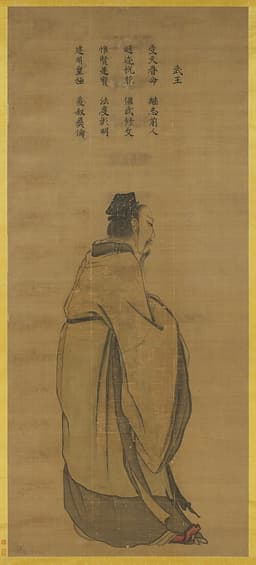
King Wu of Zhou
Emperor · Ancient
67.0Total

Marquis Wu of Wei
Emperor · Ancient
53.1Total
Basic Information
Born
-1076
-424
Died
-1043
-370
Era
Ancient
Ancient
Nationality
China
China
Occupation
Emperor
Emperor
Civilization
Eastern
Eastern
Score Comparison
Military (10%)
82.0
63.3
Political (20%)
55.0
68.0
Influence (20%)
65.0
47.9
Legacy (20%)
80.0
39.2
Leadership (15%)
51.9
65.0
Strategy (15%)
65.4
50.0
TOTAL
67.0
53.1
King Wu of Zhou — Complete Timeline
1046 BC
Battle of MuyeWar
King Wu of Zhou led a coalition of tribes and states to defeat the Shang army at Muye, near the Shang capital. The Shang king Zhou committed suicide, ending the Shang dynasty and establishing the Zhou dynasty as the ruling power in China.
Zhou DynastyBattleDynastic Change
Impact: regional
Founding of the Zhou DynastyPolitical Action◆ Major
King Wu established the Zhou dynasty, with its capital at Haojing (near modern Xi'an). He implemented the feudal system, granting land to relatives and allies, which became the basis for Zhou governance for centuries.
Zhou DynastyFoundingFeudal System
Impact: regionalconstructive
Distribution of FiefsPolitical Action◆ Major
King Wu divided the conquered Shang territories into fiefs granted to his brothers, allies, and descendants of earlier sage-kings. This system of enfeoffment created a network of semi-autonomous states loyal to the Zhou king.
Zhou DynastyFeudal SystemGovernance
Impact: regionalconstructive
Marquis Wu of Wei — Complete Timeline
395 BC
Appointed Wu Qi as commanderPolitical Action
Marquis Wu retained Wu Qi as his top general, who continued to lead successful campaigns. However, Wu Qi's strict reforms and favor with the marquis created enemies among the nobility, leading to political instability.
Military CommandWu QiNobility Conflict
Impact: national
389 BC
Expanded Wei territory at the expense of QinWar◆ Major
Marquis Wu of Wei continued his father's expansionist policies, launching campaigns against Qin. Wei forces captured the Qin stronghold of Hexi and pushed deep into Qin territory, forcing Qin to retreat west of the Luo River and weakening Qin's position.
Territorial ExpansionWei-Qin WarMilitary
Impact: regional
370 BC
Lost the Hexi region to QinWar◆ Major
Near the end of his reign, Wei's military dominance waned. Qin forces under Duke Xian recaptured the Hexi region, reversing earlier Wei gains. This loss marked the beginning of Wei's decline as a major power.
Territorial LossWei DeclineQin Resurgence
Impact: regionaldestructive
Died without a clear successorPolitical Action
Marquis Wu died without naming a clear heir, leading to a succession crisis. His sons fought for the throne, and the state of Zhao and Han intervened, further destabilizing Wei and contributing to its loss of hegemony.
Succession CrisisWei DeclineInterstate Intervention
Impact: nationaldestructive
Expert Analysis
Origins
King Wu of Zhou (born c. 11th century BCE) was the son of King Wen of Zhou, a charismatic leader who laid the groundwork for overthrowing the Shang dynasty. King Wen had gathered support from various tribes and states, but died before completing the conquest. King Wu inherited this coalition and his father's vision. He was educated in statecraft and military tactics, and his upbringing in the Zhou heartland (modern Shaanxi) exposed him to the grievances against Shang rule.
Marquis Wu of Wei (born c. 5th century BCE) was the son of Marquis Wen of Wei, who transformed Wei into a powerful state during the Warring States period. His early life was marked by the rapid reforms of his father, who appointed legalist ministers like Li Kui and military commanders like Wu Qi. Marquis Wu inherited a state that was already a major power, but faced the challenge of maintaining its dominance against rivals like Qin and Zhao.
Rise to Power
King Wu rose to power upon his father's death around 1050 BCE. He immediately prepared for war against the Shang, who under King Zhou had become tyrannical. In 1046 BCE, King Wu led a coalition of eight tribes and states, including the Shu and Qiang, to the Battle of Muye. The Shang army, though larger, was demoralized and many troops defected. King Zhou committed suicide, and King Wu entered the Shang capital. He then distributed fiefs to his allies and relatives, establishing the Zhou dynasty's feudal system.
Marquis Wu succeeded his father around 396 BCE. He continued the expansionist policies, focusing on the state of Qin to the west. In 389 BCE, he appointed the famous general Wu Qi, who had previously served in Lu and Wei. Under Wu Qi's command, Wei forces captured the Hexi region from Qin, pushing deep into Qin territory. Marquis Wu also maintained the legalist reforms that centralized power and improved military efficiency. However, his reign saw the beginning of Wei's decline as Qin recovered under Duke Xian.
Leadership & Governance
King Wu's leadership was characterized by strategic delegation and the establishment of a feudal system. He granted large fiefs to his brothers (such as the Duke of Zhou) and allies, creating a network of loyal states that would support the Zhou king. This system, known as fenjian, allowed for local autonomy while maintaining central authority. King Wu also emphasized the concept of the Mandate of Heaven, justifying his rule as a moral replacement for the corrupt Shang. He scored 51.9 in leadership, reflecting his reliance on inherited legitimacy rather than personal charisma.
Marquis Wu of Wei, with a leadership score of 65.0, was more hands-on. He personally led campaigns and appointed capable ministers like Wu Qi. However, his governance was marred by a failure to secure succession. He died without naming an heir, leading to a civil war that weakened Wei. His political score of 68.0 indicates his ability to navigate court politics, but his strategic score of 50.0 shows limitations in long-term planning. Unlike King Wu, he did not create enduring institutions; his gains were reversed within a generation.
Triumph & Tragedy
King Wu's greatest triumph was the conquest of the Shang dynasty and the founding of the Zhou dynasty, which lasted over 800 years. His military score of 82.0 reflects his successful campaign at Muye, where he defeated a numerically superior enemy. However, his tragedy was his early death just a few years after the conquest, leaving his young son King Cheng to rule. This necessitated a regency by the Duke of Zhou, who faced rebellions from King Wu's own brothers.
Marquis Wu's triumph was the expansion of Wei at the expense of Qin, capturing the strategic Hexi region. His military score of 63.3 indicates solid but not exceptional generalship. His tragedy was the loss of Hexi to Qin later in his reign, as Qin's Duke Xian recaptured the territory. This loss, combined with his failure to name a successor, led to Wei's decline. His legacy score of 39.2 reflects the impermanence of his achievements.
Character & Destiny
King Wu was decisive and pragmatic, as shown by his swift action at Muye. He was also generous, distributing fiefs to allies. However, his early death cut short his potential. The Duke of Zhou's regency, while stabilizing the dynasty, also highlighted King Wu's failure to prepare for succession. His total score of 67.0 reflects a balanced but not extraordinary ruler.
Marquis Wu was ambitious and capable, but his character was marred by indecision regarding succession. He trusted Wu Qi but failed to protect him from court intrigues—Wu Qi eventually fled to Chu. His inability to secure a stable transition led to chaos. His total score of 53.1 indicates a competent but flawed leader whose gains were reversed.
Legacy
King Wu's legacy is immense: he founded the Zhou dynasty, which shaped Chinese civilization through its feudal system and the concept of the Mandate of Heaven. The Zhou dynasty's longevity (c. 1046–256 BCE) made it a model for later dynasties. King Wu's influence score of 65.0 underestimates his impact, as his actions set the stage for classical Chinese thought.
Marquis Wu's legacy is more limited. He expanded Wei, but his gains were temporary. The Wei state eventually collapsed in 225 BCE, and its legalist reforms were adopted by Qin, which unified China. Marquis Wu's legacy score of 39.2 reflects his minor role in the grand narrative. He is remembered primarily as a footnote in the Warring States period.
Conclusion
King Wu of Zhou had a significantly greater impact than Marquis Wu of Wei. With a total score of 67.0 vs. 53.1, the 13.9-point gap reflects the enduring nature of King Wu's achievements versus the transient gains of Marquis Wu. King Wu founded a dynasty that lasted eight centuries and established political concepts that influenced all of Chinese history. Marquis Wu, while a capable expansionist, failed to secure lasting power. The data supports the conclusion that King Wu's role as a dynasty founder outweighs Marquis Wu's role as a regional power broker.
Rankings
🥇
King Wu of ZhouLeader
Mil: 82.0Pol: 55.0Inf: 65.0
67.0
🥈
Marquis Wu of Wei
Mil: 63.3Pol: 68.0Inf: 47.9
53.1
+13.9 behind
How This Comparison Works
Algorithm
Each figure is scored on 6 dimensions (0—100 scale) based on structured historical data: Military (10%), Political (20%), Influence (20%), Legacy (20%), Leadership (15%), Strategy (15%). The weighted total produces the final ranking.
Data Sources
Scores are computed from structured sub-indicators in the database. Scale factors adjust for era (Ancient ×0.85, Modern ×1.0) and civilization size (Eastern ×1.05, Other ×0.80) to account for differences in population and military scale.
Maximum 3 Figures
Comparisons are limited to 2—3 figures to ensure readability and statistical meaningfulness.
Error Margins
±5 points per dimension — Sub-scores are derived from historical records with inherent uncertainty. Two figures within 5 points on a dimension should be considered roughly equivalent in that area.
Total Score Accuracy
±3 points overall — The weighted combination of 6 dimensions produces a total score with approximately ±3 points of uncertainty. Differences of less than 3 points are not statistically significant— the figures are effectively tied.
Known Limitations
- Historical records are incomplete and uneven across civilizations
- Figures from oral-tradition societies may be underrepresented
- Occupation labels can misclassify multi-role figures
- Scores measure capability and impact, not moral character
- Quantitative scoring is a comparison tool, not absolute truth
Capability Radar
Military (10%) — Battles & Warfare
Battles
60
60
Win Rate
85
65
Expansion
70
65
Political (20%) — Governance & Reform
Reform
80
50
Diplomacy
75
55
Economy
60
50
Influence (20%) — Cultural & Global Reach
Cultural
85
30
Global
70
15
Legacy (20%) — Historical Impact
Historical
90
35
Longevity
95
20
Leadership (15%) — Power & Stability
Tenure
15
55
Stability
50
45
Strategy (15%) — Tactics & Innovation
Strategy
75
60
Tactics
70
55
Reform
65
50
Similar Comparisons
Comments & Discussion
No comments yet. Be the first to share your thoughts!