Loading...
King Wu of Zhou vs Senusret II
King Wu of Zhou leads by 19.8 pts · 2 figures compared
…
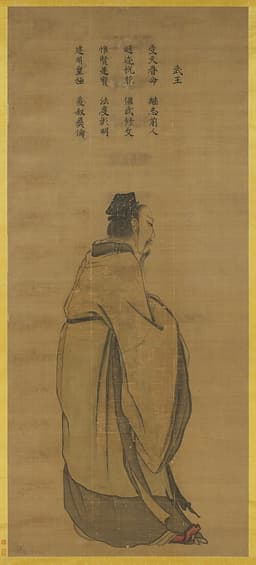
King Wu of Zhou
Emperor · Ancient
67.0Total

Senusret II
Emperor · Ancient
47.2Total
Basic Information
Born
-1076
-1860
Died
-1043
-1840
Era
Ancient
Ancient
Nationality
China
Middle Kingdom Egypt
Occupation
Emperor
Emperor
Civilization
Eastern
Middle Eastern
Score Comparison
Military (10%)
82.0
25.9
Political (20%)
55.0
45.0
Influence (20%)
65.0
50.2
Legacy (20%)
80.0
45.8
Leadership (15%)
51.9
68.0
Strategy (15%)
65.4
36.8
TOTAL
67.0
47.2
King Wu of Zhou — Complete Timeline
1046 BC
Battle of MuyeWar
King Wu of Zhou led a coalition of tribes and states to defeat the Shang army at Muye, near the Shang capital. The Shang king Zhou committed suicide, ending the Shang dynasty and establishing the Zhou dynasty as the ruling power in China.
Zhou DynastyBattleDynastic Change
Impact: regional
Founding of the Zhou DynastyPolitical Action◆ Major
King Wu established the Zhou dynasty, with its capital at Haojing (near modern Xi'an). He implemented the feudal system, granting land to relatives and allies, which became the basis for Zhou governance for centuries.
Zhou DynastyFoundingFeudal System
Impact: regionalconstructive
Distribution of FiefsPolitical Action◆ Major
King Wu divided the conquered Shang territories into fiefs granted to his brothers, allies, and descendants of earlier sage-kings. This system of enfeoffment created a network of semi-autonomous states loyal to the Zhou king.
Zhou DynastyFeudal SystemGovernance
Impact: regionalconstructive
Senusret II — Complete Timeline
1855 BC
Construction of the Pyramid at LahunCultural◆ Major
Senusret II built his pyramid at Lahun, near the entrance to the Faiyum. The pyramid was constructed of mudbrick with a limestone casing and featured a complex internal layout. The associated town of Kahun housed workers and officials, providing valuable archaeological insights into Middle Kingdom life.
PyramidArchitectureLahun
Impact: nationalconstructive
Development of the Town of KahunCultural
Senusret II founded the planned settlement of Kahun (Hetep-Senusret) to house workers building his pyramid. The town was laid out on a grid system with separate quarters for officials, artisans, and laborers, and its well-preserved remains have provided extensive information about daily life, administration, and social structure in the Middle Kingdom.
SettlementUrban PlanningArchaeology
constructive
1850 BC
Faiyum Irrigation ProjectsReform◆ Major
Senusret II initiated large-scale irrigation works in the Faiyum region, including the construction of canals and dikes to regulate the flow of water from the Nile into the Faiyum Depression. This transformed the area into fertile agricultural land, boosting food production and economic prosperity.
IrrigationAgricultureFaiyum
Impact: regionalconstructive
Expert Analysis
Origins
King Wu of Zhou, born Ji Fa in 1076 BCE, was the son of King Wen of Zhou, a powerful chieftain in the Wei River valley. His father laid the groundwork for challenging the Shang dynasty, but died before the final campaign. King Wu inherited a well-organized state with strong alliances. He was educated in military strategy and governance, surrounded by capable advisors like Jiang Ziya.
Senusret II, born around 1897 BCE, was the fourth pharaoh of the 12th Dynasty of Egypt. He was the son of Amenemhat II and inherited a stable kingdom. His education focused on administration and religious duties, preparing him for a reign centered on internal development rather than military expansion.
Rise to Power
King Wu rose to prominence by capitalizing on the Shang dynasty's decline under King Zhou, who was known for oppressive rule. In 1046 BCE, King Wu assembled a coalition of tribes and states, including the Shu and Qiang, and marched on the Shang capital. The Battle of Muye was decisive: the Shang army, demoralized by King Zhou's tyranny, defected, and King Zhou committed suicide. This victory established King Wu as the founder of the Zhou dynasty.
Senusret II ascended the throne peacefully around 1897 BCE after his father's death. He did not engage in major military campaigns; his reign was characterized by internal consolidation. His rise was typical of Egyptian succession, with no dramatic turning points.
Leadership & Governance
King Wu's leadership was transformative. He implemented a feudal system, granting fiefs to relatives and allies, which created a decentralized but loyal network of states. He also established the concept of the Mandate of Heaven, justifying his rule as divine approval. His governance focused on consolidating power and preventing rebellions. However, his political score of 55.0 reflects that the system later led to fragmentation.
Senusret II's governance was pragmatic and developmental. He initiated large-scale irrigation projects in the Faiyum region, building canals and dikes to regulate water from the Nile. This increased agricultural productivity and stabilized food supply. He also founded the planned town of Kahun to house workers, showing urban planning skills. His leadership score of 68.0 indicates effective administration, though his lack of military ambition limited his overall impact.
Triumph & Tragedy
King Wu's greatest triumph was overthrowing the Shang dynasty and founding the Zhou dynasty, which lasted over 800 years. His military score of 82.0 reflects the decisive Battle of Muye. However, his tragedy was his early death shortly after the conquest, leaving his young son to rule under regents, which led to instability and the eventual decline of central authority.
Senusret II's triumph was the successful Faiyum irrigation projects, which boosted Egypt's economy. His pyramid at Lahun, though modest, was innovative in its mudbrick construction. His tragedy is the lack of lasting political or military legacy; his influence score of 50.2 shows limited impact beyond his reign.
Character & Destiny
King Wu was decisive and charismatic, able to unite diverse groups against a common enemy. His character was shaped by a sense of destiny to overthrow tyranny. However, his early death suggests perhaps overexertion or lack of foresight in succession planning.
Senusret II was methodical and focused on internal improvements. He avoided conflict, which kept Egypt stable but also meant he did not expand its borders. His destiny was to be remembered as a builder, not a conqueror.
Legacy
King Wu's legacy is immense: the Zhou dynasty's feudal system influenced Chinese governance for centuries, and the Mandate of Heaven became a core political philosophy. His total score of 67.0 reflects high military and legacy scores (80.0). The Zhou dynasty's longevity is a testament to his foundation.
Senusret II's legacy is more contained: the Faiyum irrigation projects continued to be used, and his pyramid and town are archaeological treasures. But his overall impact was regional and temporary, with a total score of 47.2.
Conclusion
King Wu of Zhou had a greater impact due to his foundational role in Chinese civilization. His military conquest (82.0) and establishment of a dynasty that shaped East Asian history far outweigh Senusret II's administrative improvements. While Senusret II was effective, his influence was limited to Egypt's Middle Kingdom. The score gap of 19.8 points reflects this disparity. King Wu's actions changed the course of history for a major civilization, whereas Senusret II's contributions, though valuable, did not fundamentally alter Egypt's trajectory.
Rankings
🥇
King Wu of ZhouLeader
Mil: 82.0Pol: 55.0Inf: 65.0
67.0
🥈
Senusret II
Mil: 25.9Pol: 45.0Inf: 50.2
47.2
+19.8 behind
How This Comparison Works
Algorithm
Each figure is scored on 6 dimensions (0—100 scale) based on structured historical data: Military (10%), Political (20%), Influence (20%), Legacy (20%), Leadership (15%), Strategy (15%). The weighted total produces the final ranking.
Data Sources
Scores are computed from structured sub-indicators in the database. Scale factors adjust for era (Ancient ×0.85, Modern ×1.0) and civilization size (Eastern ×1.05, Other ×0.80) to account for differences in population and military scale.
Maximum 3 Figures
Comparisons are limited to 2—3 figures to ensure readability and statistical meaningfulness.
Error Margins
±5 points per dimension — Sub-scores are derived from historical records with inherent uncertainty. Two figures within 5 points on a dimension should be considered roughly equivalent in that area.
Total Score Accuracy
±3 points overall — The weighted combination of 6 dimensions produces a total score with approximately ±3 points of uncertainty. Differences of less than 3 points are not statistically significant— the figures are effectively tied.
Known Limitations
- Historical records are incomplete and uneven across civilizations
- Figures from oral-tradition societies may be underrepresented
- Occupation labels can misclassify multi-role figures
- Scores measure capability and impact, not moral character
- Quantitative scoring is a comparison tool, not absolute truth
Capability Radar
Military (10%) — Battles & Warfare
Battles
60
10
Win Rate
85
10
Expansion
70
10
Political (20%) — Governance & Reform
Reform
80
70
Diplomacy
75
50
Economy
60
75
Influence (20%) — Cultural & Global Reach
Cultural
85
40
Global
70
20
Legacy (20%) — Historical Impact
Historical
90
50
Longevity
95
45
Leadership (15%) — Power & Stability
Tenure
15
60
Stability
50
65
Strategy (15%) — Tactics & Innovation
Strategy
75
10
Tactics
70
10
Reform
65
10
Similar Comparisons
Comments & Discussion
No comments yet. Be the first to share your thoughts!