Loading...
King Wu of Zhou vs Napoleon Bonaparte
Napoleon Bonaparte leads by 3.9 pts · 2 figures compared
…
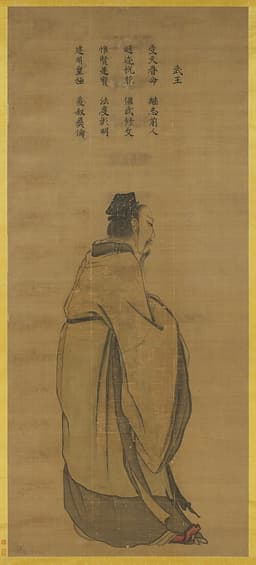
King Wu of Zhou
Emperor · Ancient
67.0Total

Napoleon Bonaparte
General · Modern
70.9Total
Basic Information
Born
-1076
1769
Died
-1043
1821
Era
Ancient
Modern
Nationality
China
France
Occupation
Emperor
General
Civilization
Eastern
Western
Score Comparison
Military (10%)
82.0
94.0
Political (20%)
55.0
72.0
Influence (20%)
65.0
40.0
Legacy (20%)
80.0
80.0
Leadership (15%)
51.9
78.0
Strategy (15%)
65.4
90.0
TOTAL
67.0
70.9
King Wu of Zhou — Complete Timeline
1046 BC
Battle of MuyeWar
King Wu of Zhou led a coalition of tribes and states to defeat the Shang army at Muye, near the Shang capital. The Shang king Zhou committed suicide, ending the Shang dynasty and establishing the Zhou dynasty as the ruling power in China.
Zhou DynastyBattleDynastic Change
Impact: regional
Founding of the Zhou DynastyPolitical Action◆ Major
King Wu established the Zhou dynasty, with its capital at Haojing (near modern Xi'an). He implemented the feudal system, granting land to relatives and allies, which became the basis for Zhou governance for centuries.
Zhou DynastyFoundingFeudal System
Impact: regionalconstructive
Distribution of FiefsPolitical Action◆ Major
King Wu divided the conquered Shang territories into fiefs granted to his brothers, allies, and descendants of earlier sage-kings. This system of enfeoffment created a network of semi-autonomous states loyal to the Zhou king.
Zhou DynastyFeudal SystemGovernance
Impact: regionalconstructive
Napoleon Bonaparte — Complete Timeline
1799 AD
Coup of 18 BrumaireOther◆ Major
Napoleon Bonaparte, with support from his brother Lucien and key political figures, overthrew the Directory in a bloodless coup. He established the Consulate with himself as First Consul, effectively becoming the ruler of France. This event ended the French Revolution's most unstable period.
French RevolutionCoupRise to Power
Impact: regional
1804 AD
Promulgation of the Napoleonic CodeOther◆ Major
Napoleon enacted the Civil Code of the French, known as the Napoleonic Code, a comprehensive set of laws that replaced the fragmented feudal legal systems. The code established legal equality, protected property rights, and secularized law. It became the basis for legal systems in many European and world countries.
Legal ReformNapoleonic CodeCivil Law
Impact: globalconstructive
1805 AD
Battle of AusterlitzWar◆ Major
Napoleon's Grande Arm
Napoleonic WarsBattleDecisive Victory
Impact: global
1812 AD
Invasion of RussiaWar◆ Major
Napoleon led the Grande Arm
Napoleonic WarsInvasionDisaster
Impact: globaldestructive
1815 AD
Battle of WaterlooWar◆ Major
Napoleon's French army was defeated by the combined forces of the Duke of Wellington's Anglo-Allied army and Gebhard Leberecht von Bl
Napoleonic WarsBattleFinal Defeat
Impact: globaldestructive
Expert Analysis
king-wu-of-zhou-vs-napoleon-bonaparte
# The Conqueror’s Mirror: Napoleon and King Wu of Zhou
On a misty morning in June 1815, Napoleon Bonaparte stood on a muddy field near Waterloo, watching his Imperial Guard march into the mouths of British cannons. Nearly three thousand years earlier and half a world away, King Wu of Zhou led his coalition army across a dusty plain at Muye, where the fate of China’s oldest dynasty hung in the balance. Both men sought to reshape their worlds through conquest. One built an empire that collapsed within a generation, the other founded a dynasty that lasted eight centuries. Their divergent fates reveal not just the chasm between East and West, but the profound difference between a man who conquered for himself and one who conquered for an idea.
Origins
Napoleon was born in 1769 on the island of Corsica, a Mediterranean backwater that France had purchased from Genoa only a year earlier. His family were minor nobility, struggling and resentful of French rule. He spoke Italian before French, and his early letters seethed with Corsican nationalism. The French Revolution, which erupted when he was twenty, shattered the old order and opened paths unimaginable under the Bourbon monarchy. A young artillery officer with no connections could rise by talent alone—and Napoleon had talent in abundance.
King Wu of Zhou, by contrast, was born into a world of rigid hierarchy. The Shang dynasty had ruled China for five centuries, and King Wu’s father, King Wen, was a vassal lord in the Wei River valley. The Shang king, Di Xin, was a legendary tyrant—given to drunkenness, cruelty, and listening to his concubine Daji instead of his ministers. But the Zhou lords did not rebel. They waited. They built alliances. They cultivated virtue. When King Wen died, his son Ji Fa—the future King Wu—inherited a coalition, not a grievance.
The difference in their worlds was stark. Napoleon’s France was a nation in convulsion, where a man could rewrite the rules of power overnight. King Wu’s China was a civilization of precedent, where legitimacy came from heaven and history, not from ambition.
Rise to Power
Napoleon’s ascent was a series of explosions. At twenty-four, he drove the British from Toulon. At twenty-six, he crushed a royalist uprising in Paris with a “whiff of grapeshot.” At twenty-seven, he conquered Italy. Each victory was a gamble, each campaign a masterpiece of speed and deception. He crossed the Alps, won at Austerlitz, and crowned himself emperor in 1804—not by inheritance, but by acclamation and force. His path was the path of the self-made man, and he made himself at the point of a bayonet.
King Wu’s rise was slower and more deliberate. The Zhou had spent generations building reputation. His father, King Wen, had been imprisoned by the Shang tyrant but used his time to compose the I Ching. When King Wen died, his son did not immediately strike. He waited until the omens were right, until the allies were ready, until the Shang army was exhausted from campaigns in the east. In 1046 BCE, he marched—not with revolutionary fervor, but with the weight of heaven’s mandate.
At the Battle of Muye, King Wu’s coalition of eight tribes faced a Shang army that supposedly numbered in the hundreds of thousands. But many of those soldiers were slaves and conscripts who had no loyalty to Di Xin. When the battle began, they turned their spears around. The Shang king fled to his palace, donned his jade ornaments, and burned himself alive. King Wu entered the capital not as a conqueror, but as a restorer.
Leadership & Governance
Napoleon ruled through genius and terror. He reformed French law with the Napoleonic Code, a rational system that ended feudalism and established equality before the law. He built roads, standardized weights and measures, and created a centralized state that France still lives with. But he also ruled as a dictator. He suppressed newspapers, imprisoned critics, and crowned his brothers as puppet kings across Europe. His military strategy was dazzling—he could read a battlefield like a chessboard—but his political strategy was brittle. He trusted no one, delegated nothing, and assumed that victory would always solve his problems.
King Wu ruled through ritual and delegation. After Muye, he did not abolish the Shang nobility; he enfeoffed them, granting lands to his brothers, allies, and even the descendants of the defeated dynasty. He established the feudal system that would define Chinese governance for centuries: the king at the center, lords in their domains, each bound by oath and ceremony. He did not rule alone. He consulted oracles, performed sacrifices, and governed through the Mandate of Heaven—the idea that a ruler’s legitimacy depends on his virtue, not his strength.
Napoleon’s Europe was a machine of war. King Wu’s China was a tapestry of obligations.
Triumph & Tragedy
Napoleon’s greatest moment was Austerlitz in 1805, where he destroyed the combined armies of Austria and Russia in a single day. His worst was Waterloo in 1815, where his old magic failed him. He died in exile on Saint Helena, a prisoner of the British, dictating memoirs to justify his life.
King Wu’s triumph was Muye, a victory so complete that the Shang dynasty vanished in a day. His tragedy came after: he died only three years later, in 1043 BCE, at the age of thirty-three. His son, King Cheng, was a child, and the regent—the Duke of Zhou, King Wu’s brother—had to suppress rebellions and consolidate the new order. King Wu did not live to see his dynasty flourish.
Character & Destiny
Napoleon was a man of immense ambition and fragile pride. He could not stop. He invaded Russia, Spain, and Egypt—each campaign a step too far. His personality demanded conquest, and conquest demanded more. He once said, “Power is my mistress. I have worked too hard at her conquest to allow anyone to take her from me.” That obsession destroyed him.
King Wu was a man of patience and restraint. He did not seek power; he accepted it as a duty. The Mandate of Heaven was not a claim to rule forever—it was a warning that tyrants would fall. His personality was shaped by the Confucian ideal of the sage-king, long before Confucius was born. He ruled to serve, not to be served.
Legacy
Napoleon’s legacy is a paradox. He spread the ideals of the French Revolution—nationalism, legal equality, secular government—across Europe, but he also inspired the reactionary forces that crushed him. His name is synonymous with military genius, but his empire lasted only a decade. His influence score of 82 reflects his enduring mark on European politics, law, and warfare.
King Wu’s legacy is quieter but deeper. The Zhou dynasty he founded lasted 790 years, the longest in Chinese history. The feudal system he created became the template for Chinese governance for millennia. The concept of the Mandate of Heaven, born from his victory, shaped every Chinese dynasty that followed. His influence score of 77.3 understates his true impact: he did not just found a dynasty; he founded a civilization’s understanding of power.
Conclusion
Napoleon and King Wu faced the same question: how does a man remake the world? Napoleon answered with speed, brilliance, and force. King Wu answered with patience, ritual, and legitimacy. One built a pyramid of sand; the other laid the foundation of a mountain. The difference was not in talent—Napoleon was the greater general, with a military score of 94 to King Wu’s 62. The difference was in purpose. Napoleon conquered for himself. King Wu conquered for heaven. In the end, heaven outlasted the self, as it always does.
Rankings
🥇
Napoleon BonaparteLeader
Mil: 94.0Pol: 72.0Inf: 40.0
70.9
🥈
King Wu of Zhou
Mil: 82.0Pol: 55.0Inf: 65.0
67.0
+3.9 behind
How This Comparison Works
Algorithm
Each figure is scored on 6 dimensions (0—100 scale) based on structured historical data: Military (10%), Political (20%), Influence (20%), Legacy (20%), Leadership (15%), Strategy (15%). The weighted total produces the final ranking.
Data Sources
Scores are computed from structured sub-indicators in the database. Scale factors adjust for era (Ancient ×0.85, Modern ×1.0) and civilization size (Eastern ×1.05, Other ×0.80) to account for differences in population and military scale.
Maximum 3 Figures
Comparisons are limited to 2—3 figures to ensure readability and statistical meaningfulness.
Error Margins
±5 points per dimension — Sub-scores are derived from historical records with inherent uncertainty. Two figures within 5 points on a dimension should be considered roughly equivalent in that area.
Total Score Accuracy
±3 points overall — The weighted combination of 6 dimensions produces a total score with approximately ±3 points of uncertainty. Differences of less than 3 points are not statistically significant— the figures are effectively tied.
Known Limitations
- Historical records are incomplete and uneven across civilizations
- Figures from oral-tradition societies may be underrepresented
- Occupation labels can misclassify multi-role figures
- Scores measure capability and impact, not moral character
- Quantitative scoring is a comparison tool, not absolute truth
Capability Radar
Military (10%) — Battles & Warfare
Battles
60
95
Win Rate
85
90
Expansion
70
95
Political (20%) — Governance & Reform
Reform
80
95
Diplomacy
75
80
Economy
60
85
Influence (20%) — Cultural & Global Reach
Cultural
85
85
Global
70
90
Legacy (20%) — Historical Impact
Historical
90
95
Longevity
95
90
Leadership (15%) — Power & Stability
Tenure
15
85
Stability
50
70
Strategy (15%) — Tactics & Innovation
Strategy
75
95
Tactics
70
98
Reform
65
92
Similar Comparisons
Comments & Discussion
坦克历史控6/17/2026
拿破仑在滑铁卢用近卫军填英军炮口,这脑子跟周武王在牧野用战车冲商军矛阵有一拼。但关键是后勤:武王靠三年蓄粮、九国联盟,拿破仑却饿着大军冲俄国雪地。军事史告诉我们:赢在战场的将领会输在粮道上。别拿天才当借口,武王会算账,拿破仑只会算人头。
古典学小迷妹6/17/2026
别拿周武王跟拿破仑比!武王伐纣的《牧誓》里提到“弗御克奔,役惟求王”——禁止杀逃兵,只追首领。这种仁义理念被儒家传颂千年。拿破仑呢?远征埃及带上了167位学者,却把开罗起义的俘虏集体枪决。一个靠道德合法性巩固王朝八百年,一个靠军靴发抖了二十年。文明底色不同,能比吗?
RegencyReview6/17/2026
Waterloo wasn’t lost on Sunday — it was lost on Saturday, when Napoleon wasted hours debating Grouchy’s orders while Prussian corps marched to Wellington’s flank. King Wu, per Sima Qian, planned Muye for months with precise timing of rivers and harvests. Napoleon’s hubris was believing speed alone beats preparation. War isn’t chess. It’s accounting with blood.
CourtChronicler6/17/2026
Napoleon’s legacy is a crumbling cake left too long in the rain — sweet for a moment, then gone. King Wu’s Zhou dynasty lasted eight centuries because he wove governance into philosophy, not just conquest. After Muye, he didn’t crown himself emperor; he distributed land and ritual. Napoleon crowned himself within a decade and fell within two. Wu built systems. Napoleon built statues.