Loading...
King Gojong of Korea vs Napoleon Bonaparte
Napoleon Bonaparte leads by 18.1 pts · 2 figures compared
…
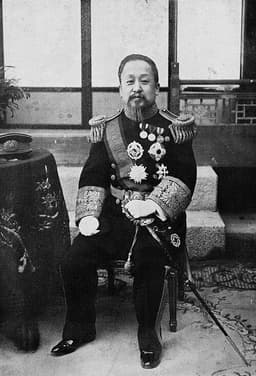
King Gojong of Korea
Emperor · Modern
52.8Total

Napoleon Bonaparte
General · Modern
70.9Total
Basic Information
Born
1852
1769
Died
1919
1821
Era
Modern
Modern
Nationality
Korea
France
Occupation
Emperor
General
Civilization
Eastern
Western
Score Comparison
Military (10%)
50.0
94.0
Political (20%)
68.0
72.0
Influence (20%)
56.4
40.0
Legacy (20%)
48.3
80.0
Leadership (15%)
40.0
78.0
Strategy (15%)
54.6
90.0
TOTAL
52.8
70.9
King Gojong of Korea — Complete Timeline
1894 AD
Gabo ReformsReform◆ Major
Gojong's government implemented the Gabo Reforms, a series of modernization measures including the abolition of slavery, reform of the civil service exam, and adoption of a solar calendar. These reforms aimed to strengthen Korea against foreign encroachment.
ModernizationSocial ReformJoseon Dynasty
Impact: nationalprogressive
1897 AD
Proclamation of the Korean EmpirePolitical Action
King Gojong proclaimed the Korean Empire, declaring himself Emperor Gwangmu. This was an attempt to assert Korea's sovereignty and independence from foreign influence, particularly China and Japan, and to modernize the state.
Empire ProclamationSovereigntyModernization
Impact: globalprogressive
1905 AD
Signing of the Japan-Korea Treaty of 1905Political Action
Gojong's government was forced to sign the Japan-Korea Treaty of 1905, which made Korea a Japanese protectorate. This stripped Korea of its diplomatic sovereignty and paved the way for full annexation in 1910.
ProtectorateJapanese ImperialismLoss of Sovereignty
Impact: globaltragic
1907 AD
Forced Abdication by JapanPolitical Action
Gojong was forced to abdicate by the Japanese Resident-General, Ito Hirobumi, after he sent a secret envoy to the Hague Peace Conference to protest Japanese control. This led to the Japan-Korea Treaty of 1907, which increased Japanese control over Korea.
Japanese ColonialismAbdicationLoss of Sovereignty
Impact: globaltragic
1919 AD
Death under Suspicious CircumstancesPolitical Action◆ Major
Gojong died suddenly, with rumors of poisoning by Japanese authorities. His death sparked the March 1st Movement, a nationwide protest against Japanese rule, which became a pivotal event in the Korean independence movement.
DeathIndependence MovementJapanese Colonialism
Impact: nationaltragic
Napoleon Bonaparte — Complete Timeline
1799 AD
Coup of 18 BrumaireOther◆ Major
Napoleon Bonaparte, with support from his brother Lucien and key political figures, overthrew the Directory in a bloodless coup. He established the Consulate with himself as First Consul, effectively becoming the ruler of France. This event ended the French Revolution's most unstable period.
French RevolutionCoupRise to Power
Impact: regional
1804 AD
Promulgation of the Napoleonic CodeOther◆ Major
Napoleon enacted the Civil Code of the French, known as the Napoleonic Code, a comprehensive set of laws that replaced the fragmented feudal legal systems. The code established legal equality, protected property rights, and secularized law. It became the basis for legal systems in many European and world countries.
Legal ReformNapoleonic CodeCivil Law
Impact: globalconstructive
1805 AD
Battle of AusterlitzWar◆ Major
Napoleon's Grande Arm
Napoleonic WarsBattleDecisive Victory
Impact: global
1812 AD
Invasion of RussiaWar◆ Major
Napoleon led the Grande Arm
Napoleonic WarsInvasionDisaster
Impact: globaldestructive
1815 AD
Battle of WaterlooWar◆ Major
Napoleon's French army was defeated by the combined forces of the Duke of Wellington's Anglo-Allied army and Gebhard Leberecht von Bl
Napoleonic WarsBattleFinal Defeat
Impact: globaldestructive
Expert Analysis
king-gojong-of-korea-vs-napoleon-bonaparte
# The Emperor and the General: Two Paths Through the Storm of Modernity
On a June morning in 1815, Napoleon Bonaparte watched his Imperial Guard march toward the ridgeline at Waterloo, their blue coats brilliant against the Belgian mud. He had staked everything on one final, crushing blow. Seven thousand miles away and nearly a century later, in January 1919, King Gojong of Korea lay dying in his palace at Deoksu, surrounded by Japanese guards who whispered rumors of poison. One man commanded the most powerful army in Europe; the other could barely command his own household. Yet both faced the same elemental question: how does a ruler survive when the world changes overnight?
Origins
Napoleon was born in 1769 on Corsica, an island only recently annexed by France. His family were minor nobility, poor enough to feel hunger but proud enough to resent their French overlords. He spoke Italian before French, and his childhood was soaked in the bitter salt of colonial resentment. This outsider’s edge—the sense that he had to prove himself against a hostile establishment—never left him. At the military academy of Brienne, classmates mocked his accent; he responded by devouring books on artillery and siegecraft.
Gojong came into the world in 1852 as the son of Prince Regent Heungseon, a man who would later rule in his son’s name. Korea’s Joseon dynasty had endured for five centuries, insulated by mountains and a fierce cultural pride that saw the outside world as barbarian. When Gojong ascended the throne at age twelve in 1864, his father locked the gates tighter, persecuting Catholics and burning Western books. The boy-king was raised in a world that believed isolation was strength. The irony would haunt him.
Rise to Power
Napoleon’s ascent was a masterpiece of opportunism. The French Revolution had shattered the old order, and a young artillery officer with talent and ambition found the doors thrown open. At the Siege of Toulon in 1793, he spotted the exact angle to place his guns—a flash of pure tactical genius that made him a brigadier general at twenty-four. By 1796, he commanded the Army of Italy, where he turned starving soldiers into a conquering force by promising them glory and plunder. Each victory fed the next: Egypt, the coup of 18 Brumaire in 1799, and by 1804, the imperial crown.
Gojong’s path was slower, more painful. He began as a puppet of his father, who ruled as regent until 1873. When the young king finally took power, he faced a Korea that was, in the words of one Western diplomat, “a hermit kingdom with a cracked door.” The Japanese had forced open that door in 1876 with gunboats, and Gojong realized that his father’s isolationism had left Korea defenseless. He began cautiously opening ports, sending students abroad, and—most painfully—watching as Japan modernized at a speed Korea could not match.
Leadership & Governance
Napoleon governed as he fought: with speed, brilliance, and a total lack of sentiment. The Napoleonic Code, which he wrote in 1804, swept away feudal privileges and established equality before the law. He built roads, standardized education, and created a centralized bureaucracy that still shapes France. His military system was equally revolutionary: the corps structure, the use of massed artillery, the relentless pursuit of the enemy’s destruction. At Austerlitz in 1805, he crushed the combined armies of Russia and Austria with a feigned retreat that remains a textbook maneuver. His political score of 75 reflects this administrative genius, but his military 94 and strategy 93 tell the truer story: he was a force of nature, not a builder of institutions.
Gojong governed through compromise and endurance. The Gabo Reforms of 1894 were ambitious: they abolished slavery, ended the civil service exam, and reorganized the government along modern lines. But these reforms were imposed under Japanese pressure, and Gojong’s political score of 84.8 reflects a ruler who understood what needed to be done but lacked the power to do it. His military score of 43 and strategy 30 are not failures of will but of circumstance—Korea had no army that could face Japan. His only weapon was diplomacy, and diplomacy failed.
Triumph & Tragedy
Napoleon’s greatest moment was also the beginning of his end. In 1812, he invaded Russia with the largest army Europe had ever seen—over 600,000 men. By December, fewer than 30,000 stumbled back. The disaster was total, yet Napoleon refused to negotiate. He raised new armies, won new battles, and then lost everything at Waterloo in 1815. His tragedy was not defeat but the inability to stop. He had conquered Europe but could not govern it.
Gojong’s triumph was symbolic but profound. In 1897, he proclaimed the Korean Empire, declaring himself Emperor Gwangmu—a title that asserted Korea’s equality with China and Japan. It was a desperate act of defiance, and it lasted only thirteen years. In 1905, Japan forced Korea to become a protectorate. In 1907, Gojong sent a secret envoy to the Hague Peace Conference to plead for Korean sovereignty. The Japanese discovered it, and Ito Hirobumi forced the emperor to abdicate. His death in 1919, under suspicious circumstances, sparked the March 1st Movement—a nationwide protest that crushed Japanese illusions of a peaceful colony.
Character & Destiny
Napoleon was driven by an insatiable hunger. “I live only for posterity,” he once said, but he could not imagine a future without himself at its center. His personality—arrogant, brilliant, restless—made him unstoppable on the battlefield and impossible in peacetime. He could not share power because he could not conceive of equals.
Gojong was the opposite: a man who understood his limits. He watched his kingdom shrink year by year, and he fought not with armies but with letters, envoys, and the slow, grinding work of survival. Where Napoleon burned, Gojong endured. Where Napoleon commanded, Gojong pleaded. Their personalities were shaped by their eras: Napoleon could conquer because Europe was weak and fragmented; Gojong could only resist because East Asia was being carved up by empires.
Legacy
Napoleon left a continent reshaped. The Napoleonic Code spread across Europe, nationalism became a force that would topple empires, and his military innovations influenced every war that followed. His legacy score of 78 is modest only because his empire collapsed so quickly—but his ideas outlived his armies.
Gojong left a nation that refused to die. The Korean Empire fell, but the March 1st Movement it inspired became the foundation of Korean resistance. Today, Gojong is remembered as a tragic figure—a king who tried to modernize but was crushed by forces beyond his control. His legacy score of 68 understates his importance: he was the last king of a dynasty that had ruled for five centuries, and his failure became the seed of Korea’s modern identity.
Conclusion
Standing at Waterloo, Napoleon could see the end coming. He had conquered cities, crowned kings, and rewritten laws—but he could not stop. Gojong, in his palace, could see the same end from a different angle. He had no army, no empire, no legend. He had only the terrible clarity of a man who knows he is losing. Both were caught in the same storm: the collision of old worlds with new. One tried to ride the storm, the other tried to shelter from it. Neither succeeded. But their failures taught us something about power: that it is not enough to be brilliant or brave. You must also know when to stop, when to bend, and when to accept that history has already made its choice.
Rankings
🥇
Napoleon BonaparteLeader
Mil: 94.0Pol: 72.0Inf: 40.0
70.9
🥈
King Gojong of Korea
Mil: 50.0Pol: 68.0Inf: 56.4
52.8
+18.1 behind
How This Comparison Works
Algorithm
Each figure is scored on 6 dimensions (0—100 scale) based on structured historical data: Military (10%), Political (20%), Influence (20%), Legacy (20%), Leadership (15%), Strategy (15%). The weighted total produces the final ranking.
Data Sources
Scores are computed from structured sub-indicators in the database. Scale factors adjust for era (Ancient ×0.85, Modern ×1.0) and civilization size (Eastern ×1.05, Other ×0.80) to account for differences in population and military scale.
Maximum 3 Figures
Comparisons are limited to 2—3 figures to ensure readability and statistical meaningfulness.
Error Margins
±5 points per dimension — Sub-scores are derived from historical records with inherent uncertainty. Two figures within 5 points on a dimension should be considered roughly equivalent in that area.
Total Score Accuracy
±3 points overall — The weighted combination of 6 dimensions produces a total score with approximately ±3 points of uncertainty. Differences of less than 3 points are not statistically significant— the figures are effectively tied.
Known Limitations
- Historical records are incomplete and uneven across civilizations
- Figures from oral-tradition societies may be underrepresented
- Occupation labels can misclassify multi-role figures
- Scores measure capability and impact, not moral character
- Quantitative scoring is a comparison tool, not absolute truth
Capability Radar
Military (10%) — Battles & Warfare
Battles
5
95
Win Rate
5
90
Expansion
0
95
Political (20%) — Governance & Reform
Reform
40
95
Diplomacy
30
80
Economy
20
85
Influence (20%) — Cultural & Global Reach
Cultural
40
85
Global
30
90
Legacy (20%) — Historical Impact
Historical
50
95
Longevity
40
90
Leadership (15%) — Power & Stability
Tenure
60
85
Stability
15
70
Strategy (15%) — Tactics & Innovation
Strategy
5
95
Tactics
5
98
Reform
10
92
Similar Comparisons
Comments & Discussion
CORSICAN THUNDER6/17/2026
Napoleon's military genius isn't even comparable to Gojong's reign. At Waterloo, Napoleon commanded 72,000 men against Wellington's 68,000 and Blücher's 48,000—a three-front nightmare he nearly won. That's tactical brilliance. Gojong let Japan dismantle his military in 1905, disbanding even the royal guard. One man shaped Europe's destiny; the other couldn't shape his own backyard. Sorry, but a king who loses his army isn't a king.
血盟守旧者6/17/2026
拿皇是军事赌徒,高宗的悲剧更深刻。拿破仑在莱比锡会战丢了20万大军后还能东山再起,高宗却连反抗的机会都没有。日本吞并朝鲜时,他连像样的抵抗命令都没下,就被软禁致死。拿破仑失败了还能写回忆录、重振帝国;高宗失败了,连历史都让日本人改写。这不是同等级别的领导者,一个是将军,一个是囚徒。
THE QUANT TWIST6/17/2026
Let's look at real metrics: Napoleon's Grand Army peaked at 600,000 men; Gojong's entire kingdom had fewer than 200,000 soldiers spread across five centuries-old garrisons. Napoleon modernized France's legal code in 1804—Gojong couldn't even modernize Korea's postal service until 1900. Napoleon's GDP per capita impact? Massive. Gojong's? Korea remained a feudal backwater until Japan annexed it. The numbers don't lie: one was a global force, the other a footnote.
帝国暴君批判者6/17/2026
别吹拿破仑了,他为了个人荣耀把法国拖入绝境。远征俄国损失40万人,滑铁卢再丢3万,最后帝国土崩瓦解。高宗至少保住了朝鲜文化500年的延续,哪怕被吞并,语言、文字、历史都没消失。拿破仑搞“大陆封锁”害苦了平民,高宗却努力开放门户,虽然失败了,但方向是对的。真正伟大的领导者不仅看对手,还要看对人民的伤害——拿破仑害惨了欧洲。
PALACE INTRIGUE6/17/2026
You're all missing the real story. Gojong wasn't just a pawn—he outmaneuvered his father Heungseon Daewongun in a 1873 coup that even Napoleon would admire. That took years of secret alliances with Queen Min and progressive scholars. Napoleon's rise was a straight military line; Gojong's was a snake of palace whispers and poison. When Japan forced the Korea-Japan Treaty of 1876, Gojong played Qing China against Russia against Japan—a diplomatic chess game Napoleon never understood. He lost, sure