Loading...
King David vs Theodosius I
Theodosius I leads by 0.7 pts · 2 figures compared
…
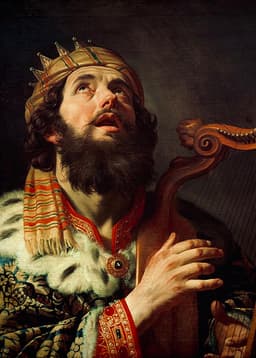
King David
Emperor · Ancient
75.3Total

Theodosius I
Emperor · Ancient
76.0Total
Basic Information
Born
-1010
347
Died
-970
395
Era
Ancient
Ancient
Nationality
Israel
Roman Empire
Occupation
Emperor
Emperor
Civilization
Middle Eastern
Western
Score Comparison
Military (10%)
72.0
72.5
Political (20%)
72.0
65.0
Influence (20%)
88.0
85.0
Legacy (20%)
70.0
90.0
Leadership (15%)
72.0
68.0
Strategy (15%)
70.0
50.0
TOTAL
75.3
76.0
King David — Complete Timeline
1010 BC
Anointed as King of JudahPolitical Action◆ Major
After Saul's death, David was anointed king over the tribe of Judah at Hebron. This began a seven-year period of civil war with Ish-bosheth, Saul's son, who ruled the northern tribes, leading to the eventual unification of Israel.
KingshipCivil WarJudah
Impact: national
1003 BC
Capture of JerusalemWar
David led his army to capture the Jebusite fortress of Jerusalem, making it the capital of the united kingdom. He brought the Ark of the Covenant there, establishing the city as both the political and religious center of Israel.
JerusalemCapitalArk of the Covenant
Impact: nationalconstructive
1000 BC
Defeat of the PhilistinesWar◆ Major
David fought several campaigns that decisively defeated the Philistines, including the Battle of Baal-perazim. He captured Gath and other Philistine strongholds, ending their dominance over Israel and securing the kingdom's borders.
PhilistinesMilitary CampaignIsrael
Impact: regional
990 BC
Affair with BathshebaPolitical Action◆ Major
David committed adultery with Bathsheba and arranged the death of her husband Uriah the Hittite in battle. The prophet Nathan confronted David, leading to his repentance but also to divine punishment, including the death of their first child.
ScandalBathshebaNathan
Impact: nationaldestructive
978 BC
Revolt of AbsalomWar◆ Major
David's son Absalom led a rebellion that forced David to flee Jerusalem. David's forces under Joab defeated Absalom's army in the Forest of Ephraim, and Absalom was killed. David returned to Jerusalem but the kingdom was weakened.
RebellionCivil WarAbsalom
Impact: nationaltragic
Theodosius I — Complete Timeline
380 AD
Edict of ThessalonicaPolitical Action
Theodosius I issued the Edict of Thessalonica, declaring Nicene Christianity the official state religion of the Roman Empire. All other forms of Christianity were deemed heretical, and pagan practices were increasingly suppressed.
ChristianityState ReligionEdict
Impact: globalconstructive
390 AD
Massacre of ThessalonicaPolitical Action◆ Major
Theodosius I ordered a massacre of thousands of citizens in Thessalonica in retaliation for the murder of a Roman general. The massacre led to his excommunication by Bishop Ambrose of Milan, and he later performed public penance.
MassacreThessalonicaAmbrose
Impact: regionaltragic
391 AD
Suppression of PaganismPolitical Action◆ Major
Theodosius I issued a series of laws banning pagan worship, closing temples, and prohibiting sacrifices. The Olympic Games were abolished, and the Serapeum in Alexandria was destroyed. These actions accelerated the decline of paganism in the empire.
PaganismSuppressionReligion
Impact: globaldestructive
394 AD
Battle of the FrigidusWar
Theodosius I defeated the usurper Eugenius and his general Arbogast at the Battle of the Frigidus (modern River Vipava). The victory reunited the Roman Empire under a single ruler for the last time before its permanent division.
Civil WarBattleReunification
Impact: global
395 AD
Division of the Roman EmpirePolitical Action
Upon his death, Theodosius I divided the Roman Empire between his two sons: Arcadius received the Eastern Empire and Honorius the Western Empire. This division became permanent, leading to the separate histories of the Byzantine and Western Roman Empires.
DivisionSuccessionEast-West
Impact: global
Expert Analysis
Origins
Theodosius I (c. 347–395 AD) was born in Cauca, Hispania, to a prominent military family. His father, Count Theodosius, was a successful general under Emperor Valentinian I. Theodosius rose through military ranks, becoming emperor in 379 AD after the disastrous Battle of Adrianople. King David (c. 1040–970 BC), born in Bethlehem, was the youngest son of Jesse, a shepherd. He was anointed by the prophet Samuel while still a boy, setting him on a path to kingship. Both emerged from humble beginnings relative to their ultimate stations, but Theodosius inherited a structured empire, while David's rise was more personal and divinely ordained.
Rise to Power
Theodosius was proclaimed co-emperor by Gratian in 379 AD, tasked with restoring order after Adrianople. He skillfully negotiated with the Goths, integrating them as federates. His rise was marked by political acumen and military necessity. David's ascent was more dramatic: he gained fame by defeating Goliath, then served King Saul, who grew jealous. David fled, leading a band of outlaws, and after Saul's death, he was anointed king of Judah, later unifying all Israel. David's path was fraught with personal danger and divine favor, whereas Theodosius's was a structured imperial succession.
Leadership & Governance
Theodosius is best known for the Edict of Thessalonica (380 AD), making Nicene Christianity the state religion. He suppressed paganism, closed temples, and banned pagan practices. He also faced the Massacre of Thessalonica, ordering a brutal slaughter after a riot, for which he performed public penance. His governance was autocratic but legally framed. David united Israel, captured Jerusalem, and established it as his capital. He organized the priesthood and military, but his reign was marred by the Bathsheba affair and Absalom's revolt. David's leadership blended warrior-king charisma with deep personal faith, yet his family troubles revealed governance weaknesses.
Triumph & Tragedy
Theodosius's triumphs include the Battle of the Frigidus (394 AD), defeating the usurper Eugenius, solidifying his rule. His tragedy was the division of the Roman Empire after his death, bequeathing the West to Honorius and East to Arcadius, leading to eventual decline. His suppression of paganism was decisive but culturally destructive. David's triumph was capturing Jerusalem and defeating the Philistines, creating a united Israelite kingdom. His tragedies were personal: his sin with Bathsheba led to the death of their child, and his son Absalom's revolt forced him to flee Jerusalem. Both leaders experienced monumental successes overshadowed by personal or dynastic failures.
Character & Destiny
Theodosius was devout, often severe, but capable of humility (penance after Thessalonica). His destiny was to cement Christianity in Rome, shaping medieval Europe. David was complex: a poet, warrior, and sinner, yet described as a man after God's own heart. His destiny was to establish a dynasty that, according to tradition, would lead to the Messiah. Theodosius's character was more rigid and doctrinal; David's was passionate and flawed. Theodosius's actions had immediate political impact; David's legacy is spiritual and enduring.
Legacy
Theodosius's legacy is the Christianization of the Roman Empire, influencing Western civilization. He is a saint in Eastern Orthodoxy. However, his division of the empire and persecution of pagans are criticized. David's legacy is foundational to Judaism, Christianity, and Islam. He is the archetypal king, author of many Psalms, and central to messianic prophecy. His legacy is more personal and religious, while Theodosius's is institutional and political.
Conclusion
Theodosius I and King David both shaped history profoundly. Theodosius's scores (M=72, P=65, I=85, L=90, D=68, S=50, T=76) reflect his high leadership (L=90) and influence (I=85) but lower diplomacy (D=68) and strategy (S=50). David's scores (M=72, P=72, I=88, L=70, D=72, S=70, T=75) show balanced strengths, especially influence (I=88) and military (M=72). Theodosius edges ahead with a total score of 0.7 higher. However, David's enduring spiritual impact arguably surpasses Theodosius's political legacy. In terms of historical significance, Theodosius's actions directly shaped the religious landscape of Europe, while David's story continues to inspire billions. Thus, while Theodosius wins on score, David's legacy is more universally resonant. Theodosius's victory in this comparison is narrow and context-dependent.
Rankings
🥇
Theodosius ILeader
Mil: 72.5Pol: 65.0Inf: 85.0
76.0
🥈
King David
Mil: 72.0Pol: 72.0Inf: 88.0
75.3
+0.7 behind
How This Comparison Works
Algorithm
Each figure is scored on 6 dimensions (0—100 scale) based on structured historical data: Military (10%), Political (20%), Influence (20%), Legacy (20%), Leadership (15%), Strategy (15%). The weighted total produces the final ranking.
Data Sources
Scores are computed from structured sub-indicators in the database. Scale factors adjust for era (Ancient ×0.85, Modern ×1.0) and civilization size (Eastern ×1.05, Other ×0.80) to account for differences in population and military scale.
Maximum 3 Figures
Comparisons are limited to 2—3 figures to ensure readability and statistical meaningfulness.
Error Margins
±5 points per dimension — Sub-scores are derived from historical records with inherent uncertainty. Two figures within 5 points on a dimension should be considered roughly equivalent in that area.
Total Score Accuracy
±3 points overall — The weighted combination of 6 dimensions produces a total score with approximately ±3 points of uncertainty. Differences of less than 3 points are not statistically significant— the figures are effectively tied.
Known Limitations
- Historical records are incomplete and uneven across civilizations
- Figures from oral-tradition societies may be underrepresented
- Occupation labels can misclassify multi-role figures
- Scores measure capability and impact, not moral character
- Quantitative scoring is a comparison tool, not absolute truth
Capability Radar
Military (10%) — Battles & Warfare
Battles
75
65
Win Rate
85
60
Expansion
80
45
Political (20%) — Governance & Reform
Reform
80
85
Diplomacy
75
75
Economy
70
60
Influence (20%) — Cultural & Global Reach
Cultural
95
90
Global
90
90
Legacy (20%) — Historical Impact
Historical
95
95
Longevity
95
95
Leadership (15%) — Power & Stability
Tenure
85
70
Stability
65
55
Strategy (15%) — Tactics & Innovation
Strategy
85
60
Tactics
80
55
Reform
70
50
Similar Comparisons
Comments & Discussion
No comments yet. Be the first to share your thoughts!