Loading...
Theodosius I vs Yu the Great
Theodosius I leads by 10.4 pts · 2 figures compared
…

Theodosius I
Emperor · Ancient
76.0Total
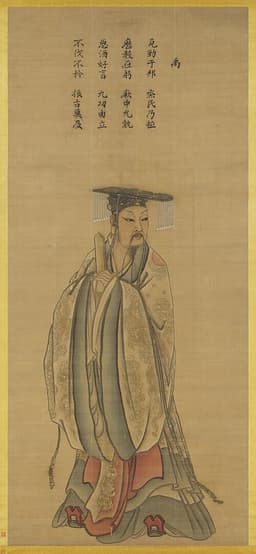
Yu the Great
Emperor · Ancient
65.6Total
Basic Information
Born
347
-2123
Died
395
-2055
Era
Ancient
Ancient
Nationality
Roman Empire
China
Occupation
Emperor
Emperor
Civilization
Western
Eastern
Score Comparison
Military (10%)
72.5
25.9
Political (20%)
65.0
65.0
Influence (20%)
85.0
65.0
Legacy (20%)
90.0
90.0
Leadership (15%)
68.0
72.0
Strategy (15%)
50.0
36.8
TOTAL
76.0
65.6
Theodosius I — Complete Timeline
380 AD
Edict of ThessalonicaPolitical Action
Theodosius I issued the Edict of Thessalonica, declaring Nicene Christianity the official state religion of the Roman Empire. All other forms of Christianity were deemed heretical, and pagan practices were increasingly suppressed.
ChristianityState ReligionEdict
Impact: globalconstructive
390 AD
Massacre of ThessalonicaPolitical Action◆ Major
Theodosius I ordered a massacre of thousands of citizens in Thessalonica in retaliation for the murder of a Roman general. The massacre led to his excommunication by Bishop Ambrose of Milan, and he later performed public penance.
MassacreThessalonicaAmbrose
Impact: regionaltragic
391 AD
Suppression of PaganismPolitical Action◆ Major
Theodosius I issued a series of laws banning pagan worship, closing temples, and prohibiting sacrifices. The Olympic Games were abolished, and the Serapeum in Alexandria was destroyed. These actions accelerated the decline of paganism in the empire.
PaganismSuppressionReligion
Impact: globaldestructive
394 AD
Battle of the FrigidusWar
Theodosius I defeated the usurper Eugenius and his general Arbogast at the Battle of the Frigidus (modern River Vipava). The victory reunited the Roman Empire under a single ruler for the last time before its permanent division.
Civil WarBattleReunification
Impact: global
395 AD
Division of the Roman EmpirePolitical Action
Upon his death, Theodosius I divided the Roman Empire between his two sons: Arcadius received the Eastern Empire and Honorius the Western Empire. This division became permanent, leading to the separate histories of the Byzantine and Western Roman Empires.
DivisionSuccessionEast-West
Impact: global
Yu the Great — Complete Timeline
2100 BC
Flood Control of the Yellow RiverOther◆ Major
According to legend, Yu the Great devised a system of dredging and channeling to control the catastrophic flooding of the Yellow River. His success in flood control earned him the favor of the sage-king Shun, who later abdicated in his favor.
Flood ControlLegendXia Dynasty
Impact: regionalconstructive
2070 BC
Founding of the Xia DynastyPolitical Action
Yu the Great established the Xia dynasty, traditionally considered the first dynasty in Chinese history. He divided the realm into nine provinces and instituted a hereditary succession, breaking the previous system of abdication to the most capable.
Xia DynastyFoundingHereditary Rule
Impact: regionalconstructive
Casting of the Nine Tripod CauldronsCultural
Yu the Great ordered the casting of nine bronze tripod cauldrons, each symbolizing one of the nine provinces of China. These cauldrons became symbols of imperial authority and were passed down through successive dynasties.
SymbolismBronze AgeImperial Authority
Impact: regionalconstructive
Expert Analysis
Origins
Theodosius I was born in 347 AD in Cauca, Hispania (modern Spain), into a prominent Roman military family. His father, Count Theodosius, was a high-ranking general under Emperor Valentinian I. Theodosius received a classical education and military training, accompanying his father on campaigns in Britain and Africa. His early life was marked by privilege and exposure to the highest echelons of Roman power. After his father's execution in 376 AD, Theodosius retired to his estates but was recalled to service by Emperor Gratian.
Yu the Great, by contrast, is a legendary figure from Chinese mythology, traditionally dated to around 2200 BC. According to ancient texts like the Records of the Grand Historian, Yu was the son of Gun, who had failed to control the Great Flood. Yu was appointed by the sage-king Yao to continue his father's work. His early life is shrouded in myth, but he is portrayed as a humble and diligent engineer who worked for 13 years without returning home, eventually taming the waters.
Rise to Power
Theodosius rose to power in a time of crisis. After the disastrous Battle of Adrianople in 378 AD, where Emperor Valens was killed by the Goths, Gratian appointed Theodosius as co-emperor for the East in 379 AD. Theodosius quickly stabilized the situation, negotiating a peace treaty with the Goths in 382 AD that settled them within the empire as foederati. This pragmatic move secured his position. He then focused on religious unity, issuing the Edict of Thessalonica in 380 AD, which declared Nicene Christianity the state religion. This solidified his authority over the Church and suppressed Arianism.
Yu the Great's rise is tied to his successful flood control. After Yao's successor, Shun, saw Yu's effectiveness, he appointed Yu as his successor. Yu then founded the Xia dynasty, traditionally considered China's first dynasty, and divided the realm into nine provinces. His rise was based on merit and popular support, rather than military conquest.
Leadership & Governance
Theodosius governed as an autocrat, centralizing power and enforcing religious orthodoxy. He issued a series of laws against paganism, banning sacrifices and closing temples. He also ordered the destruction of the Serapeum in Alexandria. His leadership style was decisive but brutal: in 390 AD, he ordered the Massacre of Thessalonica, killing thousands of citizens to avenge the murder of a general. This led to his excommunication by Bishop Ambrose, highlighting his complex relationship with the Church. Theodosius scored 68.0 in leadership and 65.0 in political skill.
Yu the Great's governance was based on engineering and organization. He established the Xia dynasty's administrative structure, dividing the realm into nine provinces and casting nine bronze tripod cauldrons as symbols of unity. His leadership score is 72.0, reflecting his hands-on approach. He is credited with creating irrigation systems and flood control measures that enabled agriculture, earning him lasting reverence.
Triumph & Tragedy
Theodosius's greatest triumph was the unification of the Roman Empire under Orthodox Christianity. He defeated the usurper Eugenius at the Battle of the Frigidus in 394 AD, which also saw the destruction of pagan temples. However, his division of the empire between his sons Arcadius and Honorius upon his death in 395 AD proved disastrous, accelerating the decline of the Western Roman Empire. The Massacre of Thessalonica remains a dark stain on his legacy.
Yu the Great's triumph was ending the Great Flood, allowing civilization to flourish in the Yellow River valley. His founding of the Xia dynasty established hereditary rule in China. However, his legacy is largely legendary, with no contemporary evidence for his existence. The Xia dynasty's historicity is debated, and his flood control methods are mythical.
Character & Destiny
Theodosius was a devout Christian but also a ruthless pragmatist. His character combined piety with violence, as seen in his submission to Ambrose's penance after Thessalonica. He was determined to enforce unity, which shaped his destiny as the emperor who cemented Christianity's dominance. His decisions, however, sowed seeds of division in the empire.
Yu the Great is depicted as selfless and diligent, a model Confucian ruler. His destiny was to become a cultural hero, embodying perseverance and wisdom. His character reflects the ideals of Chinese civilization, emphasizing harmony with nature.
Legacy
Theodosius's legacy is profound: he made Christianity the official religion of the Roman Empire, shaping Western civilization. His scores reflect this: influence 85.0, legacy 90.0. The Edict of Thessalonica established a precedent for state religion, and his suppression of paganism ended millennia of Roman polytheism. The Olympic Games were abolished in 393 AD under his decrees.
Yu the Great's legacy is equally enduring but more symbolic. He is revered as a founding father of Chinese civilization, with a legacy score of 90.0. The Xia dynasty, though legendary, set the pattern for Chinese dynastic rule. His flood control mythos underscores the importance of water management in Chinese history.
Conclusion
While both figures scored 90.0 in legacy, Theodosius I had greater historical impact due to his concrete, documented actions that changed the course of Western civilization. His total score of 76.0 edges out Yu's 65.6. Theodosius's policies directly influenced the development of medieval Europe and the Christian Church. Yu's influence, while culturally significant, remains largely mythological and less verifiable. Theodosius's division of the empire may have been a mistake, but his religious reforms had lasting global consequences. Therefore, Theodosius I is the more impactful figure.
Rankings
🥇
Theodosius ILeader
Mil: 72.5Pol: 65.0Inf: 85.0
76.0
🥈
Yu the Great
Mil: 25.9Pol: 65.0Inf: 65.0
65.6
+10.4 behind
How This Comparison Works
Algorithm
Each figure is scored on 6 dimensions (0—100 scale) based on structured historical data: Military (10%), Political (20%), Influence (20%), Legacy (20%), Leadership (15%), Strategy (15%). The weighted total produces the final ranking.
Data Sources
Scores are computed from structured sub-indicators in the database. Scale factors adjust for era (Ancient ×0.85, Modern ×1.0) and civilization size (Eastern ×1.05, Other ×0.80) to account for differences in population and military scale.
Maximum 3 Figures
Comparisons are limited to 2—3 figures to ensure readability and statistical meaningfulness.
Error Margins
±5 points per dimension — Sub-scores are derived from historical records with inherent uncertainty. Two figures within 5 points on a dimension should be considered roughly equivalent in that area.
Total Score Accuracy
±3 points overall — The weighted combination of 6 dimensions produces a total score with approximately ±3 points of uncertainty. Differences of less than 3 points are not statistically significant— the figures are effectively tied.
Known Limitations
- Historical records are incomplete and uneven across civilizations
- Figures from oral-tradition societies may be underrepresented
- Occupation labels can misclassify multi-role figures
- Scores measure capability and impact, not moral character
- Quantitative scoring is a comparison tool, not absolute truth
Capability Radar
Military (10%) — Battles & Warfare
Battles
65
10
Win Rate
60
10
Expansion
45
10
Political (20%) — Governance & Reform
Reform
85
80
Diplomacy
75
70
Economy
60
70
Influence (20%) — Cultural & Global Reach
Cultural
90
85
Global
90
70
Legacy (20%) — Historical Impact
Historical
95
90
Longevity
95
90
Leadership (15%) — Power & Stability
Tenure
70
60
Stability
55
70
Strategy (15%) — Tactics & Innovation
Strategy
60
10
Tactics
55
10
Reform
50
10
Similar Comparisons
Comments & Discussion
No comments yet. Be the first to share your thoughts!