Loading...
This comparison has not been analyzed yet.
One-time AI generation (~1 minute). Scores and timeline are already available below.
King Chungsuk of Goryeo vs Peter I of Cyprus
Peter I of Cyprus leads by 4.0 pts · 2 figures compared
…

King Chungsuk of Goryeo
Emperor · Medieval
41.7Total
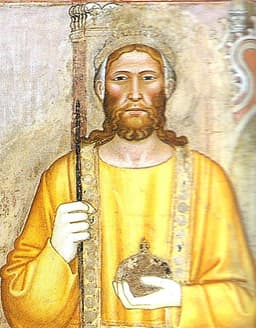
Peter I of Cyprus
Emperor · Medieval
45.7Total
Basic Information
Born
1294
1328
Died
1339
1369
Era
Medieval
Medieval
Nationality
Korea
Cyprus
Occupation
Emperor
Emperor
Civilization
Eastern
Western
Score Comparison
Military (10%)
20.0
20.0
Political (20%)
36.5
40.8
Influence (20%)
48.6
52.5
Legacy (20%)
39.2
42.5
Leadership (15%)
51.9
51.9
Strategy (15%)
45.0
60.0
TOTAL
41.7
45.7
King Chungsuk of Goryeo — Complete Timeline
1330 AD
Deposed by Yuan CourtPolitical Action◆ Major
King Chungsuk was deposed by the Yuan court after a brief reign, due to political conflicts within the Yuan imperial family. He was taken to Dadu and held there, while his son King Chunghye was installed as king with Yuan approval.
DepositionYuan InterventionSuccession Crisis
Impact: nationaldestructive
1332 AD
Reinstated as KingPolitical Action◆ Major
After King Chunghye was deposed for misrule, the Yuan court reinstated King Chungsuk as king of Goryeo. He returned to Gaegyeong and resumed rule, but his authority remained limited by Yuan oversight.
ReinstatementYuan InfluenceRestoration
Impact: national
1335 AD
Implemented Administrative ReformsReform
King Chungsuk attempted to reform Goryeo's tax system and local administration to reduce corruption and stabilize state finances. These reforms had limited success due to resistance from powerful noble families and ongoing Yuan demands for tribute.
Administrative ReformTaxationGovernance
Impact: nationalconstructive
Peter I of Cyprus — Complete Timeline
1361 AD
Capture of AdaliaWar
Peter I captured the city of Adalia (Antalya) on the Anatolian coast from the Hamidid Turks. This victory gave Cyprus a foothold in Asia Minor and boosted Peter's reputation as a crusader king.
CrusadesConquestAnatolia
Impact: regional
1362 AD
Crusade of Peter IPolitical Action◆ Major
Peter I traveled across Europe to promote a new crusade, visiting Avignon, Paris, and London. He secured promises of support from Pope Urban V and various monarchs, though the actual military response was limited.
CrusadesDiplomacyEurope
Impact: regionalconstructive
1365 AD
Sack of AlexandriaWar◆ Major
Peter I led a Crusader fleet to Egypt and sacked the city of Alexandria. The attack was a brutal raid that resulted in massive destruction and loss of life, but failed to hold the city or achieve lasting strategic gains.
CrusadesSackAlexandriaEgypt
Impact: regionaldestructive
1369 AD
AssassinationPolitical Action◆ Major
Peter I was assassinated in his bed in Nicosia by a group of Cypriot nobles. The murder was motivated by his heavy taxation, autocratic rule, and the financial strain of his crusading campaigns.
CyprusAssassinationNobility
Impact: regionaltragic
This comparison has not been analyzed yet.
One-time AI generation (~1 minute). Scores and timeline are already available below.
Rankings
🥇
Peter I of CyprusLeader
Mil: 20.0Pol: 40.8Inf: 52.5
45.7
🥈
King Chungsuk of Goryeo
Mil: 20.0Pol: 36.5Inf: 48.6
41.7
+4.0 behind
How This Comparison Works
Algorithm
Each figure is scored on 6 dimensions (0—100 scale) based on structured historical data: Military (10%), Political (20%), Influence (20%), Legacy (20%), Leadership (15%), Strategy (15%). The weighted total produces the final ranking.
Data Sources
Scores are computed from structured sub-indicators in the database. Scale factors adjust for era (Ancient ×0.85, Modern ×1.0) and civilization size (Eastern ×1.05, Other ×0.80) to account for differences in population and military scale.
Maximum 3 Figures
Comparisons are limited to 2—3 figures to ensure readability and statistical meaningfulness.
Error Margins
±5 points per dimension — Sub-scores are derived from historical records with inherent uncertainty. Two figures within 5 points on a dimension should be considered roughly equivalent in that area.
Total Score Accuracy
±3 points overall — The weighted combination of 6 dimensions produces a total score with approximately ±3 points of uncertainty. Differences of less than 3 points are not statistically significant— the figures are effectively tied.
Known Limitations
- Historical records are incomplete and uneven across civilizations
- Figures from oral-tradition societies may be underrepresented
- Occupation labels can misclassify multi-role figures
- Scores measure capability and impact, not moral character
- Quantitative scoring is a comparison tool, not absolute truth
Capability Radar
Military (10%) — Battles & Warfare
Battles
5
45
Win Rate
5
40
Expansion
5
40
Political (20%) — Governance & Reform
Reform
30
35
Diplomacy
35
45
Economy
30
30
Influence (20%) — Cultural & Global Reach
Cultural
20
30
Global
10
25
Legacy (20%) — Historical Impact
Historical
20
35
Longevity
15
20
Leadership (15%) — Power & Stability
Tenure
40
40
Stability
25
25
Strategy (15%) — Tactics & Innovation
Strategy
5
50
Tactics
5
55
Reform
5
30
Similar Comparisons
Comments & Discussion
No comments yet. Be the first to share your thoughts!