Loading...
This comparison has not been analyzed yet.
One-time AI generation (~1 minute). Scores and timeline are already available below.
King Chungsuk of Goryeo vs Stephen of Blois
Stephen of Blois leads by 0.2 pts · 2 figures compared
…

King Chungsuk of Goryeo
Emperor · Medieval
41.7Total
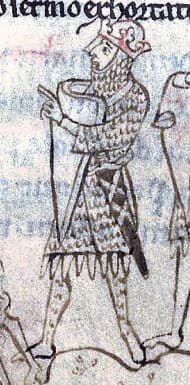
Stephen of Blois
Emperor · Medieval
41.9Total
Basic Information
Born
1294
1096
Died
1339
1154
Era
Medieval
Medieval
Nationality
Korea
England
Occupation
Emperor
Emperor
Civilization
Eastern
Western
Score Comparison
Military (10%)
20.0
50.0
Political (20%)
36.5
26.4
Influence (20%)
48.6
51.0
Legacy (20%)
39.2
41.7
Leadership (15%)
51.9
41.5
Strategy (15%)
45.0
35.7
TOTAL
41.7
41.9
King Chungsuk of Goryeo — Complete Timeline
1330 AD
Deposed by Yuan CourtPolitical Action◆ Major
King Chungsuk was deposed by the Yuan court after a brief reign, due to political conflicts within the Yuan imperial family. He was taken to Dadu and held there, while his son King Chunghye was installed as king with Yuan approval.
DepositionYuan InterventionSuccession Crisis
Impact: nationaldestructive
1332 AD
Reinstated as KingPolitical Action◆ Major
After King Chunghye was deposed for misrule, the Yuan court reinstated King Chungsuk as king of Goryeo. He returned to Gaegyeong and resumed rule, but his authority remained limited by Yuan oversight.
ReinstatementYuan InfluenceRestoration
Impact: national
1335 AD
Implemented Administrative ReformsReform
King Chungsuk attempted to reform Goryeo's tax system and local administration to reduce corruption and stabilize state finances. These reforms had limited success due to resistance from powerful noble families and ongoing Yuan demands for tribute.
Administrative ReformTaxationGovernance
Impact: nationalconstructive
Stephen of Blois — Complete Timeline
1135 AD
Coronation of StephenPolitical Action◆ Major
Stephen was crowned king of England on December 22, 1135, after the death of Henry I. He seized the throne despite Henry's designation of his daughter Matilda as heir.
CoronationUsurpationSuccession Crisis
Impact: national
1141 AD
Battle of LincolnWar◆ Major
Stephen was captured by forces loyal to Matilda at the Battle of Lincoln on February 2, 1141. He was imprisoned, and Matilda briefly ruled as Lady of the English.
BattleCaptureCivil War
Impact: nationaldestructive
Release and RestorationPolitical Action◆ Major
Stephen was released in exchange for Matilda's half-brother Robert of Gloucester, who had been captured. Stephen was restored as king, and the civil war continued.
ReleaseRestorationCivil War
Impact: national
1153 AD
Treaty of WallingfordPolitical Action◆ Major
Stephen and Matilda's son Henry Plantagenet signed the Treaty of Wallingford. Stephen recognized Henry as his heir, ending the Anarchy civil war.
TreatyPeaceSuccession
Impact: nationalconstructive
1154 AD
Death of StephenPolitical Action◆ Major
Stephen died on October 25, 1154, at Dover. His death allowed Henry Plantagenet to become king as Henry II, founding the Plantagenet dynasty.
DeathEnd of AnarchyPlantagenet
Impact: nationaltragic
This comparison has not been analyzed yet.
One-time AI generation (~1 minute). Scores and timeline are already available below.
Rankings
🥇
Stephen of BloisLeader
Mil: 50.0Pol: 26.4Inf: 51.0
41.9
🥈
King Chungsuk of Goryeo
Mil: 20.0Pol: 36.5Inf: 48.6
41.7
+0.2 behind
How This Comparison Works
Algorithm
Each figure is scored on 6 dimensions (0—100 scale) based on structured historical data: Military (10%), Political (20%), Influence (20%), Legacy (20%), Leadership (15%), Strategy (15%). The weighted total produces the final ranking.
Data Sources
Scores are computed from structured sub-indicators in the database. Scale factors adjust for era (Ancient ×0.85, Modern ×1.0) and civilization size (Eastern ×1.05, Other ×0.80) to account for differences in population and military scale.
Maximum 3 Figures
Comparisons are limited to 2—3 figures to ensure readability and statistical meaningfulness.
Error Margins
±5 points per dimension — Sub-scores are derived from historical records with inherent uncertainty. Two figures within 5 points on a dimension should be considered roughly equivalent in that area.
Total Score Accuracy
±3 points overall — The weighted combination of 6 dimensions produces a total score with approximately ±3 points of uncertainty. Differences of less than 3 points are not statistically significant— the figures are effectively tied.
Known Limitations
- Historical records are incomplete and uneven across civilizations
- Figures from oral-tradition societies may be underrepresented
- Occupation labels can misclassify multi-role figures
- Scores measure capability and impact, not moral character
- Quantitative scoring is a comparison tool, not absolute truth
Capability Radar
Military (10%) — Battles & Warfare
Battles
5
30
Win Rate
5
25
Expansion
5
10
Political (20%) — Governance & Reform
Reform
30
20
Diplomacy
35
25
Economy
30
15
Influence (20%) — Cultural & Global Reach
Cultural
20
20
Global
10
15
Legacy (20%) — Historical Impact
Historical
20
30
Longevity
15
20
Leadership (15%) — Power & Stability
Tenure
40
40
Stability
25
10
Strategy (15%) — Tactics & Innovation
Strategy
5
15
Tactics
5
20
Reform
5
10
Similar Comparisons
Comments & Discussion
No comments yet. Be the first to share your thoughts!