Loading...
Kim Il-sung vs Revanth Reddy
Kim Il-sung leads by 19.0 pts · 2 figures compared
…
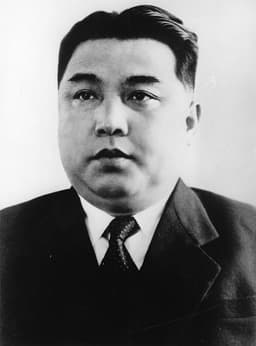
Kim Il-sung
Politician · Modern
64.0Total

Revanth Reddy
Politician · Modern
45.0Total
Basic Information
Born
1912
1969
Died
1994
—
Era
Modern
Modern
Nationality
North Korea
India
Occupation
Politician
Politician
Civilization
Eastern
Indian
Score Comparison
Military (10%)
43.3
47.2
Political (20%)
68.0
39.4
Influence (20%)
65.0
48.6
Legacy (20%)
70.0
35.8
Leadership (15%)
80.0
48.4
Strategy (15%)
36.8
60.0
TOTAL
64.0
45.0
Kim Il-sung — Complete Timeline
1948 AD
Establishment of the Democratic People's Republic of KoreaPolitical Action
Kim Il-sung proclaimed the Democratic People's Republic of Korea (North Korea) with Soviet backing, becoming its first Premier. This established a communist state in the northern half of the Korean Peninsula, separate from the US-backed South.
FoundingNorth KoreaCold War
Impact: regional
1950 AD
Start of the Korean WarWar
Kim Il-sung ordered the North Korean invasion of South Korea, initiating the Korean War. The war resulted in millions of casualties and ended in a stalemate with the 1953 armistice, leaving Korea divided.
WarInvasionKorean War
Impact: globaldestructive
1955 AD
Adoption of the Juche IdeologyCultural◆ Major
Kim Il-sung formally introduced Juche, a self-reliance ideology, as the guiding principle of North Korea. Juche emphasized political independence, economic self-sufficiency, and military autonomy, shaping the country's isolationist policies.
IdeologyJucheSelf-Reliance
Impact: national
1960 AD
Consolidation of the Kim Il-sung Cult of PersonalityPolitical Action◆ Major
Kim Il-sung established an extensive cult of personality, portraying himself as the 'Great Leader' and founder of the Juche ideology. This included rewriting history, erecting statues, and mandating loyalty oaths, creating a totalitarian state.
Cult of PersonalityJucheTotalitarianism
Impact: nationaldestructive
1994 AD
Death and Designation as Eternal PresidentPolitical Action◆ Major
Kim Il-sung died of a heart attack, and the North Korean constitution was amended to designate him 'Eternal President'. His son Kim Jong-il succeeded him, continuing the dynastic rule of the Kim family.
DeathSuccessionEternal President
Impact: national
Revanth Reddy — Complete Timeline
2021 AD
Revived Congress Party in TelanganaPolitical Action◆ Major
Revanth Reddy took over as Telangana Congress president and revitalized the party after years of decline. He organized mass outreach programs, united factions, and built a strong campaign against the BRS government.
CongressTelanganaRevival
Impact: regionalconstructive
2023 AD
Became Chief Minister of TelanganaPolitical Action◆ Major
Revanth Reddy led the Indian National Congress to victory in the 2023 Telangana assembly elections, defeating the incumbent BRS. He became the second Chief Minister of Telangana, ending KCR's decade-long rule.
ElectionCongressTelangana
Impact: regionalconstructive
2024 AD
Launched the 'Indiramma' Housing Scheme (Telangana)Reform◆ Major
Revanth Reddy announced the Indiramma housing scheme in Telangana, promising free houses to all landless poor. The program aimed to address housing shortages and fulfill a key election promise.
HousingWelfareTelangana
Impact: regionalconstructive
Implemented the 'Rythu Bharosa' Farmer SchemeReform◆ Major
Revanth Reddy introduced the Rythu Bharosa scheme, providing financial assistance of Rs 15,000 per year to farmers. The program replaced the previous BRS government's Rythu Bandhu scheme, aiming to increase farmer income.
AgricultureWelfareTelangana
Impact: regionalconstructive
Expert Analysis
Origins
Kim Il-sung was born on April 15, 1912, in Mangyongdae, near Pyongyang, during Japanese colonial rule. His family had a history of activism; his father Kim Hyong-jik was a teacher and independence activist. Kim joined the Communist Party of Korea in 1931 and later received military training in the Soviet Union. His early guerrilla activities against Japanese forces, though often exaggerated in official accounts, established his credentials as a resistance leader.
Revanth Reddy was born on November 8, 1969, in Kondareddypally, Telangana, India, into a farming family. He completed his B.A. in Commerce from Osmania University. His political career began with student activism in the 1990s, joining the Congress party. He later served as a member of the Andhra Pradesh Legislative Assembly before the bifurcation of the state.
Rise to Power
Kim Il-sung rose to prominence with Soviet backing. In 1945, after Japan's surrender, he returned to Korea and was installed as the head of the North Korean branch of the Korean Communist Party. By 1948, he became the Premier of the Democratic People's Republic of Korea (DPRK), consolidating power through purges of rivals. The Korean War (1950-1953), which he initiated, further solidified his control despite the war ending in a stalemate.
Revanth Reddy's rise was more gradual. He was first elected to the Andhra Pradesh Legislative Assembly in 2009. After Telangana's formation in 2014, he became a prominent opposition figure against the ruling Telangana Rashtra Samithi (TRS, later BRS). In 2021, he was appointed president of the Telangana Congress, tasked with reviving the party. His leadership culminated in the 2023 Telangana assembly elections, where he led Congress to a decisive victory, defeating the incumbent BRS and becoming Chief Minister.
Leadership & Governance
Kim Il-sung governed North Korea through a totalitarian system. He established the Juche ideology, emphasizing self-reliance and national independence, but it led to economic isolation and central planning. His rule was marked by a pervasive cult of personality, with statues, portraits, and daily rituals glorifying him. He prioritized military strength, allocating scarce resources to the Korean People's Army, while the economy stagnated and famines occurred.
Revanth Reddy's governance in Telangana focuses on welfare schemes. He launched the Indiramma housing scheme, promising free houses to all landless poor, and the Rythu Bharosa farmer assistance program, providing Rs 15,000 per year to farmers. His administration emphasizes transparency and public engagement, contrasting with Kim's secretive and repressive regime. However, Reddy's policies are constrained by state finances and federal relations.
Triumph & Tragedy
Kim Il-sung's triumphs include founding a state that has persisted for over 70 years and establishing a ruling dynasty. His Juche ideology became a core national identity. However, his greatest tragedy was the Korean War, which devastated the peninsula and left millions dead. His economic policies led to chronic shortages and a famine in the 1990s that killed an estimated 2-3 million people. His legacy is one of a brutal, personality-driven autocracy.
Revanth Reddy's triumph is reviving the Congress party in Telangana, which had been in decline for years. His electoral victory in 2023 was a major upset. However, his tenure is too early for definitive failures. Potential challenges include fulfilling ambitious welfare promises amid fiscal constraints and managing factionalism within the party. His long-term impact remains to be seen.
Character & Destiny
Kim Il-sung was ruthless, charismatic, and paranoid. He systematically eliminated rivals, including former comrades like Pak Hon-yong. His character shaped North Korea's isolation and militarism. He believed in total control, which ultimately led to the country's economic collapse. Historical assessments describe him as a dictator who prioritized power over people.
Revanth Reddy is pragmatic and resilient. He faced corruption allegations and a brief imprisonment in 2015 but bounced back. His ability to unite disparate Congress factions in Telangana shows political acumen. His destiny is tied to delivering on his promises; failure could lead to political irrelevance.
Legacy
Kim Il-sung's legacy is profound. He is revered in North Korea as the "Eternal President," and his Juche ideology remains official state doctrine. His family dynasty continues, with his grandson Kim Jong-un in power. Globally, he is remembered as the founder of one of the world's most repressive regimes and a nuclear-armed state. His policies left a shattered economy and a divided Korean peninsula.
Revanth Reddy's legacy is nascent. If he succeeds in transforming Telangana's governance, he could be remembered as a reformer. Currently, his impact is limited to state-level politics. His scores reflect this: Kim Il-sung totals 64.0, while Reddy scores 45.0, a gap of 19 points. Kim's influence spans decades and continents; Reddy's is regional and contemporary.
Conclusion
Kim Il-sung had a far greater historical impact than Revanth Reddy. Kim founded a nation, a dynasty, and an ideology that continues to shape global geopolitics. His scores reflect this: Leadership 80.0, Legacy 70.0, Influence 65.0. In contrast, Reddy's scores are modest: Leadership 48.4, Legacy 35.8, Influence 48.6. While Reddy's career is ongoing, it is unlikely to approach the scale of Kim's impact. Kim Il-sung, for better or worse, changed the course of history for millions.
Rankings
🥇
Kim Il-sungLeader
Mil: 43.3Pol: 68.0Inf: 65.0
64.0
🥈
Revanth Reddy
Mil: 47.2Pol: 39.4Inf: 48.6
45.0
+19.0 behind
How This Comparison Works
Algorithm
Each figure is scored on 6 dimensions (0—100 scale) based on structured historical data: Military (10%), Political (20%), Influence (20%), Legacy (20%), Leadership (15%), Strategy (15%). The weighted total produces the final ranking.
Data Sources
Scores are computed from structured sub-indicators in the database. Scale factors adjust for era (Ancient ×0.85, Modern ×1.0) and civilization size (Eastern ×1.05, Other ×0.80) to account for differences in population and military scale.
Maximum 3 Figures
Comparisons are limited to 2—3 figures to ensure readability and statistical meaningfulness.
Error Margins
±5 points per dimension — Sub-scores are derived from historical records with inherent uncertainty. Two figures within 5 points on a dimension should be considered roughly equivalent in that area.
Total Score Accuracy
±3 points overall — The weighted combination of 6 dimensions produces a total score with approximately ±3 points of uncertainty. Differences of less than 3 points are not statistically significant— the figures are effectively tied.
Known Limitations
- Historical records are incomplete and uneven across civilizations
- Figures from oral-tradition societies may be underrepresented
- Occupation labels can misclassify multi-role figures
- Scores measure capability and impact, not moral character
- Quantitative scoring is a comparison tool, not absolute truth
Capability Radar
Military (10%) — Battles & Warfare
Battles
15
42
Win Rate
10
48
Expansion
10
48
Political (20%) — Governance & Reform
Reform
70
30
Diplomacy
30
35
Economy
20
25
Influence (20%) — Cultural & Global Reach
Cultural
60
15
Global
60
5
Legacy (20%) — Historical Impact
Historical
70
10
Longevity
80
5
Leadership (15%) — Power & Stability
Tenure
95
20
Stability
40
20
Strategy (15%) — Tactics & Innovation
Strategy
25
50
Tactics
20
54
Reform
30
59
Similar Comparisons
Comments & Discussion
No comments yet. Be the first to share your thoughts!