Loading...
Kim Il-sung vs Napoleon Bonaparte
Napoleon Bonaparte leads by 6.9 pts · 2 figures compared
…
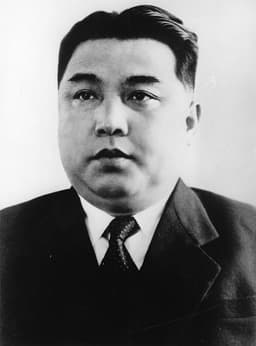
Kim Il-sung
Politician · Modern
64.0Total

Napoleon Bonaparte
General · Modern
70.9Total
Basic Information
Born
1912
1769
Died
1994
1821
Era
Modern
Modern
Nationality
North Korea
France
Occupation
Politician
General
Civilization
Eastern
Western
Score Comparison
Military (10%)
43.3
94.0
Political (20%)
68.0
72.0
Influence (20%)
65.0
40.0
Legacy (20%)
70.0
80.0
Leadership (15%)
80.0
78.0
Strategy (15%)
36.8
90.0
TOTAL
64.0
70.9
Kim Il-sung — Complete Timeline
1948 AD
Establishment of the Democratic People's Republic of KoreaPolitical Action
Kim Il-sung proclaimed the Democratic People's Republic of Korea (North Korea) with Soviet backing, becoming its first Premier. This established a communist state in the northern half of the Korean Peninsula, separate from the US-backed South.
FoundingNorth KoreaCold War
Impact: regional
1950 AD
Start of the Korean WarWar
Kim Il-sung ordered the North Korean invasion of South Korea, initiating the Korean War. The war resulted in millions of casualties and ended in a stalemate with the 1953 armistice, leaving Korea divided.
WarInvasionKorean War
Impact: globaldestructive
1955 AD
Adoption of the Juche IdeologyCultural◆ Major
Kim Il-sung formally introduced Juche, a self-reliance ideology, as the guiding principle of North Korea. Juche emphasized political independence, economic self-sufficiency, and military autonomy, shaping the country's isolationist policies.
IdeologyJucheSelf-Reliance
Impact: national
1960 AD
Consolidation of the Kim Il-sung Cult of PersonalityPolitical Action◆ Major
Kim Il-sung established an extensive cult of personality, portraying himself as the 'Great Leader' and founder of the Juche ideology. This included rewriting history, erecting statues, and mandating loyalty oaths, creating a totalitarian state.
Cult of PersonalityJucheTotalitarianism
Impact: nationaldestructive
1994 AD
Death and Designation as Eternal PresidentPolitical Action◆ Major
Kim Il-sung died of a heart attack, and the North Korean constitution was amended to designate him 'Eternal President'. His son Kim Jong-il succeeded him, continuing the dynastic rule of the Kim family.
DeathSuccessionEternal President
Impact: national
Napoleon Bonaparte — Complete Timeline
1799 AD
Coup of 18 BrumaireOther◆ Major
Napoleon Bonaparte, with support from his brother Lucien and key political figures, overthrew the Directory in a bloodless coup. He established the Consulate with himself as First Consul, effectively becoming the ruler of France. This event ended the French Revolution's most unstable period.
French RevolutionCoupRise to Power
Impact: regional
1804 AD
Promulgation of the Napoleonic CodeOther◆ Major
Napoleon enacted the Civil Code of the French, known as the Napoleonic Code, a comprehensive set of laws that replaced the fragmented feudal legal systems. The code established legal equality, protected property rights, and secularized law. It became the basis for legal systems in many European and world countries.
Legal ReformNapoleonic CodeCivil Law
Impact: globalconstructive
1805 AD
Battle of AusterlitzWar◆ Major
Napoleon's Grande Arm
Napoleonic WarsBattleDecisive Victory
Impact: global
1812 AD
Invasion of RussiaWar◆ Major
Napoleon led the Grande Arm
Napoleonic WarsInvasionDisaster
Impact: globaldestructive
1815 AD
Battle of WaterlooWar◆ Major
Napoleon's French army was defeated by the combined forces of the Duke of Wellington's Anglo-Allied army and Gebhard Leberecht von Bl
Napoleonic WarsBattleFinal Defeat
Impact: globaldestructive
Expert Analysis
kim-il-sung-vs-napoleon-bonaparte
### The Emperor and the Eternal President
On a June morning in 1815, Napoleon Bonaparte stood on a muddy field near Waterloo, watching his Imperial Guard march into annihilation. The man who had crowned himself Emperor of Europe was about to become a prisoner of the Atlantic. One hundred and thirty-nine years later, on a September day in 1948, Kim Il-sung stood on a podium in Pyongyang, proclaiming the Democratic People’s Republic of Korea. He would die in bed, still bearing the title "Eternal President." Two men, both architects of absolute power, yet their trajectories could not have diverged more sharply. One built an empire that crumbled in a single battle; the other built a dynasty that outlasted the Soviet Union that spawned it. Why did Napoleon’s ambition end in exile, while Kim Il-sung’s ended in immortality?
### Origins
Napoleon was born in 1769 on the island of Corsica, a place that had only become French the year before. His family was minor nobility, poor enough to feel the sting of hunger, proud enough to resent their mainland overlords. He spoke Italian before French, and his schoolmates mocked his accent. This outsider’s fury drove him. At the military academy of Brienne, he devoured history and mathematics, dreaming not of France but of Corsican independence. Yet by his twenties, France’s revolution had opened doors that the old monarchy would have kept shut. A young artillery officer with talent could rise fast—and Napoleon did.
Kim Il-sung was born in 1912 in a small village near Pyongyang, then under Japanese colonial rule. His family was Christian and politically active; his father was arrested by the Japanese. Kim grew up in Manchuria, speaking Korean and Chinese, fighting in guerrilla bands against the Japanese occupation. He was no Corsican outsider—he was a colonial subject, and his fury was not against a distant monarchy but against a foreign empire that had swallowed his homeland. By his twenties, he had joined the Communist Party and trained with Soviet partisans. The revolution that opened doors for him was not French but Russian.
### Rise to Power
Napoleon’s rise was a masterpiece of speed and audacity. In 1793, at age 24, he recaptured the port of Toulon from British forces with a brilliant artillery plan. By 1796, he was commanding the French army in Italy, where he turned starving, unpaid soldiers into a conquering force. His victory at the Battle of Rivoli in 1797 made him a national hero. Then came Egypt, then the coup of 18 Brumaire in 1799, when he overthrew the French Directory and made himself First Consul. By 1804, he crowned himself Emperor. Each step was a gamble, each victory a stepping stone.
Kim Il-sung’s rise was slower and more dependent on external forces. He fought as a guerrilla commander in the 1930s, but his fame was largely manufactured after the fact. In 1945, when Japan surrendered, the Soviet Union installed him as the leader of northern Korea. He was 33 years old, a relatively unknown figure. But he had Soviet tanks and a propaganda machine. In 1948, he proclaimed the DPRK, and by 1950, he had convinced Stalin and Mao to back his invasion of South Korea. Unlike Napoleon, Kim did not seize power through personal brilliance—he was handed power by a superpower and then worked to make it absolute.
### Leadership & Governance
Napoleon governed through a fusion of military genius and legal reform. His Napoleonic Code, enacted in 1804, standardized French law, abolished feudal privileges, and enshrined principles of meritocracy—though it also restricted women’s rights and restored slavery in the colonies. He reformed education, built roads, and centralized the state. On the battlefield, his strategy was aggressive and adaptable: he used speed, concentration of force, and the division of enemy armies. His military score of 94 reflects a near-supreme talent. Yet his political score of 75 reveals a weakness: he could conquer but not consolidate. He alienated the European powers he defeated, and his Continental System—an attempt to blockade Britain—backfired, dragging him into the disastrous Peninsular War and the invasion of Russia.
Kim Il-sung governed through ideology and terror. His Juche ideology, formally adopted in 1955, preached self-reliance and national independence, though in practice North Korea depended on Soviet and Chinese aid for decades. He created a cult of personality that portrayed him as the "Great Leader," with statues, songs, and mandatory portraits. He purged rivals, including many of his own guerrilla comrades. His military score of 59.7 is mediocre—the Korean War, which he started in 1950, ended in a bloody stalemate that devastated his country. But his political score of 84.8 reflects a ruthless genius for survival. He kept power for 46 years, outlasting Stalin, Mao, and every American president from Truman to Clinton.
### Triumph & Tragedy
Napoleon’s greatest moment was Austerlitz in 1805, where he crushed the combined armies of Russia and Austria. It was a triumph of strategy and nerve. His greatest tragedy was the invasion of Russia in 1812. He marched 600,000 men into the vastness; fewer than 100,000 returned. The disaster broke his aura of invincibility. By 1814, he was exiled to Elba. He escaped, returned, and raised another army—only to be defeated at Waterloo in 1815. His final exile on Saint Helena was a slow death in a damp Atlantic island.
Kim Il-sung’s greatest moment was the mere survival of his regime. When the Korean War ended in 1953 in a stalemate, he had lost millions of people, but he remained in power. His greatest tragedy was the famine of the 1990s, which killed hundreds of thousands—but he died in 1994, before its full horror was known. His tragedy was not personal defeat but the suffering he inflicted on his people. Where Napoleon’s tragedy was a fall from glory, Kim’s was a long, grinding tyranny.
### Character & Destiny
Napoleon was restless, brilliant, and insatiable. He once said, "Power is my mistress." He could not stop. He needed conquest the way a fish needs water. His personality drove him to overreach—to invade Russia, to fight the Peninsular War, to refuse a negotiated peace. He believed in his own star. This hubris was his undoing.
Kim Il-sung was patient, paranoid, and methodical. He said, "A revolutionary should not be afraid of death, but he should not die in vain." He was willing to wait decades, to purge slowly, to build a cult brick by brick. His personality drove him to consolidate, not expand. He did not overreach; he built a prison. His destiny was not a dramatic fall but a permanent entombment in his own propaganda.
### Legacy
Napoleon’s legacy is vast and contested. His Napoleonic Code influenced legal systems across Europe and the world. He reshaped nationalism, warfare, and governance. He is remembered as a genius and a tyrant, a liberator and a conqueror. His influence score of 82 and legacy score of 78 reflect this complex, enduring presence.
Kim Il-sung’s legacy is narrower but deeper in its grip. He founded a dynasty that continues to rule North Korea, with his grandson Kim Jong-un in power today. His Juche ideology is still the state religion. He is remembered as a god by his subjects, a monster by the outside world. His influence score of 78 and legacy score of 69.9 reflect a regime that has outlasted its creator—but at a terrible price.
### Conclusion
Napoleon built an empire that burned bright and fast, like a meteor. Kim Il-sung built a dynasty that endured like a frozen lake. One sought to conquer the world; the other sought to control a single nation absolutely. Their differences are not just in talent or ambition but in the eras that shaped them. Napoleon lived in a time of open borders and revolutionary dreams, where a Corsican outsider could crown himself emperor. Kim Il-sung lived in a time of iron curtains and colonial aftermath, where a guerrilla leader could become a god. Both men achieved power beyond ordinary measure. But Napoleon’s power ended in exile and defeat, while Kim’s power ended in a mausoleum where his embalmed body still lies, the Eternal President of a country that has never stopped mourning him. The difference is not in the height of their ambition but in the nature of their prisons. Napoleon built an empire that collapsed under its own weight. Kim built a cage that held.
Rankings
🥇
Napoleon BonaparteLeader
Mil: 94.0Pol: 72.0Inf: 40.0
70.9
🥈
Kim Il-sung
Mil: 43.3Pol: 68.0Inf: 65.0
64.0
+6.9 behind
How This Comparison Works
Algorithm
Each figure is scored on 6 dimensions (0—100 scale) based on structured historical data: Military (10%), Political (20%), Influence (20%), Legacy (20%), Leadership (15%), Strategy (15%). The weighted total produces the final ranking.
Data Sources
Scores are computed from structured sub-indicators in the database. Scale factors adjust for era (Ancient ×0.85, Modern ×1.0) and civilization size (Eastern ×1.05, Other ×0.80) to account for differences in population and military scale.
Maximum 3 Figures
Comparisons are limited to 2—3 figures to ensure readability and statistical meaningfulness.
Error Margins
±5 points per dimension — Sub-scores are derived from historical records with inherent uncertainty. Two figures within 5 points on a dimension should be considered roughly equivalent in that area.
Total Score Accuracy
±3 points overall — The weighted combination of 6 dimensions produces a total score with approximately ±3 points of uncertainty. Differences of less than 3 points are not statistically significant— the figures are effectively tied.
Known Limitations
- Historical records are incomplete and uneven across civilizations
- Figures from oral-tradition societies may be underrepresented
- Occupation labels can misclassify multi-role figures
- Scores measure capability and impact, not moral character
- Quantitative scoring is a comparison tool, not absolute truth
Capability Radar
Military (10%) — Battles & Warfare
Battles
15
95
Win Rate
10
90
Expansion
10
95
Political (20%) — Governance & Reform
Reform
70
95
Diplomacy
30
80
Economy
20
85
Influence (20%) — Cultural & Global Reach
Cultural
60
85
Global
60
90
Legacy (20%) — Historical Impact
Historical
70
95
Longevity
80
90
Leadership (15%) — Power & Stability
Tenure
95
85
Stability
40
70
Strategy (15%) — Tactics & Innovation
Strategy
25
95
Tactics
20
98
Reform
30
92
Similar Comparisons
Comments & Discussion
No comments yet. Be the first to share your thoughts!