Loading...
Kim Il-sung vs Marine Le Pen
Kim Il-sung leads by 11.0 pts · 2 figures compared
…
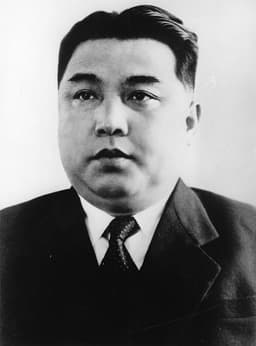
Kim Il-sung
Politician · Modern
64.0Total

Marine Le Pen
Politician · Modern
53.0Total
Basic Information
Born
1912
1968
Died
1994
—
Era
Modern
Modern
Nationality
North Korea
France
Occupation
Politician
Politician
Civilization
Eastern
Western
Score Comparison
Military (10%)
43.3
50.0
Political (20%)
68.0
48.0
Influence (20%)
65.0
57.2
Legacy (20%)
70.0
45.0
Leadership (15%)
80.0
74.0
Strategy (15%)
36.8
41.8
TOTAL
64.0
53.0
Kim Il-sung — Complete Timeline
1948 AD
Establishment of the Democratic People's Republic of KoreaPolitical Action
Kim Il-sung proclaimed the Democratic People's Republic of Korea (North Korea) with Soviet backing, becoming its first Premier. This established a communist state in the northern half of the Korean Peninsula, separate from the US-backed South.
FoundingNorth KoreaCold War
Impact: regional
1950 AD
Start of the Korean WarWar
Kim Il-sung ordered the North Korean invasion of South Korea, initiating the Korean War. The war resulted in millions of casualties and ended in a stalemate with the 1953 armistice, leaving Korea divided.
WarInvasionKorean War
Impact: globaldestructive
1955 AD
Adoption of the Juche IdeologyCultural◆ Major
Kim Il-sung formally introduced Juche, a self-reliance ideology, as the guiding principle of North Korea. Juche emphasized political independence, economic self-sufficiency, and military autonomy, shaping the country's isolationist policies.
IdeologyJucheSelf-Reliance
Impact: national
1960 AD
Consolidation of the Kim Il-sung Cult of PersonalityPolitical Action◆ Major
Kim Il-sung established an extensive cult of personality, portraying himself as the 'Great Leader' and founder of the Juche ideology. This included rewriting history, erecting statues, and mandating loyalty oaths, creating a totalitarian state.
Cult of PersonalityJucheTotalitarianism
Impact: nationaldestructive
1994 AD
Death and Designation as Eternal PresidentPolitical Action◆ Major
Kim Il-sung died of a heart attack, and the North Korean constitution was amended to designate him 'Eternal President'. His son Kim Jong-il succeeded him, continuing the dynastic rule of the Kim family.
DeathSuccessionEternal President
Impact: national
Marine Le Pen — Complete Timeline
2011 AD
Took leadership of the National FrontPolitical Action◆ Major
Marine Le Pen was elected president of the National Front (later renamed National Rally), succeeding her father Jean-Marie Le Pen. She began a process of de-demonization to broaden the party's appeal.
Party LeadershipDe-demonization
Impact: nationalconstructive
2017 AD
First-round presidential election result (2017)Political Action◆ Major
Le Pen finished second in the first round of the 2017 presidential election with 21.3% of the vote, qualifying for the runoff. She lost the runoff to Emmanuel Macron with 33.9%.
ElectionRunoff Defeat
Impact: national
2022 AD
First-round presidential election result (2022)Political Action◆ Major
Le Pen again finished second in the first round of the 2022 presidential election with 23.15% of the vote. She lost the runoff to Emmanuel Macron with 41.5%, her best-ever result.
ElectionRunoff Defeat
Impact: national
Expert Analysis
Origins
Kim Il-sung was born on April 15, 1912, in Mangyongdae, near Pyongyang, into a peasant family with a history of anti-Japanese activism. His father, Kim Hyong-jik, was a schoolteacher and independence activist. Kim Il-sung attended school in Manchuria and joined the Communist Party of Korea in 1931. His early guerrilla activities against Japanese occupation, including the Battle of Pochonbo in 1937, shaped his militant nationalism.
Marine Le Pen was born on August 5, 1968, in Neuilly-sur-Seine, France, the youngest daughter of Jean-Marie Le Pen, founder of the far-right National Front. She studied law at Panthéon-Assas University and became a lawyer. Her early political involvement began in 1986 when she joined the National Front, working her way up through party ranks. Her father's controversial statements, including Holocaust denial, defined her early challenges in distancing the party from extremism.
Rise to Power
Kim Il-sung rose to power through Soviet patronage. During World War II, he led a Korean guerrilla unit with the Soviet Red Army, and after Japan's surrender in 1945, he returned to Korea. With Soviet backing, he became the head of the Provisional People's Committee in 1946, and in 1948, he proclaimed the Democratic People's Republic of Korea, becoming its first Premier. The turning point was the Korean War (1950-1953), which he initiated with Soviet and Chinese support, but ended in a stalemate. After the war, he purged rival factions within the Korean Workers' Party, including the Yan'an faction and the Soviet faction, consolidating absolute power by the late 1950s.
Marine Le Pen rose through family inheritance and strategic rebranding. She became president of the National Front in 2011, succeeding her father. Her key turning point was the 2017 presidential election, where she finished second in the first round with 21.3% and advanced to the runoff against Emmanuel Macron, securing 33.9% in the second round. In 2022, she improved to 23.15% in the first round and 41.5% in the runoff. Her rise was marked by 'de-demonization'—expelling her father from the party in 2015 and renaming it National Rally in 2018 to shed extremist associations.
Leadership & Governance
Kim Il-sung's leadership was absolute and totalitarian. He governed through the Juche ideology, emphasizing self-reliance, militarism, and a cult of personality. He implemented centralized economic planning, collectivized agriculture, and prioritized heavy industry and military. His governance involved systematic repression, with a vast security apparatus, concentration camps (kwanliso), and strict control over information. He scored 80.0 in leadership, reflecting his unchallenged authority, but only 43.3 in military, due to the stalemate in the Korean War.
Marine Le Pen's leadership is democratic and populist. As head of the National Rally, she focuses on immigration, national sovereignty, and economic protectionism. She has moderated the party's image, dropping anti-Semitic rhetoric and supporting same-sex marriage, though maintaining hardline positions on Islam and the EU. Her political score of 48.0 reflects her limited success in gaining national power—she has never won a presidential election—but her influence score of 57.2 shows her impact on French politics, pushing the mainstream right towards her positions.
Triumph & Tragedy
Kim Il-sung's greatest triumph was founding a sovereign North Korean state that outlasted the Soviet Union, with a nuclear program developed by his successors. He also established a dynastic succession, passing power to his son Kim Jong-il. His greatest tragedy was the Korean War, which caused millions of deaths and devastated the peninsula, and the subsequent economic stagnation and famine (especially after his death) due to his failed economic policies. His legacy score of 70.0 reflects the enduring nature of his regime.
Marine Le Pen's triumph is transforming the National Front into a mainstream political force, achieving record vote shares in presidential elections and winning seats in the National Assembly. Her tragedy is that she has never won the presidency, losing both runoffs to Macron, and her party remains marginalized in coalition politics. Her legacy score of 45.0 is lower, as her long-term impact is uncertain.
Character & Destiny
Kim Il-sung was ruthless, paranoid, and megalomaniacal. He systematically eliminated rivals, including his own uncle and top party officials. His personality cult, with titles like 'Great Leader' and 'Sun of the Nation', was unprecedented. His character led to a hermit kingdom, isolated and impoverished. He died in 1994 of a heart attack, but his legacy of total control continued through his family.
Marine Le Pen is pragmatic, disciplined, and strategic. She has distanced herself from her father's extremism while maintaining core nationalist themes. Her character has allowed her to broaden the party's appeal but also limits her ability to break the glass ceiling of French politics. Her destiny remains unfulfilled, with potential for future success.
Legacy
Kim Il-sung's legacy is the totalitarian North Korean state, with its Juche ideology, nuclear weapons, and dynastic rule. He is officially the 'Eternal President' and his body is preserved in the Kumsusan Palace of the Sun. His influence extends to the global stage as a symbol of dictatorship. He scored 65.0 in influence and 70.0 in legacy.
Marine Le Pen's legacy is the normalization of far-right politics in France. She has influenced policy debates on immigration and national identity, but her long-term legacy depends on whether she or her party eventually gains power. Her total score of 53.0 lags behind Kim Il-sung's 64.0.
Conclusion
Kim Il-sung had a greater impact than Marine Le Pen. His total score of 64.0 exceeds her 53.0, and his legacy is more concrete: he created a nation and a dynasty that persists. Le Pen, while influential, has not achieved power and her changes are more superficial. Kim Il-sung's regime has caused immense suffering but also endured for decades, making him a historically significant figure.
Rankings
🥇
Kim Il-sungLeader
Mil: 43.3Pol: 68.0Inf: 65.0
64.0
🥈
Marine Le Pen
Mil: 50.0Pol: 48.0Inf: 57.2
53.0
+11.0 behind
How This Comparison Works
Algorithm
Each figure is scored on 6 dimensions (0—100 scale) based on structured historical data: Military (10%), Political (20%), Influence (20%), Legacy (20%), Leadership (15%), Strategy (15%). The weighted total produces the final ranking.
Data Sources
Scores are computed from structured sub-indicators in the database. Scale factors adjust for era (Ancient ×0.85, Modern ×1.0) and civilization size (Eastern ×1.05, Other ×0.80) to account for differences in population and military scale.
Maximum 3 Figures
Comparisons are limited to 2—3 figures to ensure readability and statistical meaningfulness.
Error Margins
±5 points per dimension — Sub-scores are derived from historical records with inherent uncertainty. Two figures within 5 points on a dimension should be considered roughly equivalent in that area.
Total Score Accuracy
±3 points overall — The weighted combination of 6 dimensions produces a total score with approximately ±3 points of uncertainty. Differences of less than 3 points are not statistically significant— the figures are effectively tied.
Known Limitations
- Historical records are incomplete and uneven across civilizations
- Figures from oral-tradition societies may be underrepresented
- Occupation labels can misclassify multi-role figures
- Scores measure capability and impact, not moral character
- Quantitative scoring is a comparison tool, not absolute truth
Capability Radar
Military (10%) — Battles & Warfare
Battles
15
28
Win Rate
10
29
Expansion
10
37
Political (20%) — Governance & Reform
Reform
70
40
Diplomacy
30
45
Economy
20
35
Influence (20%) — Cultural & Global Reach
Cultural
60
45
Global
60
40
Legacy (20%) — Historical Impact
Historical
70
40
Longevity
80
30
Leadership (15%) — Power & Stability
Tenure
95
55
Stability
40
30
Strategy (15%) — Tactics & Innovation
Strategy
25
37
Tactics
20
41
Reform
30
42
Similar Comparisons
Comments & Discussion
No comments yet. Be the first to share your thoughts!