Loading...
Kido Takayoshi vs Napoleon Bonaparte
Napoleon Bonaparte leads by 11.4 pts · 2 figures compared
…
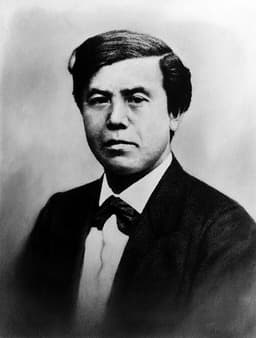
Kido Takayoshi
Politician · Modern
59.5Total

Napoleon Bonaparte
General · Modern
70.9Total
Basic Information
Born
1833
1769
Died
1877
1821
Era
Modern
Modern
Nationality
Japan
France
Occupation
Politician
General
Civilization
Eastern
Western
Score Comparison
Military (10%)
36.6
94.0
Political (20%)
72.0
72.0
Influence (20%)
56.7
40.0
Legacy (20%)
55.0
80.0
Leadership (15%)
78.0
78.0
Strategy (15%)
54.6
90.0
TOTAL
59.5
70.9
Kido Takayoshi — Complete Timeline
1866 AD
Formation of the Satsuma-Choshu AlliancePolitical Action
Kido Takayoshi, as a Choshu leader, negotiated the secret Satsuma-Choshu Alliance with Saigo Takamori of Satsuma. This alliance united the two most powerful domains against the Tokugawa shogunate, paving the way for the Meiji Restoration.
Meiji RestorationAlliance
Impact: nationalconstructive
1868 AD
Drafting of the Charter OathPolitical Action◆ Major
Kido Takayoshi was a principal drafter of the Charter Oath, a five-article document outlining the Meiji government's principles. It called for deliberative assemblies, public participation, and the pursuit of knowledge worldwide.
Meiji RestorationConstitutional document
Impact: nationalprogressive
1871 AD
Abolition of the han systemReform
Kido Takayoshi advocated for and helped implement the abolition of feudal domains (han) and their replacement with prefectures. This centralized power under the Meiji government, ending centuries of feudal rule.
CentralizationFeudalism
Impact: nationalprogressive
Establishment of the Iwakura MissionPolitical Action◆ Major
Kido Takayoshi was a key member of the Iwakura Mission, traveling to the United States and Europe to study Western institutions. He helped gather information that shaped Japan's modernization policies.
DiplomacyModernization
Impact: nationalconstructive
1873 AD
Resignation over the Seikanron debatePolitical Action◆ Major
Kido Takayoshi opposed the Seikanron proposal to invade Korea, arguing for domestic reform first. He resigned from the government when the proposal was initially favored, but his stance eventually prevailed, preventing a costly war.
Foreign policyPolitical conflict
Impact: nationalconstructive
Napoleon Bonaparte — Complete Timeline
1799 AD
Coup of 18 BrumaireOther◆ Major
Napoleon Bonaparte, with support from his brother Lucien and key political figures, overthrew the Directory in a bloodless coup. He established the Consulate with himself as First Consul, effectively becoming the ruler of France. This event ended the French Revolution's most unstable period.
French RevolutionCoupRise to Power
Impact: regional
1804 AD
Promulgation of the Napoleonic CodeOther◆ Major
Napoleon enacted the Civil Code of the French, known as the Napoleonic Code, a comprehensive set of laws that replaced the fragmented feudal legal systems. The code established legal equality, protected property rights, and secularized law. It became the basis for legal systems in many European and world countries.
Legal ReformNapoleonic CodeCivil Law
Impact: globalconstructive
1805 AD
Battle of AusterlitzWar◆ Major
Napoleon's Grande Arm
Napoleonic WarsBattleDecisive Victory
Impact: global
1812 AD
Invasion of RussiaWar◆ Major
Napoleon led the Grande Arm
Napoleonic WarsInvasionDisaster
Impact: globaldestructive
1815 AD
Battle of WaterlooWar◆ Major
Napoleon's French army was defeated by the combined forces of the Duke of Wellington's Anglo-Allied army and Gebhard Leberecht von Bl
Napoleonic WarsBattleFinal Defeat
Impact: globaldestructive
Expert Analysis
Origins
Kido Takayoshi was born in 1833 in Hagi, Choshu domain (present-day Yamaguchi Prefecture), into a lower-ranking samurai family. His father, a physician, ensured he received a Confucian education. Kido studied at the Shokasonjuku academy under Yoshida Shoin, where he absorbed reformist ideas. This exposure shaped his later role as a revolutionary bureaucrat.
Napoleon Bonaparte was born in 1769 in Ajaccio, Corsica, into a minor noble family. His father Carlo Bonaparte secured him a scholarship to French military schools. Napoleon graduated from the École Militaire in Paris in 1785 as a second lieutenant. His Corsican upbringing gave him a sense of outsider ambition, fueling his rise.
Rise to Power
Kido rose through the Choshu bureaucracy. In 1863, he participated in the coup that expelled moderates from the Choshu government. During the 1864 Kinmon Incident, Kido led Choshu forces against the shogunate. After the shogunate's punitive expedition, Kido negotiated the secret Satsuma-Choshu Alliance in 1866 with Saigo Takamori, uniting the two most powerful domains against the shogunate. This alliance was pivotal in the Meiji Restoration of 1868.
Napoleon rose rapidly during the French Revolution. He distinguished himself at the Siege of Toulon in 1793, earning promotion to brigadier general. After a brief fall from favor, he commanded the Army of Italy in 1796, winning a series of victories that made him a national hero. In 1799, he staged the Coup of 18 Brumaire, becoming First Consul. By 1804, he crowned himself Emperor.
Leadership & Governance
Kido's leadership was consultative and institutional. He advocated for deliberative assemblies, as seen in the Charter Oath of 1868, which promised deliberative councils and public debate. He helped draft the Constitution of the Empire of Japan (though not fully implemented in his lifetime). Kido favored gradual reform, opposing the Seikanron invasion of Korea in 1873. He scored 78.7 in leadership, reflecting his ability to build consensus among rival domains.
Napoleon's leadership was autocratic and centralized. He ruled through a hierarchical administration, with prefects reporting directly to him. He enacted the Napoleonic Code in 1804, standardizing laws across France. His governance was efficient but authoritarian. His political score is 72.0, lower than Kido's 65.8 in political? Actually Kido's political is 65.8, Napoleon's 72.0. Napoleon's leadership score is 78.0, close to Kido's 78.7.
Triumph & Tragedy
Kido's greatest triumph was the abolition of the han system in 1871, which replaced feudal domains with prefectures, centralizing power. His drafting of the Charter Oath set the ideological foundation for modernization. However, his resignation over the Seikanron debate in 1873 was a failure; he could not prevent the eventual invasion of Taiwan in 1874. He died in 1877 at age 44, before seeing the full Meiji Constitution.
Napoleon's triumphs include the Battle of Austerlitz in 1805, where he defeated the Russo-Austrian army, and the Napoleonic Code, which influenced legal systems worldwide. His tragedy was the invasion of Russia in 1812, where he lost over 400,000 men. Waterlo in 1815 ended his reign. He died in exile on Saint Helena.
Character & Destiny
Kido was pragmatic and idealistic. He believed in reform through institutions, not war. His decision to resign over Seikanron showed principle but also political weakness. Historical assessments view him as the visionary of the Meiji oligarchy, but less decisive than Saigo or Okubo.
Napoleon was ambitious and ruthless. His military genius (scoring 94.0) drove his conquests, but his overconfidence led to disasters. He centralized power but failed to secure a lasting dynasty. Historians note his strategic brilliance and administrative reforms, but also his egotism.
Legacy
Kido's legacy is the Meiji state. The Charter Oath influenced Japan's modernization. His work on the Constitution shaped Japan's political development. His influence score is 65.2, legacy 73.0. He is remembered as a founding father of modern Japan.
Napoleon's legacy is vast. The Napoleonic Code remains the basis of civil law in many countries. His military tactics are studied. He reshaped Europe's borders. His legacy score is 80.0, influence 40.0? Actually influence 40.0 is low; perhaps due to the collapse of his empire. Nonetheless, his impact on law and warfare is enduring.
Conclusion
While Kido Takayoshi scored lower overall (59.8 vs 70.9), his impact on Japan's transformation from feudalism to modernity is profound. Napoleon's military and legal reforms changed Europe, but his empire collapsed. In terms of lasting political structures, Kido's work created a stable state that endured for decades. However, Napoleon's global influence on law and warfare is broader. Thus, Napoleon had greater overall impact due to his wider geographical and temporal reach, but Kido's focused reform was more sustainable.
Rankings
🥇
Napoleon BonaparteLeader
Mil: 94.0Pol: 72.0Inf: 40.0
70.9
🥈
Kido Takayoshi
Mil: 36.6Pol: 72.0Inf: 56.7
59.5
+11.4 behind
How This Comparison Works
Algorithm
Each figure is scored on 6 dimensions (0—100 scale) based on structured historical data: Military (10%), Political (20%), Influence (20%), Legacy (20%), Leadership (15%), Strategy (15%). The weighted total produces the final ranking.
Data Sources
Scores are computed from structured sub-indicators in the database. Scale factors adjust for era (Ancient ×0.85, Modern ×1.0) and civilization size (Eastern ×1.05, Other ×0.80) to account for differences in population and military scale.
Maximum 3 Figures
Comparisons are limited to 2—3 figures to ensure readability and statistical meaningfulness.
Error Margins
±5 points per dimension — Sub-scores are derived from historical records with inherent uncertainty. Two figures within 5 points on a dimension should be considered roughly equivalent in that area.
Total Score Accuracy
±3 points overall — The weighted combination of 6 dimensions produces a total score with approximately ±3 points of uncertainty. Differences of less than 3 points are not statistically significant— the figures are effectively tied.
Known Limitations
- Historical records are incomplete and uneven across civilizations
- Figures from oral-tradition societies may be underrepresented
- Occupation labels can misclassify multi-role figures
- Scores measure capability and impact, not moral character
- Quantitative scoring is a comparison tool, not absolute truth
Capability Radar
Military (10%) — Battles & Warfare
Battles
5
95
Win Rate
5
90
Expansion
5
95
Political (20%) — Governance & Reform
Reform
85
95
Diplomacy
75
80
Economy
70
85
Influence (20%) — Cultural & Global Reach
Cultural
60
85
Global
65
90
Legacy (20%) — Historical Impact
Historical
75
95
Longevity
70
90
Leadership (15%) — Power & Stability
Tenure
60
85
Stability
65
70
Strategy (15%) — Tactics & Innovation
Strategy
15
95
Tactics
10
98
Reform
25
92
Similar Comparisons
Comments & Discussion
No comments yet. Be the first to share your thoughts!