Loading...
This comparison has not been analyzed yet.
One-time AI generation (~1 minute). Scores and timeline are already available below.
Kido Takayoshi vs Michel Debre
Kido Takayoshi leads by 3.3 pts · 2 figures compared
…
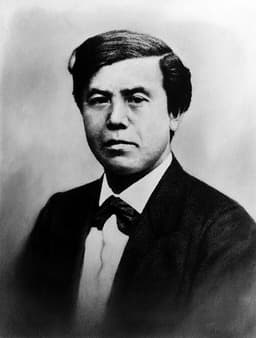
Kido Takayoshi
Politician · Modern
59.5Total

Michel Debre
Politician · Modern
56.2Total
Basic Information
Born
1833
1912
Died
1877
1996
Era
Modern
Modern
Nationality
Japan
France
Occupation
Politician
Politician
Civilization
Eastern
Western
Score Comparison
Military (10%)
36.6
50.0
Political (20%)
72.0
62.7
Influence (20%)
56.7
57.2
Legacy (20%)
55.0
50.0
Leadership (15%)
78.0
72.0
Strategy (15%)
54.6
41.5
TOTAL
59.5
56.2
Kido Takayoshi — Complete Timeline
1866 AD
Formation of the Satsuma-Choshu AlliancePolitical Action
Kido Takayoshi, as a Choshu leader, negotiated the secret Satsuma-Choshu Alliance with Saigo Takamori of Satsuma. This alliance united the two most powerful domains against the Tokugawa shogunate, paving the way for the Meiji Restoration.
Meiji RestorationAlliance
Impact: nationalconstructive
1868 AD
Drafting of the Charter OathPolitical Action◆ Major
Kido Takayoshi was a principal drafter of the Charter Oath, a five-article document outlining the Meiji government's principles. It called for deliberative assemblies, public participation, and the pursuit of knowledge worldwide.
Meiji RestorationConstitutional document
Impact: nationalprogressive
1871 AD
Abolition of the han systemReform
Kido Takayoshi advocated for and helped implement the abolition of feudal domains (han) and their replacement with prefectures. This centralized power under the Meiji government, ending centuries of feudal rule.
CentralizationFeudalism
Impact: nationalprogressive
Establishment of the Iwakura MissionPolitical Action◆ Major
Kido Takayoshi was a key member of the Iwakura Mission, traveling to the United States and Europe to study Western institutions. He helped gather information that shaped Japan's modernization policies.
DiplomacyModernization
Impact: nationalconstructive
1873 AD
Resignation over the Seikanron debatePolitical Action◆ Major
Kido Takayoshi opposed the Seikanron proposal to invade Korea, arguing for domestic reform first. He resigned from the government when the proposal was initially favored, but his stance eventually prevailed, preventing a costly war.
Foreign policyPolitical conflict
Impact: nationalconstructive
Michel Debre — Complete Timeline
1958 AD
Drafting of the Constitution of the Fifth RepublicPolitical Action◆ Major
As Minister of Justice, Debr
ConstitutionFifth RepublicPolitical Reform
Impact: nationalconstructive
1959 AD
Appointment as First Prime Minister of the Fifth RepublicPolitical Action
De Gaulle appointed Debr
Fifth RepublicGovernmentConstitution
Impact: nationalconstructive
1962 AD
Algerian War and the Evian AccordsPolitical Action◆ Major
As Prime Minister, Debr
Algerian WarEvian AccordsDecolonization
Impact: global
Resignation as Prime MinisterPolitical Action
Debré resigned as Prime Minister in April 1962 after de Gaulle's referendum on direct election of the president, which Debré opposed. He was replaced by Georges Pompidou. Debré later served as Minister of Economy and Finance and Foreign Minister, but his influence declined.
Fifth RepublicResignationGovernment
Impact: national
This comparison has not been analyzed yet.
One-time AI generation (~1 minute). Scores and timeline are already available below.
Rankings
🥇
Kido TakayoshiLeader
Mil: 36.6Pol: 72.0Inf: 56.7
59.5
🥈
Michel Debre
Mil: 50.0Pol: 62.7Inf: 57.2
56.2
+3.3 behind
How This Comparison Works
Algorithm
Each figure is scored on 6 dimensions (0—100 scale) based on structured historical data: Military (10%), Political (20%), Influence (20%), Legacy (20%), Leadership (15%), Strategy (15%). The weighted total produces the final ranking.
Data Sources
Scores are computed from structured sub-indicators in the database. Scale factors adjust for era (Ancient ×0.85, Modern ×1.0) and civilization size (Eastern ×1.05, Other ×0.80) to account for differences in population and military scale.
Maximum 3 Figures
Comparisons are limited to 2—3 figures to ensure readability and statistical meaningfulness.
Error Margins
±5 points per dimension — Sub-scores are derived from historical records with inherent uncertainty. Two figures within 5 points on a dimension should be considered roughly equivalent in that area.
Total Score Accuracy
±3 points overall — The weighted combination of 6 dimensions produces a total score with approximately ±3 points of uncertainty. Differences of less than 3 points are not statistically significant— the figures are effectively tied.
Known Limitations
- Historical records are incomplete and uneven across civilizations
- Figures from oral-tradition societies may be underrepresented
- Occupation labels can misclassify multi-role figures
- Scores measure capability and impact, not moral character
- Quantitative scoring is a comparison tool, not absolute truth
Capability Radar
Military (10%) — Battles & Warfare
Battles
5
30
Win Rate
5
30
Expansion
5
33
Political (20%) — Governance & Reform
Reform
85
75
Diplomacy
75
70
Economy
70
60
Influence (20%) — Cultural & Global Reach
Cultural
60
40
Global
65
45
Legacy (20%) — Historical Impact
Historical
75
55
Longevity
70
50
Leadership (15%) — Power & Stability
Tenure
60
65
Stability
65
65
Strategy (15%) — Tactics & Innovation
Strategy
15
36
Tactics
10
40
Reform
25
44
Similar Comparisons
Comments & Discussion
No comments yet. Be the first to share your thoughts!