Loading...
Kido Takayoshi vs Ruud Lubbers
Kido Takayoshi leads by 1.8 pts · 2 figures compared
…
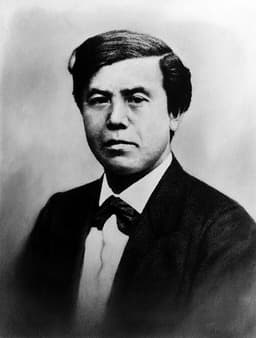
Kido Takayoshi
Politician · Modern
59.5Total

Ruud Lubbers
Politician · Modern
57.7Total
Basic Information
Born
1833
1939
Died
1877
—
Era
Modern
Modern
Nationality
Japan
Netherlands
Occupation
Politician
Politician
Civilization
Eastern
Western
Score Comparison
Military (10%)
36.6
50.0
Political (20%)
72.0
59.6
Influence (20%)
56.7
60.0
Legacy (20%)
55.0
50.0
Leadership (15%)
78.0
81.0
Strategy (15%)
54.6
41.4
TOTAL
59.5
57.7
Kido Takayoshi — Complete Timeline
1866 AD
Formation of the Satsuma-Choshu AlliancePolitical Action
Kido Takayoshi, as a Choshu leader, negotiated the secret Satsuma-Choshu Alliance with Saigo Takamori of Satsuma. This alliance united the two most powerful domains against the Tokugawa shogunate, paving the way for the Meiji Restoration.
Meiji RestorationAlliance
Impact: nationalconstructive
1868 AD
Drafting of the Charter OathPolitical Action◆ Major
Kido Takayoshi was a principal drafter of the Charter Oath, a five-article document outlining the Meiji government's principles. It called for deliberative assemblies, public participation, and the pursuit of knowledge worldwide.
Meiji RestorationConstitutional document
Impact: nationalprogressive
1871 AD
Abolition of the han systemReform
Kido Takayoshi advocated for and helped implement the abolition of feudal domains (han) and their replacement with prefectures. This centralized power under the Meiji government, ending centuries of feudal rule.
CentralizationFeudalism
Impact: nationalprogressive
Establishment of the Iwakura MissionPolitical Action◆ Major
Kido Takayoshi was a key member of the Iwakura Mission, traveling to the United States and Europe to study Western institutions. He helped gather information that shaped Japan's modernization policies.
DiplomacyModernization
Impact: nationalconstructive
1873 AD
Resignation over the Seikanron debatePolitical Action◆ Major
Kido Takayoshi opposed the Seikanron proposal to invade Korea, arguing for domestic reform first. He resigned from the government when the proposal was initially favored, but his stance eventually prevailed, preventing a costly war.
Foreign policyPolitical conflict
Impact: nationalconstructive
Ruud Lubbers — Complete Timeline
1982 AD
Implemented the 'No Nonsense' economic reformsReform◆ Major
Lubbers introduced austerity measures, cutting social benefits, reducing public sector wages, and deregulating the economy. These 'No Nonsense' policies aimed to combat stagflation and high unemployment. They reduced the budget deficit but also increased social inequality and labor market flexibility.
Economic ReformAusterityDeregulation
Impact: nationalconstructive
Became Prime Minister of the NetherlandsPolitical Action◆ Major
Lubbers became prime minister at age 43, leading a coalition of CDA and VVD. He was the youngest Dutch prime minister since World War II. His first term focused on economic recovery, cutting public spending, and reducing the budget deficit.
GovernmentLeadershipEconomic Policy
Impact: nationalconstructive
1985 AD
Presided over the placement of cruise missilesPolitical Action◆ Major
Lubbers' government agreed to the deployment of 48 US cruise missiles on Dutch soil as part of NATO's dual-track decision. This was highly controversial, sparking massive peace protests. The decision was later reversed after the INF Treaty with the Soviet Union.
NATOCold WarNuclear Weapons
Impact: regional
1994 AD
Resigned as Prime MinisterPolitical Action◆ Major
Lubbers resigned after the 1994 election, in which his CDA lost 20 seats, its worst result ever. He had served three consecutive terms (1982-1994), making him the longest-serving Dutch prime minister. His resignation marked the end of Christian Democratic dominance.
ResignationElection LossEnd of Era
Impact: national
2004 AD
Failed UN High Commissioner for Refugees candidacyPolitical Action
Lubbers resigned as UN High Commissioner for Refugees after an internal investigation found he had sexually harassed a female staff member. He denied the allegations but stepped down to avoid damaging the UN. This ended his international career on a negative note.
ScandalUNResignation
Impact: globaldestructive
Expert Analysis
Origins
**Kido Takayoshi** (1833-1877) was born into a samurai family in the Choshu domain (modern Yamaguchi Prefecture). As a child, he was adopted into the Kido family and received a Confucian education at the Shoka Sonjuku academy, where he was influenced by Yoshida Shoin's radical ideas. His early exposure to Western learning through Dutch studies (Rangaku) shaped his worldview. **Ruud Lubbers** (1939-2018) was born in Rotterdam, Netherlands, into a Catholic family. His father was a businessman and politician. Lubbers studied economics at Erasmus University Rotterdam, earning a doctorate in 1962. He entered politics through the Catholic People's Party (KVP), later merging into the Christian Democratic Appeal (CDA).
Rise to Power
Kido rose to prominence as a key figure in the Meiji Restoration. In 1866, he negotiated the secret Satsuma-Choshu Alliance with Saigo Takamori, uniting the two most powerful domains against the Tokugawa shogunate. This alliance was pivotal in the 1868 Boshin War. After the restoration, Kido joined the new government as a councilor. He was instrumental in drafting the Charter Oath in 1868, a five-article document outlining the government's principles. Lubbers became Prime Minister in 1982 at age 43, the youngest since WWII. He led a coalition of CDA and VVD after the previous government collapsed. His rise was marked by his reputation as a pragmatic economist and his ability to navigate coalition politics.
Leadership & Governance
Kido advocated for centralized government and modernization. He pushed for the abolition of feudal domains (han) in 1871, replacing them with prefectures, which concentrated power in Tokyo. He also championed the Iwakura Mission (1871-1873), traveling to the US and Europe to study Western institutions. His political score of 72.0 reflects his role as a constitutional architect. However, his leadership score of 78.0 indicates his effectiveness in guiding reform. Lubbers, with a leadership score of 81.0, was known for his 'No Nonsense' economic reforms: austerity measures, cutting social benefits, and deregulation. He reduced the budget deficit from 10.3% of GDP in 1982 to 3.4% in 1990. His governance style was pragmatic, focusing on consensus and coalition management.
Triumph & Tragedy
Kido's greatest triumph was the creation of the Meiji constitutional framework. He was a principal drafter of the Charter Oath and helped establish a modern government. His tragedy was the Seikanron debate in 1873: he opposed invading Korea, arguing for domestic reform first, and resigned when the proposal was initially favored. He later returned but his influence waned. Lubbers' triumph was his economic turnaround of the Netherlands, which became known as the 'Dutch Miracle.' His tragedy was the cruise missile controversy: his government agreed to deploy 48 US cruise missiles, sparking massive protests. He also resigned as UN High Commissioner for Refugees after a sexual harassment allegation, damaging his legacy.
Character & Destiny
Kido was an intellectual and idealist, often clashing with more pragmatic leaders like Saigo Takamori. His decision to resign over Seikanron showed his commitment to his principles, but it also marginalized him. His character shaped his destiny as a reformer who compromised his position. Lubbers was a pragmatic, consensus-driven leader. His ability to build coalitions was key to his longevity. However, his later career was tarnished by the UN scandal, which highlighted a lack of accountability. Historical assessments note his economic successes but also his controversial decisions.
Legacy
Kido's legacy is as a founding father of modern Japan. The Charter Oath and the abolition of the han system set the stage for Japan's rapid modernization. His influence score of 56.7 reflects his foundational role. Lubbers' legacy is as the architect of the Dutch economic recovery. His reforms influenced later European austerity policies. However, his legacy is mixed due to the missile controversy and UN scandal. His total score of 57.7 is slightly lower than Kido's 59.5, reflecting a narrower impact.
Conclusion
Kido Takayoshi had a greater impact on history. His constitutional work shaped Japan's transformation from a feudal society to a modern state, affecting millions. Lubbers' reforms, while significant, were limited to the Netherlands and a specific era. Kido's political score of 72.0 and leadership of 78.0, combined with his role in the Meiji Restoration, outweigh Lubbers' 81.0 leadership but lower political score of 59.6. Kido's legacy endures in Japan's political system, while Lubbers' is more contested. Thus, Kido Takayoshi is the more impactful figure.
Rankings
🥇
Kido TakayoshiLeader
Mil: 36.6Pol: 72.0Inf: 56.7
59.5
🥈
Ruud Lubbers
Mil: 50.0Pol: 59.6Inf: 60.0
57.7
+1.8 behind
How This Comparison Works
Algorithm
Each figure is scored on 6 dimensions (0—100 scale) based on structured historical data: Military (10%), Political (20%), Influence (20%), Legacy (20%), Leadership (15%), Strategy (15%). The weighted total produces the final ranking.
Data Sources
Scores are computed from structured sub-indicators in the database. Scale factors adjust for era (Ancient ×0.85, Modern ×1.0) and civilization size (Eastern ×1.05, Other ×0.80) to account for differences in population and military scale.
Maximum 3 Figures
Comparisons are limited to 2—3 figures to ensure readability and statistical meaningfulness.
Error Margins
±5 points per dimension — Sub-scores are derived from historical records with inherent uncertainty. Two figures within 5 points on a dimension should be considered roughly equivalent in that area.
Total Score Accuracy
±3 points overall — The weighted combination of 6 dimensions produces a total score with approximately ±3 points of uncertainty. Differences of less than 3 points are not statistically significant— the figures are effectively tied.
Known Limitations
- Historical records are incomplete and uneven across civilizations
- Figures from oral-tradition societies may be underrepresented
- Occupation labels can misclassify multi-role figures
- Scores measure capability and impact, not moral character
- Quantitative scoring is a comparison tool, not absolute truth
Capability Radar
Military (10%) — Battles & Warfare
Battles
5
31
Win Rate
5
32
Expansion
5
32
Political (20%) — Governance & Reform
Reform
85
75
Diplomacy
75
80
Economy
70
78
Influence (20%) — Cultural & Global Reach
Cultural
60
45
Global
65
55
Legacy (20%) — Historical Impact
Historical
75
55
Longevity
70
50
Leadership (15%) — Power & Stability
Tenure
60
85
Stability
65
82
Strategy (15%) — Tactics & Innovation
Strategy
15
39
Tactics
10
39
Reform
25
42
Similar Comparisons
Comments & Discussion
No comments yet. Be the first to share your thoughts!