Loading...
Khosrow I Anushirvan vs Mentuhotep II
Khosrow I Anushirvan leads by 9.8 pts · 2 figures compared
…
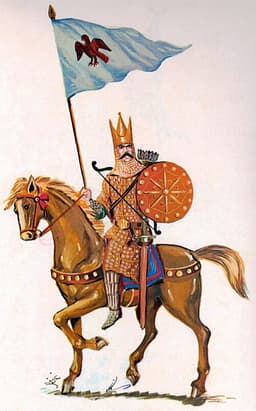
Khosrow I Anushirvan
Emperor · Ancient
68.2Total

Mentuhotep II
Emperor · Ancient
58.4Total
Basic Information
Born
-501
-2061
Died
—
-2010
Era
Ancient
Ancient
Nationality
Sasanian Empire
Egypt
Occupation
Emperor
Emperor
Civilization
Middle Eastern
Middle Eastern
Score Comparison
Military (10%)
72.0
76.0
Political (20%)
72.0
55.0
Influence (20%)
82.0
56.7
Legacy (20%)
40.0
40.0
Leadership (15%)
78.0
78.0
Strategy (15%)
80.0
66.3
TOTAL
68.2
58.4
Khosrow I Anushirvan — Complete Timeline
531 AD
Reign as the greatest Sasanian rulerPolitical Action
Khosrow I Anushirvan ascended the throne and began a reign that would be remembered as the golden age of the Sasanian Empire. He implemented sweeping reforms in administration, military, and taxation, earning the epithet 'the Just'.
ReignGolden AgeSasanian Empire
Impact: globalconstructive
532 AD
Peace treaty with the Byzantine Empire (Eternal Peace)Political Action◆ Major
Khosrow I negotiated the 'Eternal Peace' with the Byzantine Emperor Justinian I, ending the Iberian War. The treaty required the Sasanians to return occupied territories in exchange for a large gold payment, securing a temporary truce.
TreatyByzantine EmpireDiplomacy
Impact: global
540 AD
Invasion of Syria and sack of AntiochWar◆ Major
Taking advantage of Justinian's focus on the West, Khosrow I invaded Byzantine Syria. He captured and sacked the great city of Antioch, deporting its inhabitants to a new city near Ctesiphon, demonstrating Sasanian military power.
InvasionSack of AntiochByzantine-Sasanian Wars
Impact: regionaldestructive
Reforms of the army and tax systemReform◆ Major
Khosrow I reorganized the Sasanian military, creating a standing army of heavily armored cavalry (aswaran) and improving logistics. He also reformed the tax system, introducing a fixed land tax and a poll tax, which increased state revenue.
Military ReformTax ReformAdministration
Impact: nationalconstructive
541 AD
Foundation of the city of Weh Antiok KhosrowCultural
Khosrow I founded a new city near Ctesiphon, named Weh Antiok Khosrow ('Better than Antioch, Khosrow built this'), to house the deported population of Antioch. The city became a center for trade and culture.
City FoundationUrban PlanningDeportation
constructive
Mentuhotep II — Complete Timeline
2040 BC
Reunification of EgyptWar
Mentuhotep II, a Theban ruler, conquered the rival Heracleopolitan kingdom, reunifying Upper and Lower Egypt. This victory ended the First Intermediate Period and established the Middle Kingdom, with Mentuhotep II as its first pharaoh.
UnificationMiddle KingdomThebes
Impact: regionalconstructive
2030 BC
Construction of the Mortuary Temple at Deir el-BahriCultural◆ Major
Mentuhotep II built a terraced mortuary temple at Deir el-Bahri, blending rock-cut and free-standing architecture. The temple, with its colonnades and pyramid, became a model for later New Kingdom structures and symbolized his reunification.
TempleArchitectureDeir el-Bahri
Impact: regionalconstructive
Expert Analysis
Origins
Khosrow I Anushirvan (born c. 501 AD) was the son of Kavadh I, a Sasanian king who faced internal strife and external threats. Raised in the royal court, Khosrow received training in Zoroastrian theology, military tactics, and governance. His father's reign was marked by the Mazdakite uprising, a religious and social movement that challenged the nobility and clergy. This environment shaped Khosrow's later reforms aimed at centralizing power.
Mentuhotep II (born c. 2061 BC) was a Theban prince of the 11th Dynasty, ruling during the First Intermediate Period when Egypt was divided between the Heracleopolitan kingdom in the north and the Theban kingdom in the south. His lineage included Intef II and Intef III, who had already expanded Theban control. Mentuhotep's upbringing in a militarized Theban court prepared him for the campaign to reunify Egypt.
Rise to Power
Khosrow I ascended the throne in 531 AD after his father Kavadh I died. Kavadh had designated Khosrow as successor, bypassing his older brother Zamaspes, which led to a brief succession crisis. Khosrow quickly executed Zamaspes and other rivals, securing his position. He then negotiated the 'Eternal Peace' with Byzantine Emperor Justinian I in 532 AD, ending the Iberian War. This treaty required the Sasanians to return the fortress of Daras but provided a 5,000-pound gold payment. Khosrow used this peace to consolidate his reforms.
Mentuhotep II became king of Thebes around 2061 BC, inheriting a kingdom that controlled Upper Egypt as far north as the 10th nome. His early reign focused on consolidating Theban power and preparing for war against the Heracleopolitan kingdom. Around 2040 BC, he launched a campaign that culminated in the capture of Heracleopolis, reunifying Egypt. He adopted the title 'Uniter of the Two Lands' and established the Middle Kingdom.
Leadership & Governance
Khosrow I reorganized the Sasanian administration, creating four military districts (spahbeds) to defend the empire's borders. He reformed the tax system, replacing variable taxes with a fixed land tax based on crop yield and a poll tax on non-Zoroastrians. This increased revenue and reduced corruption. He also patronized scholarship, translating Greek and Indian texts into Middle Persian, including the works of Aristotle and the Panchatantra. His leadership score of 78.0 reflects his effective governance.
Mentuhotep II centralized power by appointing loyal nobles to key positions and reducing the influence of regional nomarchs. He launched military campaigns into Nubia and Libya to secure borders. His mortuary temple at Deir el-Bahri, with its terraced design and colonnades, influenced later architecture. However, his political score of 55.0 indicates limited institutional reforms compared to Khosrow.
Triumph & Tragedy
Khosrow I's greatest success was the reform of the army and tax system, creating a standing army of heavily armored cavalry (aswaran) that scored 72.0 in military effectiveness. He also invaded Syria in 540 AD, sacking Antioch and deporting its population to a new city, Weh Antiok Khosrow. However, his reign ended with a disastrous war against the Byzantine Empire under Justin II, leading to defeats and territorial losses. His legacy score of 40.0 reflects the temporary nature of his achievements.
Mentuhotep II's triumph was the reunification of Egypt, ending the First Intermediate Period and starting the Middle Kingdom. His military score of 76.0 reflects his successful campaigns. He also built a mortuary temple that symbolized his power. However, his political reforms were less enduring, and after his death, the 12th Dynasty eclipsed his 11th Dynasty. His legacy score of 40.0 mirrors Khosrow's.
Character & Destiny
Khosrow I was known as 'Anushirvan' (Immortal Soul) for his justice and learning. He was a pragmatic ruler, willing to make peace to enable reforms. His decision to invade Syria showed opportunism but also overreach. His character shaped his destiny: his reforms strengthened the empire but his later wars exhausted it.
Mentuhotep II was a determined unifier, personally leading campaigns. His adoption of the Horus name 'Netjerihedjet' (Divine of the White Crown) emphasized his divine right. His character drove him to complete reunification, but his centralized rule did not survive his death.
Legacy
Khosrow I's tax and military reforms influenced later Islamic caliphates, particularly the land tax system. His patronage of learning preserved Greek and Indian knowledge. However, his empire declined after his death, and his reforms did not prevent the eventual collapse.
Mentuhotep II's reunification established the Middle Kingdom, a period of stability and cultural flourishing. His mortuary temple inspired later constructions like Hatshepsut's temple. Yet his dynasty was short-lived, and his political system faded.
Conclusion
Khosrow I Anushirvan had greater impact due to his comprehensive reforms that shaped governance in the Middle East for centuries. His military score of 72.0 and political score of 72.0, combined with a total score of 68.2, surpass Mentuhotep II's 58.4. While Mentuhotep's reunification was a singular achievement, Khosrow's systemic changes left a more enduring legacy.
Rankings
🥇
Khosrow I AnushirvanLeader
Mil: 72.0Pol: 72.0Inf: 82.0
68.2
🥈
Mentuhotep II
Mil: 76.0Pol: 55.0Inf: 56.7
58.4
+9.8 behind
How This Comparison Works
Algorithm
Each figure is scored on 6 dimensions (0—100 scale) based on structured historical data: Military (10%), Political (20%), Influence (20%), Legacy (20%), Leadership (15%), Strategy (15%). The weighted total produces the final ranking.
Data Sources
Scores are computed from structured sub-indicators in the database. Scale factors adjust for era (Ancient ×0.85, Modern ×1.0) and civilization size (Eastern ×1.05, Other ×0.80) to account for differences in population and military scale.
Maximum 3 Figures
Comparisons are limited to 2—3 figures to ensure readability and statistical meaningfulness.
Error Margins
±5 points per dimension — Sub-scores are derived from historical records with inherent uncertainty. Two figures within 5 points on a dimension should be considered roughly equivalent in that area.
Total Score Accuracy
±3 points overall — The weighted combination of 6 dimensions produces a total score with approximately ±3 points of uncertainty. Differences of less than 3 points are not statistically significant— the figures are effectively tied.
Known Limitations
- Historical records are incomplete and uneven across civilizations
- Figures from oral-tradition societies may be underrepresented
- Occupation labels can misclassify multi-role figures
- Scores measure capability and impact, not moral character
- Quantitative scoring is a comparison tool, not absolute truth
Capability Radar
Military (10%) — Battles & Warfare
Battles
85
75
Win Rate
80
85
Expansion
75
70
Political (20%) — Governance & Reform
Reform
95
75
Diplomacy
85
70
Economy
95
70
Influence (20%) — Cultural & Global Reach
Cultural
85
75
Global
75
70
Legacy (20%) — Historical Impact
Historical
85
80
Longevity
80
85
Leadership (15%) — Power & Stability
Tenure
90
80
Stability
90
80
Strategy (15%) — Tactics & Innovation
Strategy
90
80
Tactics
85
70
Reform
95
65
Similar Comparisons
Comments & Discussion
No comments yet. Be the first to share your thoughts!