Loading...
Kharavela of Kalinga vs Philip II of Macedon
Philip II of Macedon leads by 17.8 pts · 2 figures compared
…

Kharavela of Kalinga
Emperor · Ancient
56.1Total
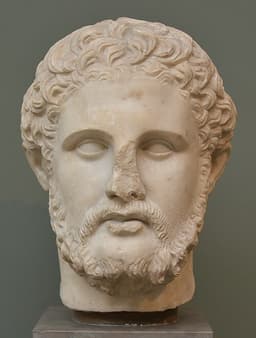
Philip II of Macedon
Emperor · Ancient
73.9Total
Basic Information
Born
-193
-382
Died
-155
-336
Era
Ancient
Ancient
Nationality
India
Macedon
Occupation
Emperor
Emperor
Civilization
Indian
Western
Score Comparison
Military (10%)
74.0
65.0
Political (20%)
45.0
76.0
Influence (20%)
57.2
75.0
Legacy (20%)
46.7
70.0
Leadership (15%)
66.0
78.0
Strategy (15%)
61.2
80.3
TOTAL
56.1
73.9
Kharavela of Kalinga — Complete Timeline
170 BC
Conquest of MagadhaWar◆ Major
Kharavela led a military campaign against Magadha, defeating the king and forcing him to pay tribute. He brought back treasures and statues of Jain Tirthankaras that had been taken by the Nandas, restoring them to Kalinga.
ConquestMagadhaJain Restoration
Impact: regional
165 BC
Expedition to the Pandya KingdomWar◆ Major
Kharavela led a military expedition to the Pandya kingdom in southern India. He defeated the Pandya king and extracted tribute, extending Kalinga's influence into the Tamil region for the first time.
ExpeditionPandyaSouth India
Impact: regional
160 BC
Construction of the Udayagiri CavesCultural◆ Major
Kharavela patronized the excavation of the Udayagiri and Khandagiri caves near Bhubaneswar. These caves served as Jain monastic retreats and feature inscriptions detailing his reign, including the famous Hathigumpha inscription.
CavesJain ArchitectureInscriptions
Impact: regionalconstructive
155 BC
Hathigumpha InscriptionCultural◆ Major
Kharavela commissioned the Hathigumpha inscription in the Udayagiri caves. This 17-line inscription in Prakrit details his life, military campaigns, and public works, providing the primary historical source for his reign.
InscriptionHistorical RecordPrakrit
Impact: regional
Philip II of Macedon — Complete Timeline
359 BC
Reforms of the Macedonian ArmyReform◆ Major
Philip II reorganized the Macedonian army, introducing the sarissa (long pike) and the phalanx formation. He also improved cavalry tactics and logistics, creating a professional, disciplined force that was superior to Greek hoplite armies.
MacedonMilitary ReformPhalanx
Impact: regionalconstructive
338 BC
Battle of ChaeroneaWar
Philip II led the Macedonian army to a decisive victory over the combined forces of Athens and Thebes at Chaeronea. The battle ended Greek independence and established Macedonian hegemony over Greece. Philip's son Alexander commanded the cavalry on the left wing.
MacedonGreeceBattle
Impact: regionaldestructive
337 BC
Formation of the League of CorinthPolitical Action◆ Major
Philip II established the League of Corinth, a federation of Greek states under Macedonian leadership. The league declared war on Persia and appointed Philip as its commander-in-chief, laying the groundwork for Alexander's later invasion.
MacedonGreeceAlliance
Impact: regionalconstructive
336 BC
Assassination at AegaePolitical Action◆ Major
Philip II was assassinated by his bodyguard Pausanias at the wedding of his daughter Cleopatra in Aegae. The motive remains unclear, but his death led to the immediate succession of his son Alexander the Great, who continued his plans for the Persian invasion.
MacedonAssassinationSuccession
Impact: regionaltragic
Expert Analysis
Origins
Kharavela (c. 2nd century BCE) was born into the Chedi dynasty of Kalinga (modern Odisha, India). Little is known of his early life, but he likely received training in statecraft and military arts. He rose to become the third king of the Mahameghavahana dynasty, ruling from around 170 BCE. Kharavela's reign is documented primarily through the Hathigumpha inscription, a 17-line Prakrit text carved in the Udayagiri caves.
Philip II (382–336 BCE) was born in Pella, Macedon, the youngest son of King Amyntas III. He spent his youth as a hostage in Thebes (368–365 BCE), where he studied military tactics under Epaminondas. This experience profoundly shaped his later reforms. Philip became king in 359 BCE after his brother Perdiccas III died in battle against the Illyrians.
Rise to Power
Kharavela ascended the throne of Kalinga at age 24, possibly after a regency. His rise was marked by aggressive expansion. Within his first year, he repaired the city gates and walls of his capital. By his second year, he launched campaigns against the Satavahanas in the west. His major conquest came in his eighth year when he defeated the king of Magadha, forcing him to pay tribute and returning Jain statues taken earlier. He also led expeditions to the Pandya kingdom in the south, extracting tribute.
Philip II inherited a weakened kingdom plagued by internal strife and external threats. He quickly consolidated power by defeating the Illyrians and Paeonians in 358–357 BCE. He then turned to the Greek city-states, using diplomacy and military force. His key turning point was the Battle of Chaeronea in 338 BCE, where he decisively defeated the combined forces of Athens and Thebes, ending Greek independence. He then formed the League of Corinth in 337 BCE, uniting Greece under Macedonian hegemony and preparing for a campaign against Persia.
Leadership & Governance
Kharavela's leadership style was expansionist and religiously patronizing. As a Jain, he supported Jain monasticism, funding the excavation of the Udayagiri and Khandagiri caves. His governance focused on infrastructure: he repaired the capital, built canals, and maintained a strong military. He also convened a council of Jain monks, reflecting his religious devotion. However, his political score of 45.0 suggests limited institutional reforms; his empire likely relied on personal authority and tribute.
Philip II was a transformative leader in governance and military organization. He reformed the Macedonian army, introducing the sarissa (a 5–6 meter pike) and the phalanx formation, which gave his infantry a decisive advantage. He also integrated cavalry with infantry, creating combined arms tactics. Politically, he used marriage alliances, bribery, and conquest to unify Greece. His League of Corinth was a sophisticated federal system that allowed Greek states autonomy while ensuring Macedonian control. His political score of 76.0 reflects these achievements.
Triumph & Tragedy
Kharavela's greatest successes include his conquest of Magadha and his southern expedition, which expanded Kalinga's influence across eastern and central India. He also promoted Jainism through cave construction, leaving a lasting cultural legacy. However, his failures are less documented but likely include inability to create a lasting empire: after his death, Kalinga's power declined rapidly. There is no record of a stable succession or administrative system that outlasted him.
Philip II's triumph was the unification of Greece and the creation of a military machine that his son Alexander used to conquer Persia. His reforms were so effective that the Macedonian phalanx dominated battlefields for centuries. His tragedy was his assassination in 336 BCE at the wedding of his daughter Cleopatra, just as he was about to invade Persia. The murder, likely motivated by personal grievances or political intrigue, cut short his own campaign. Additionally, his marriage to Cleopatra Eurydice alienated his first wife Olympias and Alexander, causing dynastic strife.
Character & Destiny
Kharavela appears as a confident, ambitious ruler from the Hathigumpha inscription, which boasts of his victories and piety. He claimed to have recovered a Jain statue taken by a Nanda king, suggesting a focus on religious prestige. His character was likely pragmatic, but his lack of institutional legacy indicates he may have been more a conqueror than a builder. His destiny was to be a regional power who faded into obscurity compared to contemporaries like Ashoka.
Philip II was shrewd, patient, and ruthless. He learned from his Theban captivity to combine diplomacy with force. His character was marked by strategic thinking: he often avoided direct conflict until he had an advantage. His assassination reflects the volatile politics of his court, where personal vendettas and power struggles were common. His destiny was to lay the foundation for Alexander's empire, but he died before seeing it through.
Legacy
Kharavela's legacy is primarily cultural: the Udayagiri and Khandagiri caves remain important Jain sites, and the Hathigumpha inscription is a key source for ancient Indian history. However, his political and military impact was short-lived. Kalinga never again achieved such power, and his dynasty faded. His influence score of 57.2 reflects this limited reach.
Philip II's legacy is immense. He transformed Macedon from a peripheral kingdom into the dominant power in Greece. His military reforms shaped warfare for centuries, and the League of Corinth provided a model for federal governance. His son Alexander's conquests were built directly on Philip's foundations. Philip's political and strategic scores (76.0 and 80.3) highlight his enduring influence. He is remembered as one of history's great administrators and military innovators.
Conclusion
While Kharavela achieved notable regional conquests and promoted Jain culture, Philip II's impact was far greater in scale and duration. Philip unified Greece, reformed the army, and set the stage for the Hellenistic world. His total score of 73.9 versus Kharavela's 56.1 reflects this disparity. In military terms, Philip's innovations had global repercussions, while Kharavela's campaigns were limited to eastern India. In governance, Philip created durable institutions, whereas Kharavela left no lasting political structure. Therefore, Philip II of Macedon had a significantly greater impact on world history.
Rankings
🥇
Philip II of MacedonLeader
Mil: 65.0Pol: 76.0Inf: 75.0
73.9
🥈
Kharavela of Kalinga
Mil: 74.0Pol: 45.0Inf: 57.2
56.1
+17.8 behind
How This Comparison Works
Algorithm
Each figure is scored on 6 dimensions (0—100 scale) based on structured historical data: Military (10%), Political (20%), Influence (20%), Legacy (20%), Leadership (15%), Strategy (15%). The weighted total produces the final ranking.
Data Sources
Scores are computed from structured sub-indicators in the database. Scale factors adjust for era (Ancient ×0.85, Modern ×1.0) and civilization size (Eastern ×1.05, Other ×0.80) to account for differences in population and military scale.
Maximum 3 Figures
Comparisons are limited to 2—3 figures to ensure readability and statistical meaningfulness.
Error Margins
±5 points per dimension — Sub-scores are derived from historical records with inherent uncertainty. Two figures within 5 points on a dimension should be considered roughly equivalent in that area.
Total Score Accuracy
±3 points overall — The weighted combination of 6 dimensions produces a total score with approximately ±3 points of uncertainty. Differences of less than 3 points are not statistically significant— the figures are effectively tied.
Known Limitations
- Historical records are incomplete and uneven across civilizations
- Figures from oral-tradition societies may be underrepresented
- Occupation labels can misclassify multi-role figures
- Scores measure capability and impact, not moral character
- Quantitative scoring is a comparison tool, not absolute truth
Capability Radar
Military (10%) — Battles & Warfare
Battles
75
85
Win Rate
80
90
Expansion
80
85
Political (20%) — Governance & Reform
Reform
65
90
Diplomacy
60
92
Economy
70
80
Influence (20%) — Cultural & Global Reach
Cultural
55
80
Global
30
80
Legacy (20%) — Historical Impact
Historical
50
85
Longevity
40
85
Leadership (15%) — Power & Stability
Tenure
70
75
Stability
65
70
Strategy (15%) — Tactics & Innovation
Strategy
75
92
Tactics
70
88
Reform
60
95
Similar Comparisons
Comments & Discussion
No comments yet. Be the first to share your thoughts!