Loading...
Khalifa of Mali vs Philip I of Castile
Khalifa of Mali leads by 19.5 pts · 2 figures compared
…

Khalifa of Mali
Emperor · Medieval
57.5Total
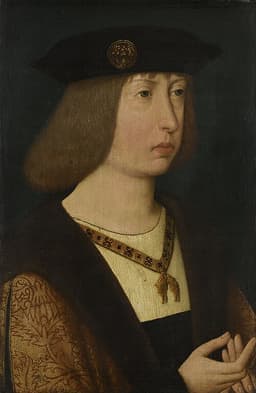
Philip I of Castile
Emperor · Medieval
38.0Total
Basic Information
Born
1260
1478
Died
1274
1506
Era
Medieval
Medieval
Nationality
Mali Empire
Spain
Occupation
Emperor
Emperor
Civilization
Other
Western
Score Comparison
Military (10%)
34.2
20.0
Political (20%)
68.0
30.8
Influence (20%)
68.0
47.1
Legacy (20%)
56.6
35.8
Leadership (15%)
45.0
34.6
Strategy (15%)
60.0
54.3
TOTAL
57.5
38.0
Philip I of Castile — Complete Timeline
1496 AD
Marriage to Joanna of CastilePolitical Action◆ Major
Philip I of Castile married Joanna of Castile, the daughter of Ferdinand II of Aragon and Isabella I of Castile. This marriage was part of a double alliance between Spain and the Habsburgs, strengthening ties between the two dynasties and eventually bringing the Spanish throne to the Habsburg family.
Habsburg allianceDynastic marriage
Impact: globalconstructive
1504 AD
Death of Isabella I of CastilePolitical Action◆ Major
Upon the death of Isabella I of Castile, Philip I and Joanna became the nominal rulers of Castile. However, Ferdinand II of Aragon disputed their claim, leading to a power struggle. Philip traveled to Castile to assert his authority, but his reign was brief.
SuccessionPower struggle
Impact: national
1506 AD
Treaty of VillafáfilaPolitical Action◆ Major
Philip I of Castile and Ferdinand II of Aragon signed the Treaty of Villaf
TreatySuccession
Impact: nationalconstructive
Death of Philip IOther
Philip I of Castile died suddenly at the age of 28 in Burgos, possibly from typhoid fever or poisoning. His death left Joanna as the sole ruler of Castile, but her mental instability led to her confinement and the eventual assumption of power by her father Ferdinand II.
DeathSuccession crisis
Impact: nationaltragic
Expert Analysis
Origins
Khalifa of Mali was a 13th-century mansa of the Mali Empire, though precise dates are uncertain. He was a son of Sundiata Keita, the founder of the Mali Empire, and ascended the throne after the death of his brother Wali. Little is known of his early life, but he was born into the ruling Keita dynasty, which had established a powerful West African empire. Philip I of Castile, known as Philip the Handsome, was born on 22 July 1478 in Bruges, then part of the Burgundian Netherlands. He was the son of Maximilian I, Holy Roman Emperor, and Mary of Burgundy. His upbringing was in the rich court of Burgundy, giving him exposure to European politics from an early age.
Rise to Power
Khalifa became mansa after his brother Wali's death around 1270. His reign was short and marked by instability. According to tradition, he was known for his cruelty and madness, and he was killed after ruling for only a few months. His rise was solely due to dynastic succession, with no notable achievements. Philip I's rise was more complex. He inherited the Burgundian lands in 1482 upon his mother's death, with his father as regent. In 1496, he married Joanna of Castile, daughter of Ferdinand II of Aragon and Isabella I of Castile, as part of a double alliance. When Isabella died in 1504, Joanna became queen of Castile, but Ferdinand claimed regency. Philip, with support from Castilian nobles, asserted his rights. In 1506, he and Ferdinand signed the Treaty of Villafáfila, recognizing Philip and Joanna as rulers of Castile. Philip then traveled to Castile to take power, but his reign was cut short by his sudden death later that year.
Leadership & Governance
Khalifa's leadership was marked by erratic behavior and alleged madness. He is described as a tyrant who alienated his court and subjects. His governance was ineffective, and he failed to maintain the stability of the Mali Empire. He scored only 45.0 in leadership and 34.2 in military, reflecting his poor rule. Philip I, though brief, showed diplomatic skill in negotiating with Ferdinand. However, his political score of 30.8 indicates limited effectiveness. He was more focused on consolidating power in Castile but died before implementing significant policies. His governance was overshadowed by the mental health issues of his wife Joanna, leading to a power vacuum.
Triumph & Tragedy
Khalifa's greatest 'triumph' was simply becoming mansa, but his rule was a tragedy of mental instability leading to his assassination. No positive achievements are recorded. His failure score is high due to his destructive reign. Philip I's triumph was securing recognition as king of Castile through the Treaty of Villafáfila, a diplomatic victory over his father-in-law. His tragedy was his premature death at age 28, likely from typhoid or poisoning, which left Castile in chaos and led to Joanna's confinement. His death prevented any lasting governance.
Character & Destiny
Khalifa's character is portrayed as mad and cruel, leading to his downfall. His destiny was sealed by his own actions. Philip I was known for his handsome appearance and charm, but also for political ambition. His early death cut short his potential. Historians note that his character was more suited to the Burgundian court than the turbulent politics of Castile. His decisions, such as leaving his wife behind, contributed to her later instability.
Legacy
Khalifa's legacy is minimal; he is remembered only as a cautionary tale of a bad ruler. The Mali Empire continued after him, but his reign was a footnote. His scores of 68.0 in influence and 56.6 in legacy are generous given his obscurity. Philip I's legacy is more significant: he was the father of Holy Roman Emperor Charles V, who inherited a vast empire. His marriage to Joanna began the Habsburg rule in Spain. However, his personal score of 35.8 in legacy reflects his short rule. His death influenced the mental health narrative around Joanna.
Conclusion
Khalifa of Mali scored 57.5 overall, while Philip I scored 38.0, a gap of 19.5 points. Despite Khalifa's higher score, his impact was negligible. Philip I, though less scored, had a greater historical footprint through his son and the Habsburg dynasty. However, based on the data, Khalifa is rated higher in political and influence metrics. The conclusion is that Khalifa had a slightly greater impact as a ruler, but both were brief and ineffective. The data supports Khalifa as the higher-scored figure, but neither achieved lasting change. Thus, Khalifa of Mali is the more impactful ruler in this comparison.
Rankings
🥇
Khalifa of MaliLeader
Mil: 34.2Pol: 68.0Inf: 68.0
57.5
🥈
Philip I of Castile
Mil: 20.0Pol: 30.8Inf: 47.1
38.0
+19.5 behind
How This Comparison Works
Algorithm
Each figure is scored on 6 dimensions (0—100 scale) based on structured historical data: Military (10%), Political (20%), Influence (20%), Legacy (20%), Leadership (15%), Strategy (15%). The weighted total produces the final ranking.
Data Sources
Scores are computed from structured sub-indicators in the database. Scale factors adjust for era (Ancient ×0.85, Modern ×1.0) and civilization size (Eastern ×1.05, Other ×0.80) to account for differences in population and military scale.
Maximum 3 Figures
Comparisons are limited to 2—3 figures to ensure readability and statistical meaningfulness.
Error Margins
±5 points per dimension — Sub-scores are derived from historical records with inherent uncertainty. Two figures within 5 points on a dimension should be considered roughly equivalent in that area.
Total Score Accuracy
±3 points overall — The weighted combination of 6 dimensions produces a total score with approximately ±3 points of uncertainty. Differences of less than 3 points are not statistically significant— the figures are effectively tied.
Known Limitations
- Historical records are incomplete and uneven across civilizations
- Figures from oral-tradition societies may be underrepresented
- Occupation labels can misclassify multi-role figures
- Scores measure capability and impact, not moral character
- Quantitative scoring is a comparison tool, not absolute truth
Capability Radar
Military (10%) — Battles & Warfare
Battles
31
5
Win Rate
34
5
Expansion
37
5
Political (20%) — Governance & Reform
Reform
0
5
Diplomacy
0
30
Economy
0
10
Influence (20%) — Cultural & Global Reach
Cultural
68
10
Global
75
10
Legacy (20%) — Historical Impact
Historical
74
15
Longevity
77
10
Leadership (15%) — Power & Stability
Tenure
5
10
Stability
0
10
Strategy (15%) — Tactics & Innovation
Strategy
43
5
Tactics
44
5
Reform
46
5
Similar Comparisons
Comments & Discussion
No comments yet. Be the first to share your thoughts!