Loading...
Khadga Prasad Oli vs Napoleon Bonaparte
Napoleon Bonaparte leads by 16.8 pts · 2 figures compared
…
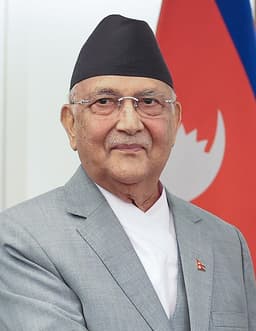
Khadga Prasad Oli
Politician · Modern
54.1Total

Napoleon Bonaparte
General · Modern
70.9Total
Basic Information
Born
1952
1769
Died
—
1821
Era
Modern
Modern
Nationality
Nepal
France
Occupation
Politician
General
Civilization
Indian
Western
Score Comparison
Military (10%)
36.4
94.0
Political (20%)
68.0
72.0
Influence (20%)
51.0
40.0
Legacy (20%)
41.7
80.0
Leadership (15%)
74.0
78.0
Strategy (15%)
60.0
90.0
TOTAL
54.1
70.9
Khadga Prasad Oli — Complete Timeline
2015 AD
Promulgation of 2015 ConstitutionReform◆ Major
Under Oli's premiership, Nepal adopted a new constitution that established the country as a federal democratic republic. The constitution was criticized by some ethnic groups for its provincial boundaries and citizenship provisions.
ConstitutionFederalismNepal
Impact: nationalconstructive
Election as Prime MinisterPolitical Action◆ Major
Khadga Prasad Oli was elected prime minister of Nepal by the parliament. His first term was marked by the promulgation of the new constitution in 2015 and a subsequent economic blockade along the India-Nepal border.
ElectionGovernmentNepal
Impact: national
2020 AD
Nationalist Stance on Border DisputesPolitical Action
Oli's government published a new political map showing disputed territories with India, including Kalapani and Lipulekh. This nationalist move escalated tensions with India and led to a diplomatic rift between the two countries.
Border DisputeNationalismDiplomacy
Impact: regional
Napoleon Bonaparte — Complete Timeline
1799 AD
Coup of 18 BrumaireOther◆ Major
Napoleon Bonaparte, with support from his brother Lucien and key political figures, overthrew the Directory in a bloodless coup. He established the Consulate with himself as First Consul, effectively becoming the ruler of France. This event ended the French Revolution's most unstable period.
French RevolutionCoupRise to Power
Impact: regional
1804 AD
Promulgation of the Napoleonic CodeOther◆ Major
Napoleon enacted the Civil Code of the French, known as the Napoleonic Code, a comprehensive set of laws that replaced the fragmented feudal legal systems. The code established legal equality, protected property rights, and secularized law. It became the basis for legal systems in many European and world countries.
Legal ReformNapoleonic CodeCivil Law
Impact: globalconstructive
1805 AD
Battle of AusterlitzWar◆ Major
Napoleon's Grande Arm
Napoleonic WarsBattleDecisive Victory
Impact: global
1812 AD
Invasion of RussiaWar◆ Major
Napoleon led the Grande Arm
Napoleonic WarsInvasionDisaster
Impact: globaldestructive
1815 AD
Battle of WaterlooWar◆ Major
Napoleon's French army was defeated by the combined forces of the Duke of Wellington's Anglo-Allied army and Gebhard Leberecht von Bl
Napoleonic WarsBattleFinal Defeat
Impact: globaldestructive
Expert Analysis
Origins
Khadga Prasad Oli was born on February 22, 1952, in Terhathum District, Nepal, into a lower-middle-class Brahmin family. His father, Mohan Prasad Oli, was a farmer. Oli's early life was marked by poverty, and he became involved in politics as a teenager, joining the Communist Party of Nepal. He was imprisoned for 14 years during the Panchayat regime for his political activities, using that time to study law and political theory.
Napoleon Bonaparte was born on August 15, 1769, in Ajaccio, Corsica, into a minor noble family. His father, Carlo Buonaparte, was a lawyer who secured a scholarship for Napoleon to attend a military academy in mainland France. Napoleon graduated from the École Militaire in Paris in 1785, becoming a second lieutenant in the artillery. His Corsican origins and modest nobility shaped his outsider status and ambition.
Rise to Power
Oli's rise came within the Communist Party of Nepal (Unified Marxist–Leninist). He became a central committee member in the 1990s and served as Deputy Prime Minister in 2006-2007. In 2014, he was elected Prime Minister by parliament, a position he first held from October 2014 to August 2016. His election followed the 2013 Constituent Assembly elections, where his party won the most seats. Key turning points included his leadership during the 2015 earthquake and the promulgation of the constitution that year.
Napoleon's rise was meteoric during the French Revolution. He gained fame for his role in the Siege of Toulon in 1793, where he led artillery to recapture the city from royalists. In 1795, he saved the Directory from a royalist uprising, becoming commander of the Army of the Interior. In 1796, he married Joséphine de Beauharnais and took command of the Italian campaign, winning a series of battles against Austria. In 1799, he staged the Coup of 18 Brumaire, overthrowing the Directory and establishing the Consulate, with himself as First Consul.
Leadership & Governance
Oli's leadership style is characterized by assertive nationalism and centralization of power. He pushed through the 2015 Constitution, which transformed Nepal into a federal democratic republic but faced criticism for marginalizing certain ethnic groups. He also adopted a hardline stance on border disputes with India, releasing a new map in 2020 that included Kalapani and Lipulekh. His governance score of 77.6 reflects his decisive but sometimes polarizing approach.
Napoleon's governance was transformative. He centralized the French state, reformed the legal system with the Napoleonic Code (1804), which influenced civil law globally. He established the Bank of France, improved education through lycées, and reorganized the administrative divisions. However, his rule became authoritarian, with censorship and a secret police. He crowned himself Emperor in 1804, blending revolutionary ideals with monarchy. His political score of 72.0 underscores his effective but autocratic methods.
Triumph & Tragedy
Oli's greatest success was the promulgation of the 2015 Constitution, which ended a decade-long political transition and established federalism. He also managed the post-earthquake reconstruction. His failures include economic stagnation, rising corruption, and the mishandling of the COVID-19 pandemic in 2020. His nationalist map policy strained relations with India, Nepal's largest trading partner, leading to economic difficulties.
Napoleon's triumphs include the Battle of Austerlitz (1805), where he crushed the Russian and Austrian armies, securing his dominance in Europe. He expanded French control across the continent, creating the Confederation of the Rhine and the Duchy of Warsaw. His Napoleonic Code remains a cornerstone of civil law. His tragedies are the disastrous Invasion of Russia (1812), where his Grande Armée of over 600,000 men was destroyed by winter and scorched-earth tactics. He was defeated at Waterloo (1815) and exiled to Saint Helena, where he died in 1821.
Character & Destiny
Oli is known for his stubbornness and rhetorical skill. He often makes provocative statements, such as claiming Nepal's territory beyond actual control. His character has led to internal party splits and a contentious relationship with India. Historians assess him as a shrewd politician but a divisive leader.
Napoleon was ambitious, brilliant, and ruthless. His military genius was matched by his administrative talent, but his hubris led to overreach. He once said, "Power is my mistress." His character drove him to conquer Europe, but also to his downfall. He is often compared to Alexander the Great in terms of ambition and tragedy.
Legacy
Oli's legacy is mixed. He is remembered as a nationalist leader who asserted Nepal's sovereignty, but his economic and governance failures limit his impact. His scores: military 52.2, influence 68.8, legacy 55.8. His long-term influence on Nepali politics is uncertain, as his party has since splintered.
Napoleon's legacy is immense. He reshaped European borders, spread nationalist ideas, and his legal reforms endure in many countries. His military tactics are studied in academies worldwide. He scored 94.0 in military, 80.0 in legacy, and 90.0 in strategy. He is a global historical figure, while Oli remains a regional one.
Conclusion
Napoleon Bonaparte had a greater impact on world history than Khadga Prasad Oli. Napoleon's total score of 70.9 surpasses Oli's 63.9 by 7 points. While Oli's nationalist stance affected Nepal's geopolitics, Napoleon's military conquests, legal reforms, and institutional changes influenced the entire modern world. Napoleon's legacy is global and enduring; Oli's is local and contested. The data supports Napoleon as the more significant figure by a clear margin.
Rankings
🥇
Napoleon BonaparteLeader
Mil: 94.0Pol: 72.0Inf: 40.0
70.9
🥈
Khadga Prasad Oli
Mil: 36.4Pol: 68.0Inf: 51.0
54.1
+16.8 behind
How This Comparison Works
Algorithm
Each figure is scored on 6 dimensions (0—100 scale) based on structured historical data: Military (10%), Political (20%), Influence (20%), Legacy (20%), Leadership (15%), Strategy (15%). The weighted total produces the final ranking.
Data Sources
Scores are computed from structured sub-indicators in the database. Scale factors adjust for era (Ancient ×0.85, Modern ×1.0) and civilization size (Eastern ×1.05, Other ×0.80) to account for differences in population and military scale.
Maximum 3 Figures
Comparisons are limited to 2—3 figures to ensure readability and statistical meaningfulness.
Error Margins
±5 points per dimension — Sub-scores are derived from historical records with inherent uncertainty. Two figures within 5 points on a dimension should be considered roughly equivalent in that area.
Total Score Accuracy
±3 points overall — The weighted combination of 6 dimensions produces a total score with approximately ±3 points of uncertainty. Differences of less than 3 points are not statistically significant— the figures are effectively tied.
Known Limitations
- Historical records are incomplete and uneven across civilizations
- Figures from oral-tradition societies may be underrepresented
- Occupation labels can misclassify multi-role figures
- Scores measure capability and impact, not moral character
- Quantitative scoring is a comparison tool, not absolute truth
Capability Radar
Military (10%) — Battles & Warfare
Battles
44
95
Win Rate
46
90
Expansion
52
95
Political (20%) — Governance & Reform
Reform
40
95
Diplomacy
45
80
Economy
35
85
Influence (20%) — Cultural & Global Reach
Cultural
25
85
Global
20
90
Legacy (20%) — Historical Impact
Historical
30
95
Longevity
20
90
Leadership (15%) — Power & Stability
Tenure
55
85
Stability
30
70
Strategy (15%) — Tactics & Innovation
Strategy
50
95
Tactics
54
98
Reform
57
92
Similar Comparisons
Comments & Discussion
No comments yet. Be the first to share your thoughts!