Loading...
Kessai Note vs Trygve Lie
Trygve Lie leads by 8.5 pts · 2 figures compared
…

Kessai Note
Politician · Modern
50.2Total
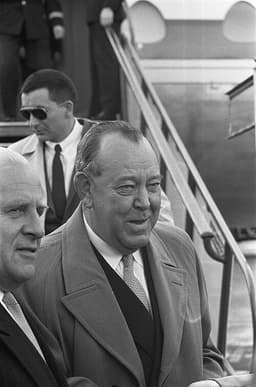
Trygve Lie
Politician · Modern
58.7Total
Basic Information
Born
1950
1896
Died
—
1968
Era
Modern
Modern
Nationality
Marshall Islands
Norway
Occupation
Politician
Politician
Civilization
Other
Western
Score Comparison
Military (10%)
50.0
49.2
Political (20%)
54.7
68.0
Influence (20%)
50.2
61.0
Legacy (20%)
40.8
52.0
Leadership (15%)
67.0
72.0
Strategy (15%)
41.9
45.3
TOTAL
50.2
58.7
Kessai Note — Complete Timeline
2000 AD
Elected President of the Marshall IslandsPolitical Action
Kessai Note was elected President by the Nitijela (parliament) in January 2000, becoming the first commoner to hold the office. His election broke the traditional dominance of the iroij (chiefly class) in Marshallese politics, representing a shift toward democratic representation.
DemocracySocial ChangeElection
Impact: nationalprogressive
2004 AD
Re-elected for a second termPolitical Action
Note was re-elected as President in 2004, continuing his leadership. His second term focused on economic development and education reform, though his administration faced challenges including budget deficits and political infighting.
Re-electionGovernance
Impact: national
2008 AD
Lost re-election bidPolitical Action◆ Major
Kessai Note was defeated in the presidential election by Litokwa Tomeing in January 2008. His loss marked the end of his eight-year tenure and demonstrated the peaceful transfer of power in the Marshall Islands' parliamentary system.
ElectionDefeatTransition
Impact: national
Trygve Lie — Complete Timeline
1941 AD
Served as Norwegian Minister of Foreign AffairsPolitical Action
Lie served as Norwegian Minister of Foreign Affairs in the London-based exile government during World War II. He helped maintain Norwegian diplomatic relations and advocated for post-war international cooperation.
World War IINorwegian GovernmentDiplomacy
Impact: nationalconstructive
1946 AD
Elected first Secretary-General of the United NationsPolitical Action◆ Major
Trygve Lie became the first Secretary-General of the United Nations, serving from 1946 to 1952. His appointment was a compromise between the US and Soviet Union, and he helped establish the UN's administrative structure.
UN Secretary-GeneralFoundingPost-War
Impact: globalconstructive
Oversaw the creation of the UN Security CouncilPolitical Action◆ Major
Lie played a key role in establishing the UN Security Council as the primary body for maintaining international peace and security. He helped define its procedures and the veto power of permanent members.
UN Security CouncilInstitution BuildingPeace
Impact: globalconstructive
1948 AD
Mediated the Berlin BlockadePolitical Action◆ Major
Lie attempted to mediate the Berlin Blockade, but the Soviet Union rejected his proposals. The crisis was eventually resolved through the Berlin Airlift, highlighting the limitations of UN diplomacy during the Cold War.
Cold WarBerlinDiplomacy
Impact: global
1952 AD
Resigned as Secretary-GeneralPolitical Action◆ Major
Lie resigned as UN Secretary-General after facing Soviet opposition and criticism for his handling of the Korean War. His resignation paved the way for Dag Hammarskj
ResignationUN PoliticsCold War
Impact: global
Expert Analysis
Origins
Kessai Note was born in 1950 in the Marshall Islands, a Pacific nation that had been under US administration as part of the Trust Territory of the Pacific Islands. He came from a commoner background, which was significant in a society with traditional chiefly hierarchies. Note studied at the University of Hawaii and later worked as a teacher and civil servant, eventually entering politics. He was elected to the Nitijela (parliament) in 1991 and served as Minister of Health and Education before becoming President.
Trygve Lie was born on July 16, 1896, in Oslo, Norway. His father was a carpenter, and Lie grew up in a working-class family. He studied law at the University of Oslo and became a lawyer. He joined the Norwegian Labour Party and was elected to the Norwegian Parliament in 1937. He served as Minister of Justice and later as Minister of Trade and Industry in the pre-war government. During World War II, he was appointed Norwegian Minister of Foreign Affairs in the London-based exile government from 1941 to 1945.
Rise to Power
Kessai Note rose to prominence by breaking the traditional chiefly hold on political power. In January 2000, the Nitijela elected him President, making him the first commoner to hold the office. His election was a turning point for Marshall Islands politics, signaling a shift toward meritocracy over hereditary status. He was re-elected in 2004, consolidating his position.
Trygve Lie rose to international prominence through his diplomatic work. As Norwegian Foreign Minister in exile, he helped maintain Norway's diplomatic presence and secured Allied support. After the war, he led the Norwegian delegation to the United Nations Conference on International Organization in San Francisco in 1945. His skills in negotiation led to his election as the first Secretary-General of the United Nations in February 1946, a compromise between the US and the Soviet Union.
Leadership & Governance
Kessai Note focused on economic development and education reform. He promoted foreign investment in fisheries and tourism, and sought to strengthen the compact with the United States. His governance style was consultative, working with traditional leaders to advance his agenda. However, his policies faced criticism for not addressing corruption and for limited improvements in living standards. His political score of 54.7 reflects moderate effectiveness.
Trygve Lie's leadership was defined by his role in shaping the UN's early structure. He oversaw the creation of the UN Security Council and its procedures, establishing it as the primary body for peace and security. He also initiated the UN's peacekeeping operations, particularly in Palestine. His leadership score of 72.0 is the highest among these figures. However, his tenure was marked by Cold War tensions; his handling of the Korean War led to Soviet opposition and his eventual resignation in 1952.
Triumph & Tragedy
Kessai Note's greatest success was breaking the political monopoly of traditional chiefs, opening the presidency to commoners. He also secured continued US financial support through the Compact of Free Association. His tragedy was his failure to substantially improve the Marshall Islands' economic conditions; the country remained heavily dependent on US aid. He lost re-election in 2008 to Litokwa Tomeing, ending his eight-year tenure with a legacy of unfulfilled promises.
Trygve Lie's triumph was establishing the UN as a functional international organization in its early years. He successfully mediated the Berlin Blockade crisis by working with the US and UK, though the Soviet Union rejected his proposals. His tragedy was the inability to maintain superpower trust; his support for the UN intervention in Korea angered the Soviet Union, leading to a Soviet veto of his reappointment. He resigned in 1952, leaving the UN weakened by Cold War divisions.
Character & Destiny
Kessai Note was known as a pragmatic reformer, willing to challenge traditional structures. His commoner background gave him a unique perspective, but his governance was constrained by limited resources and political infighting. His character shaped a destiny of modest change; he opened doors but could not fully transform his nation.
Trygve Lie was determined and diplomatic, but also stubborn. He pushed for a strong UN role in global affairs, which put him at odds with the Soviet Union. His character led to his downfall; his insistence on UN action in Korea without Soviet approval made him a target. His destiny was to be a pioneer who shaped the UN but was consumed by the Cold War.
Legacy
Kessai Note's legacy is that of a democratizer in the Marshall Islands. He is remembered as the first commoner president, a symbol of political inclusion. However, his policy impacts were limited; the country remains poor and dependent. His legacy score of 40.8 reflects this constrained influence.
Trygve Lie's legacy is foundational. He established many UN procedures and norms that endure today, including peacekeeping and the role of the Secretary-General. Despite his resignation, the UN continued to grow. His influence score of 61.0 and legacy score of 52.0 are higher than Note's, reflecting his global impact.
Conclusion
Trygve Lie had a greater overall impact, with a total score of 58.7 compared to Kessai Note's 50.2. Lie shaped the United Nations, an institution that has influenced global governance for decades. Note's reforms were significant but limited to a small island nation with a population under 60,000. While Note broke political barriers, Lie broke international ground. The data supports the conclusion that Lie's contributions to world order outweigh Note's contributions to local democracy.
Rankings
🥇
Trygve LieLeader
Mil: 49.2Pol: 68.0Inf: 61.0
58.7
🥈
Kessai Note
Mil: 50.0Pol: 54.7Inf: 50.2
50.2
+8.5 behind
How This Comparison Works
Algorithm
Each figure is scored on 6 dimensions (0—100 scale) based on structured historical data: Military (10%), Political (20%), Influence (20%), Legacy (20%), Leadership (15%), Strategy (15%). The weighted total produces the final ranking.
Data Sources
Scores are computed from structured sub-indicators in the database. Scale factors adjust for era (Ancient ×0.85, Modern ×1.0) and civilization size (Eastern ×1.05, Other ×0.80) to account for differences in population and military scale.
Maximum 3 Figures
Comparisons are limited to 2—3 figures to ensure readability and statistical meaningfulness.
Error Margins
±5 points per dimension — Sub-scores are derived from historical records with inherent uncertainty. Two figures within 5 points on a dimension should be considered roughly equivalent in that area.
Total Score Accuracy
±3 points overall — The weighted combination of 6 dimensions produces a total score with approximately ±3 points of uncertainty. Differences of less than 3 points are not statistically significant— the figures are effectively tied.
Known Limitations
- Historical records are incomplete and uneven across civilizations
- Figures from oral-tradition societies may be underrepresented
- Occupation labels can misclassify multi-role figures
- Scores measure capability and impact, not moral character
- Quantitative scoring is a comparison tool, not absolute truth
Capability Radar
Military (10%) — Battles & Warfare
Battles
22
32
Win Rate
26
30
Expansion
29
34
Political (20%) — Governance & Reform
Reform
40
55
Diplomacy
50
65
Economy
35
40
Influence (20%) — Cultural & Global Reach
Cultural
20
40
Global
20
65
Legacy (20%) — Historical Impact
Historical
25
60
Longevity
20
50
Leadership (15%) — Power & Stability
Tenure
30
60
Stability
40
50
Strategy (15%) — Tactics & Innovation
Strategy
31
37
Tactics
36
38
Reform
35
45
Similar Comparisons
Comments & Discussion
No comments yet. Be the first to share your thoughts!