Loading...
Boun Oum vs Trygve Lie
Trygve Lie leads by 11.4 pts · 2 figures compared
…
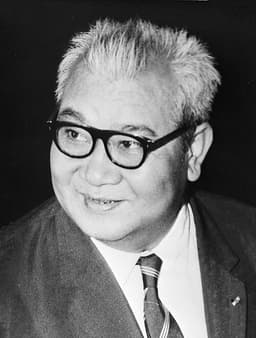
Boun Oum
Politician · Modern
47.3Total
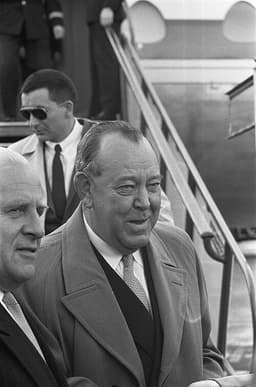
Trygve Lie
Politician · Modern
58.7Total
Basic Information
Born
1912
1896
Died
1980
1968
Era
Modern
Modern
Nationality
Laos
Norway
Occupation
Politician
Politician
Civilization
Eastern
Western
Score Comparison
Military (10%)
36.6
49.2
Political (20%)
40.8
68.0
Influence (20%)
49.4
61.0
Legacy (20%)
40.0
52.0
Leadership (15%)
65.7
72.0
Strategy (15%)
52.8
45.3
TOTAL
47.3
58.7
Boun Oum — Complete Timeline
1960 AD
Role in the Battle of VientianeWar◆ Major
Boun Oum allied with General Phoumi Nosavan to retake Vientiane from neutralist forces led by Kong Le. The battle resulted in heavy casualties and destruction in the capital, and Boun Oum's forces emerged victorious, installing a right-wing government.
BattleCivil WarVientiane
Impact: nationaldestructive
Formation of the Right-Wing Government in ChampasakPolitical Action◆ Major
Boun Oum, as prince of Champasak, formed a right-wing government in southern Laos with support from the United States and Thailand. His government opposed the neutralist coalition of Souvanna Phouma and the communist Pathet Lao, deepening the Laotian Civil War.
Civil WarRight-WingUS Support
Impact: nationaldestructive
1975 AD
Exile to ThailandPolitical Action◆ Major
Following the communist takeover of Laos, Boun Oum fled to Thailand, where he lived in exile. He continued to oppose the Pathet Lao government but never returned to Laos. His exile marked the end of the traditional Lao aristocracy's political influence.
ExileCommunist TakeoverAristocracy
Impact: nationaltragic
Trygve Lie — Complete Timeline
1941 AD
Served as Norwegian Minister of Foreign AffairsPolitical Action
Lie served as Norwegian Minister of Foreign Affairs in the London-based exile government during World War II. He helped maintain Norwegian diplomatic relations and advocated for post-war international cooperation.
World War IINorwegian GovernmentDiplomacy
Impact: nationalconstructive
1946 AD
Elected first Secretary-General of the United NationsPolitical Action◆ Major
Trygve Lie became the first Secretary-General of the United Nations, serving from 1946 to 1952. His appointment was a compromise between the US and Soviet Union, and he helped establish the UN's administrative structure.
UN Secretary-GeneralFoundingPost-War
Impact: globalconstructive
Oversaw the creation of the UN Security CouncilPolitical Action◆ Major
Lie played a key role in establishing the UN Security Council as the primary body for maintaining international peace and security. He helped define its procedures and the veto power of permanent members.
UN Security CouncilInstitution BuildingPeace
Impact: globalconstructive
1948 AD
Mediated the Berlin BlockadePolitical Action◆ Major
Lie attempted to mediate the Berlin Blockade, but the Soviet Union rejected his proposals. The crisis was eventually resolved through the Berlin Airlift, highlighting the limitations of UN diplomacy during the Cold War.
Cold WarBerlinDiplomacy
Impact: global
1952 AD
Resigned as Secretary-GeneralPolitical Action◆ Major
Lie resigned as UN Secretary-General after facing Soviet opposition and criticism for his handling of the Korean War. His resignation paved the way for Dag Hammarskj
ResignationUN PoliticsCold War
Impact: global
Expert Analysis
Origins
Boun Oum (born 1911) was a prince of the Champasak royal family in southern Laos. He was educated in French schools and inherited a feudal position, deeply rooted in the traditional Lao elite. His early life was marked by the decline of French colonial power and the rise of nationalist movements.
Trygve Lie (born 1896) was a Norwegian labor lawyer and politician. He grew up in a working-class family in Oslo and became active in the Norwegian Labour Party. His legal career and political ascent were shaped by the interwar period and the experience of Nazi occupation.
Rise to Power
Boun Oum rose to prominence as a right-wing leader during the Laotian Civil War (1953-1975). In 1960, after the neutralist coup by Kong Le, Boun Oum and General Phoumi Nosavan formed a right-wing government in Champasak, backed by the United States and Thailand. His forces retook Vientiane in the Battle of Vientiane (December 1960), causing heavy casualties. He became Prime Minister in 1961 but was forced to step down after the Geneva Accords of 1962.
Trygve Lie was elected as the first Secretary-General of the United Nations in 1946, a compromise between the US and Soviet Union. He had previously served as Norwegian Minister of Foreign Affairs in the exile government during WWII, which gave him diplomatic credibility. His rise was based on his ability to navigate great power politics and his commitment to international cooperation.
Leadership & Governance
Boun Oum's leadership was characterized by authoritarianism and reliance on foreign support. He opposed neutralism and sought to crush communist and neutralist forces. His governance was marked by corruption and favoritism toward the Champasak elite. He scored 65.7 in leadership but only 40.8 in political skill, reflecting his inability to build broad coalitions.
Trygve Lie's governance style was pragmatic and diplomatic. He focused on building the UN's institutional capacity, including the creation of the UN Security Council's structure. He scored 72.0 in leadership and 68.0 in political skill. However, his strategy score of 45.3 indicates limited long-term planning.
Triumph & Tragedy
Boun Oum's greatest success was his temporary military victory in Vientiane, which secured right-wing control for a few years. His greatest failure was his inability to prevent the eventual communist takeover; his policies alienated moderates and strengthened the Pathet Lao. He fled to Thailand in 1975, living in exile until his death in 1980.
Trygve Lie's triumphs include mediating the creation of Israel (1947) and establishing the UN's role in peacekeeping. His tragedy was the failure to resolve the Berlin Blockade (1948-1949) and the Korean War (1950-1953). Soviet opposition to his handling of Korea forced his resignation in 1952.
Character & Destiny
Boun Oum was stubborn and elitist, unwilling to compromise with neutralists or communists. His character led to a rigid political stance that ultimately isolated him. He is often described as a feudal relic unable to adapt to modern politics.
Trygve Lie was determined and idealistic but also cautious. He believed in the UN's potential but was constrained by Cold War dynamics. His character drove him to pursue ambitious diplomatic initiatives, but his destiny was shaped by the superpowers' rivalry.
Legacy
Boun Oum's legacy is largely negative in Laos, where he is remembered as a US-backed warlord who contributed to the country's devastation. His scores reflect this: influence 49.4, legacy 40.0.
Trygve Lie's legacy is mixed but more positive. He established the office of the Secretary-General as a diplomatic force. His scores: influence 61.0, legacy 52.0. He is remembered as a founder of the modern UN system.
Conclusion
Trygve Lie had greater impact than Boun Oum. Lie's total score of 58.7 exceeds Oum's 47.3 by 11.4 points. Lie shaped international institutions that continue to function, while Oum's influence was limited to a brief, destructive period in Lao history. Lie's role in creating the UN Security Council and his mediation efforts had global consequences, whereas Oum's actions affected only a small region and ended in failure. The data supports that Lie's leadership and political skills were superior, and his legacy endures in global governance.
Rankings
🥇
Trygve LieLeader
Mil: 49.2Pol: 68.0Inf: 61.0
58.7
🥈
Boun Oum
Mil: 36.6Pol: 40.8Inf: 49.4
47.3
+11.4 behind
How This Comparison Works
Algorithm
Each figure is scored on 6 dimensions (0—100 scale) based on structured historical data: Military (10%), Political (20%), Influence (20%), Legacy (20%), Leadership (15%), Strategy (15%). The weighted total produces the final ranking.
Data Sources
Scores are computed from structured sub-indicators in the database. Scale factors adjust for era (Ancient ×0.85, Modern ×1.0) and civilization size (Eastern ×1.05, Other ×0.80) to account for differences in population and military scale.
Maximum 3 Figures
Comparisons are limited to 2—3 figures to ensure readability and statistical meaningfulness.
Error Margins
±5 points per dimension — Sub-scores are derived from historical records with inherent uncertainty. Two figures within 5 points on a dimension should be considered roughly equivalent in that area.
Total Score Accuracy
±3 points overall — The weighted combination of 6 dimensions produces a total score with approximately ±3 points of uncertainty. Differences of less than 3 points are not statistically significant— the figures are effectively tied.
Known Limitations
- Historical records are incomplete and uneven across civilizations
- Figures from oral-tradition societies may be underrepresented
- Occupation labels can misclassify multi-role figures
- Scores measure capability and impact, not moral character
- Quantitative scoring is a comparison tool, not absolute truth
Capability Radar
Military (10%) — Battles & Warfare
Battles
5
32
Win Rate
5
30
Expansion
5
34
Political (20%) — Governance & Reform
Reform
30
55
Diplomacy
40
65
Economy
25
40
Influence (20%) — Cultural & Global Reach
Cultural
20
40
Global
15
65
Legacy (20%) — Historical Impact
Historical
25
60
Longevity
15
50
Leadership (15%) — Power & Stability
Tenure
45
60
Stability
20
50
Strategy (15%) — Tactics & Innovation
Strategy
5
37
Tactics
5
38
Reform
5
45
Similar Comparisons
Comments & Discussion
No comments yet. Be the first to share your thoughts!