Loading...
Kenneth MacAlpin vs Ramathibodi II
Ramathibodi II leads by 4.9 pts · 2 figures compared
…
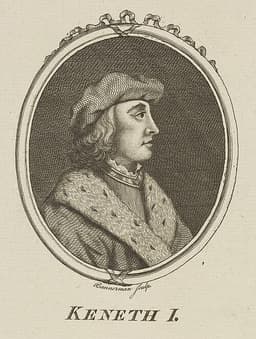
Kenneth MacAlpin
Emperor · Medieval
49.8Total
Ramathibodi II
Emperor · Medieval
54.7Total
Basic Information
Born
810
1472
Died
858
1529
Era
Medieval
Medieval
Nationality
Scotland
Thailand
Occupation
Emperor
Emperor
Civilization
Western
Eastern
Score Comparison
Military (10%)
35.0
55.0
Political (20%)
42.3
68.0
Influence (20%)
54.9
52.5
Legacy (20%)
50.0
42.5
Leadership (15%)
65.7
68.0
Strategy (15%)
38.6
50.0
TOTAL
49.8
54.7
Kenneth MacAlpin — Complete Timeline
839 AD
Battle of FortriuWar◆ Major
Kenneth MacAlpin's predecessor, E
VikingsPictsSuccession
Impact: regional
843 AD
Unification of Picts and ScotsPolitical Action
Kenneth MacAlpin became king of both the Picts and the Scots, traditionally dated to 843. He united the two peoples under his rule, creating the Kingdom of Alba. This unification is considered the foundation of the medieval Scottish kingdom.
UnificationScotlandAlba
Impact: regionalconstructive
849 AD
Transfer of Relics to DunkeldCultural◆ Major
Kenneth MacAlpin transferred the relics of Saint Columba from Iona to Dunkeld for safekeeping from Viking raids. This act established Dunkeld as a major religious center and reinforced the link between the Scottish monarchy and the Columban church.
ReligionRelicsDunkeld
Impact: regionalconstructive
850 AD
Invasion of NorthumbriaWar
Kenneth MacAlpin led a raid into Northumbria, burning the monastery at Lindisfarne and attacking the region. This was part of a pattern of Scottish expansion southward, though the raid did not result in permanent territorial gains.
NorthumbriaRaidExpansion
Impact: regionaldestructive
Ramathibodi II — Complete Timeline
1492 AD
Construction of Wat Phra Si SanphetCultural◆ Major
Ramathibodi II ordered the construction of Wat Phra Si Sanphet, the holiest temple in the Ayutthaya royal palace complex. The temple housed a large standing Buddha image and served as the site for royal ceremonies. Its construction demonstrated the king's piety and reinforced the link between Buddhism and monarchy.
Temple ConstructionBuddhismRoyal Patronage
Impact: nationalconstructive
1511 AD
First Portuguese Contact with AyutthayaPolitical Action
Ramathibodi II received the first Portuguese diplomatic mission to Ayutthaya, led by Duarte Fernandes. This initial contact established formal relations between the two kingdoms, leading to a treaty in 1516 that allowed Portuguese trade and settlement in Ayutthaya, marking the beginning of European involvement in Siam.
European ContactPortugalDiplomacy
Impact: regionalconstructive
1516 AD
Treaty of 1516 with PortugalPolitical Action◆ Major
Ramathibodi II signed a treaty with the Portuguese Empire, granting them permission to establish a trading post and reside in Ayutthaya. In exchange, the Portuguese provided firearms and military advisors. This treaty opened Ayutthaya to European trade and introduced Western military technology to the kingdom.
TreatyPortugalTrade
Impact: regionalconstructive
Introduction of Firearms to Ayutthayan MilitaryInvention◆ Major
Following the treaty with Portugal, Ramathibodi II incorporated Portuguese-supplied firearms and cannon into the Ayutthayan military. This adoption of gunpowder weapons transformed the kingdom's warfare capabilities, giving Ayutthaya a technological advantage over neighboring states for several decades.
Military TechnologyFirearmsInnovation
Impact: regionalconstructive
Expert Analysis
Origins
Kenneth MacAlpin (c. 810–858) was born into the ruling dynasty of Dál Riata, a Gaelic kingdom in western Scotland. His father, Alpín mac Echdach, was king of Dál Riata. Kenneth's early life was shaped by the fragmentation of the Pictish kingdom after heavy Viking raids. The death of the Pictish king Eóganán in the Battle of Fortriu (839) against Vikings created a power vacuum that Kenneth would exploit.
Ramathibodi II (1472–1529) was born as Prince Chettha to King Borommatrailokkanat of Ayutthaya (modern Thailand). He was educated in the royal court and appointed as uparaja (viceroy) of Phitsanulok, a key northern city. His early experience involved administering a vassal state and preparing for succession.
Rise to Power
Kenneth MacAlpin became king of Dál Riata around 840. According to later tradition, he claimed the Pictish throne through his mother, a Pictish princess. In 843, after a period of warfare, he was accepted as king of the Picts, uniting the two peoples. The unification is often called the "Kenneth MacAlpin tradition," though details are obscure. Key to his rise was the prior weakening of Pictish nobility by Viking attacks.
Ramathibodi II became king in 1491 after the death of his brother, King Borommaracha III. His reign was stable, with no major internal revolts. He focused on consolidating the kingdom and expanding trade. His major turning point came in 1511 when Portuguese envoys arrived in Ayutthaya, seeking diplomatic and commercial ties.
Leadership & Governance
Kenneth MacAlpin ruled a newly unified kingdom that blended Gaelic and Pictish traditions. He established Dunkeld as a religious center by transferring relics of Saint Columba from Iona, which had been raided by Vikings. This act reinforced his legitimacy with the Church. He also led raids into Northumbria (c. 849–850), burning the monastery at Lindisfarne, demonstrating military assertiveness. Politically, he scored 42.3, reflecting his ability to consolidate power but limited administrative reforms.
Ramathibodi II was a pragmatic diplomat and modernizer. In 1516, he signed a treaty with Portugal that allowed the Portuguese to establish a trading post in Ayutthaya and provided firearms and cannon for the Ayutthayan military. This was the first European treaty in Southeast Asia. He also built Wat Phra Si Sanphet, a grand temple that symbolized royal authority. His political score of 68.0 reflects his effective diplomacy and state-building.
Triumph & Tragedy
Kenneth MacAlpin's greatest success was unifying the Picts and Scots, creating the Kingdom of Alba, the foundation of medieval Scotland. This unification survived his death and endured for centuries. However, his failure was the lack of a strong centralized administration; the kingdom remained vulnerable to Viking raids and internal strife. His military score of 35.0 reflects limited expansion and constant defensive struggles.
Ramathibodi II's triumph was establishing diplomatic and trade relations with Portugal, which brought modern firearms and wealth to Ayutthaya. The treaty of 1516 opened a period of European engagement that would influence the region for centuries. His tragedy was that the reliance on foreign firearms and trade eventually made Ayutthaya dependent on European powers, contributing to its later decline. His military score of 55.0 reflects the successful integration of gunpowder weapons.
Character & Destiny
Kenneth MacAlpin was a pragmatic unifier who used a combination of dynastic claims and military force. He is remembered as a legendary founder, but historical records are sparse, leading to an influence score of 54.9. His destiny was to create a nation that would outlast him, but his personal ambitions were cut short by death in 858.
Ramathibodi II was a cautious reformer who prioritized stability and prosperity. His openness to foreign influence was strategic, not ideological. His leadership score of 68.0 reflects his ability to navigate complex international relations. His destiny was to transform Ayutthaya into a regional power but also to sow the seeds of future dependency.
Legacy
Kenneth MacAlpin's legacy is the unification of Scotland. The Kingdom of Alba evolved into the medieval Kingdom of Scotland, and he is often called the first King of Scots. His legacy score of 50.0 reflects the foundational but mythologized nature of his achievement.
Ramathibodi II's legacy is more concrete: the introduction of firearms revolutionized Southeast Asian warfare, and the Portuguese alliance set a pattern for European engagement. However, his legacy score of 42.5 is lower because his kingdom eventually collapsed in 1767, and his reforms did not prevent decline.
Conclusion
While Kenneth MacAlpin achieved a lasting unification that defined Scottish identity, Ramathibodi II's practical reforms had more immediate and measurable impact on his kingdom's power. Ramathibodi II scored higher overall (54.7 vs 49.8), driven by superior political (68.0 vs 42.3) and military (55.0 vs 35.0) scores. His introduction of firearms and treaty with Portugal represent a decisive shift in Ayutthayan history that shaped Southeast Asia for centuries. Kenneth MacAlpin's unification was foundational but lacked the transformative institutional changes seen in Ramathibodi II's reign. Therefore, Ramathibodi II had greater impact as a ruler.
Rankings
🥇
Ramathibodi IILeader
Mil: 55.0Pol: 68.0Inf: 52.5
54.7
🥈
Kenneth MacAlpin
Mil: 35.0Pol: 42.3Inf: 54.9
49.8
+4.9 behind
How This Comparison Works
Algorithm
Each figure is scored on 6 dimensions (0—100 scale) based on structured historical data: Military (10%), Political (20%), Influence (20%), Legacy (20%), Leadership (15%), Strategy (15%). The weighted total produces the final ranking.
Data Sources
Scores are computed from structured sub-indicators in the database. Scale factors adjust for era (Ancient ×0.85, Modern ×1.0) and civilization size (Eastern ×1.05, Other ×0.80) to account for differences in population and military scale.
Maximum 3 Figures
Comparisons are limited to 2—3 figures to ensure readability and statistical meaningfulness.
Error Margins
±5 points per dimension — Sub-scores are derived from historical records with inherent uncertainty. Two figures within 5 points on a dimension should be considered roughly equivalent in that area.
Total Score Accuracy
±3 points overall — The weighted combination of 6 dimensions produces a total score with approximately ±3 points of uncertainty. Differences of less than 3 points are not statistically significant— the figures are effectively tied.
Known Limitations
- Historical records are incomplete and uneven across civilizations
- Figures from oral-tradition societies may be underrepresented
- Occupation labels can misclassify multi-role figures
- Scores measure capability and impact, not moral character
- Quantitative scoring is a comparison tool, not absolute truth
Capability Radar
Military (10%) — Battles & Warfare
Battles
20
30
Win Rate
25
35
Expansion
35
40
Political (20%) — Governance & Reform
Reform
40
40
Diplomacy
45
50
Economy
30
45
Influence (20%) — Cultural & Global Reach
Cultural
40
30
Global
30
25
Legacy (20%) — Historical Impact
Historical
55
35
Longevity
50
30
Leadership (15%) — Power & Stability
Tenure
50
55
Stability
35
50
Strategy (15%) — Tactics & Innovation
Strategy
25
30
Tactics
20
30
Reform
15
25
Similar Comparisons
Comments & Discussion
No comments yet. Be the first to share your thoughts!