Loading...
Keith Rowley vs Napoleon Bonaparte
Napoleon Bonaparte leads by 18.6 pts · 2 figures compared
…
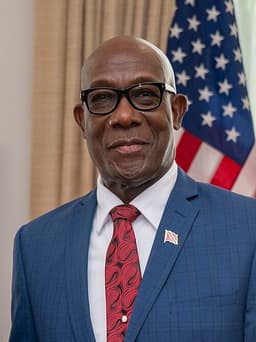
Keith Rowley
Politician · Modern
52.3Total

Napoleon Bonaparte
General · Modern
70.9Total
Basic Information
Born
1949
1769
Died
—
1821
Era
Modern
Modern
Nationality
Trinidad and Tobago
France
Occupation
Politician
General
Civilization
Other
Western
Score Comparison
Military (10%)
41.8
94.0
Political (20%)
62.7
72.0
Influence (20%)
53.3
40.0
Legacy (20%)
41.7
80.0
Leadership (15%)
72.0
78.0
Strategy (15%)
41.3
90.0
TOTAL
52.3
70.9
Keith Rowley — Complete Timeline
1970 AD
Volcanologist Career and Academic WorkCultural
Before entering politics, Rowley worked as a volcanologist, studying volcanic activity in the Caribbean. His scientific background influenced his approach to disaster management and environmental policy as Prime Minister.
ScienceVolcanologyCareer
Impact: regionalconstructive
2010 AD
Leadership of the People's National MovementPolitical Action◆ Major
Rowley became the political leader of the People's National Movement (PNM) after a leadership contest. He revitalized the party and led it to victory in 2015, ending a five-year opposition period.
Political PartyLeadershipRevitalization
Impact: nationalconstructive
2015 AD
Crime Reduction InitiativesReform◆ Major
Rowley launched a series of crime reduction initiatives, including increased police patrols, anti-gang legislation, and social programs. Despite efforts, crime rates remained high, drawing criticism from opposition and civil society.
CrimeSecurityPolicy
Impact: national
Prime Minister of Trinidad and TobagoPolitical Action◆ Major
Keith Rowley became Prime Minister of Trinidad and Tobago after leading the People's National Movement to victory in the 2015 general election. He succeeded Kamla Persad-Bissessar and focused on economic diversification and crime reduction.
Prime MinisterElectionGovernment
Impact: nationalconstructive
2020 AD
Re-election as Prime MinisterPolitical Action◆ Major
Rowley won re-election in the 2020 general election, securing a second term. His victory was attributed to his handling of the COVID-19 pandemic and economic management, though the opposition criticized his policies.
ElectionRe-electionCOVID-19
Impact: nationalconstructive
Napoleon Bonaparte — Complete Timeline
1799 AD
Coup of 18 BrumaireOther◆ Major
Napoleon Bonaparte, with support from his brother Lucien and key political figures, overthrew the Directory in a bloodless coup. He established the Consulate with himself as First Consul, effectively becoming the ruler of France. This event ended the French Revolution's most unstable period.
French RevolutionCoupRise to Power
Impact: regional
1804 AD
Promulgation of the Napoleonic CodeOther◆ Major
Napoleon enacted the Civil Code of the French, known as the Napoleonic Code, a comprehensive set of laws that replaced the fragmented feudal legal systems. The code established legal equality, protected property rights, and secularized law. It became the basis for legal systems in many European and world countries.
Legal ReformNapoleonic CodeCivil Law
Impact: globalconstructive
1805 AD
Battle of AusterlitzWar◆ Major
Napoleon's Grande Arm
Napoleonic WarsBattleDecisive Victory
Impact: global
1812 AD
Invasion of RussiaWar◆ Major
Napoleon led the Grande Arm
Napoleonic WarsInvasionDisaster
Impact: globaldestructive
1815 AD
Battle of WaterlooWar◆ Major
Napoleon's French army was defeated by the combined forces of the Duke of Wellington's Anglo-Allied army and Gebhard Leberecht von Bl
Napoleonic WarsBattleFinal Defeat
Impact: globaldestructive
Expert Analysis
keith-rowley-vs-napoleon-bonaparte
# The Conqueror and the Volcanologist
On a June morning in 1815, Napoleon Bonaparte surveyed a muddy field near Waterloo, his Grande Armée poised to crush the Duke of Wellington’s allied forces. Two centuries later, on a September evening in 2020, Keith Rowley stood before a television camera in Port of Spain, celebrating a narrow re-election victory. One man commanded armies that reshaped continents; the other managed a small Caribbean nation through the quiet pressures of governance. What drives such radically different trajectories? The answer lies not merely in ambition or circumstance, but in the very nature of the historical stage each man was born to occupy.
Origins
Napoleon entered the world in 1769 on the Mediterranean island of Corsica, a territory only recently annexed by France. His family belonged to the minor nobility—enough to send him to military school, but not enough to guarantee advancement. In that crucible of revolution and war, a young artillery officer learned that talent could shatter the barriers of birth. He devoured history and strategy, absorbing the campaigns of Alexander and Caesar as if they were personal letters.
Keith Rowley was born in 1949 in Trinidad and Tobago, a twin-island nation still under British colonial rule. His father was a schoolteacher, his mother a homemaker. Instead of military academies, Rowley studied geology at the University of the West Indies, eventually earning a doctorate in volcanology. While Napoleon learned to read a battlefield, Rowley learned to read the earth—studying the restless volcanoes of the Caribbean, understanding that pressure builds unseen until it must find release. Both men, in their own ways, were students of eruption.
Rise to Power
Napoleon’s ascent was a masterpiece of timing and nerve. In 1793, at age 24, he drove British forces from the port of Toulon with a brilliant artillery barrage. By 1796, he commanded the Army of Italy, winning victory after victory against the Austrians. His Italian campaign of 1796-1797 was not merely a military triumph but a political education: he learned to negotiate, to inspire, and to present himself as a man of destiny. When he returned to France in 1799, he seized power in the coup of 18 Brumaire, becoming First Consul at age 30. Within five years, he crowned himself Emperor.
Rowley’s path was slower, more patient. He entered politics in the 1980s, serving in various ministerial roles—agriculture, housing, planning. For decades, he was a competent but unremarkable figure in the People’s National Movement (PNM). Then, in 2010, he challenged the party’s leadership and won. The PNM had been in opposition, demoralized and fractured. Rowley revitalized it, not with battlefield glory but with steady organizational work and a message of pragmatic governance. In 2015, he led the party to electoral victory and became Prime Minister at age 66—more than three decades after Napoleon had conquered Italy.
Leadership & Governance
Napoleon governed as he conquered: with speed, clarity, and an iron will. He centralized the French state, streamlined the legal system, and in 1804 promulgated the Napoleonic Code—a civil law framework that influenced legal systems from Europe to Latin America. He built roads, established the Bank of France, and reformed education. Yet his genius for administration was inseparable from his hunger for war. Each reform served a larger purpose: to fund his armies, to cement his legitimacy, to project French power across the continent.
Rowley governs a nation of 1.4 million people, not a continent of 200 million. His challenges are those of scale and resource: crime, unemployment, energy dependence. In 2015, he launched crime reduction initiatives—increased police patrols, anti-gang legislation, community programs—that produced modest but measurable results. His handling of the COVID-19 pandemic in 2020 was widely praised for its pragmatism, helping secure his re-election that year. Where Napoleon issued decrees from a palace, Rowley holds press conferences from a lectern. Where Napoleon commanded armies across the Alps, Rowley negotiates with oil companies over drilling rights.
Triumph & Tragedy
Napoleon’s greatest moment was Austerlitz in 1805, where he destroyed a combined Russian and Austrian army in a single day of tactical perfection. His worst was the invasion of Russia in 1812—600,000 men marched east; fewer than 100,000 returned. The disaster shattered his aura of invincibility. Exiled to Elba in 1814, he escaped and ruled France for 100 days before Waterloo ended his dream forever. He died in 1821 on the remote island of Saint Helena, a prisoner of the British.
Rowley’s triumphs are quieter. Leading the PNM to victory in 2015 after a decade in opposition was, for Trinidad and Tobago, a significant political achievement. Winning re-election in 2020, despite economic headwinds and a global pandemic, demonstrated resilience. His tragedy, if it can be called that, is the tragedy of small-state leadership: no matter how competent, no matter how dedicated, the global forces of oil prices, climate change, and geopolitical shifts dwarf his capacity to shape outcomes. He will not be remembered in history books alongside Napoleon—but he may well be remembered as a steady hand in turbulent times.
Character & Destiny
Napoleon was driven by an insatiable ambition that bordered on the pathological. “I am not a man,” he once said, “but a thing—a thing to be used by destiny.” He believed he was destined to remake Europe, and that belief became a self-fulfilling prophecy. His personality—brilliant, arrogant, tireless—shaped every decision, from the invasion of Russia to the rejection of peace offers. He could not stop because he could not imagine a world in which he was not the center.
Rowley, by contrast, is a man of measured ambition. A volcanologist by training, he understands that some forces cannot be controlled, only monitored and managed. His leadership style is cautious, consensus-seeking, pragmatic. Where Napoleon burned bridges, Rowley builds coalitions. Where Napoleon saw enemies to crush, Rowley sees voters to persuade. Their personalities reflect their contexts: Napoleon’s Europe was a battlefield; Rowley’s Trinidad is a democracy.
Legacy
Napoleon’s legacy is enormous and contested. The Napoleonic Code remains a foundation of civil law worldwide. His military campaigns are still studied in war colleges. He reshaped nationalism, state-building, and the very idea of modern Europe. But he also left a trail of death—perhaps 3 to 6 million people died in the Napoleonic Wars—and his final legacy is that of a brilliant conqueror who could not stop conquering.
Keith Rowley’s legacy is still being written. He has served as Prime Minister since 2015, and his impact on Trinidad and Tobago is measurable but modest: stable governance, incremental reforms, no major scandals. His score of 54.5 for legacy reflects the reality that leaders of small nations, however competent, rarely achieve global historical significance. Yet perhaps that is the point. Not every leader needs to conquer Europe. Some simply need to keep the volcano from erupting.
Conclusion
We compare Napoleon and Rowley not because they are equals, but because their differences illuminate something essential about history itself. Napoleon had the fortune—and the curse—of living in an era when a single man could reshape the world through sheer will and military genius. Rowley lives in an age of institutions, checks and balances, and global interdependence, where power is diffuse and lasting change requires patience. One was a force of nature; the other studies it. One conquered; the other governs. Both, in their own ways, did what their times demanded. The question for us is not which was greater, but which kind of leadership our own age most needs.
Rankings
🥇
Napoleon BonaparteLeader
Mil: 94.0Pol: 72.0Inf: 40.0
70.9
🥈
Keith Rowley
Mil: 41.8Pol: 62.7Inf: 53.3
52.3
+18.6 behind
How This Comparison Works
Algorithm
Each figure is scored on 6 dimensions (0—100 scale) based on structured historical data: Military (10%), Political (20%), Influence (20%), Legacy (20%), Leadership (15%), Strategy (15%). The weighted total produces the final ranking.
Data Sources
Scores are computed from structured sub-indicators in the database. Scale factors adjust for era (Ancient ×0.85, Modern ×1.0) and civilization size (Eastern ×1.05, Other ×0.80) to account for differences in population and military scale.
Maximum 3 Figures
Comparisons are limited to 2—3 figures to ensure readability and statistical meaningfulness.
Error Margins
±5 points per dimension — Sub-scores are derived from historical records with inherent uncertainty. Two figures within 5 points on a dimension should be considered roughly equivalent in that area.
Total Score Accuracy
±3 points overall — The weighted combination of 6 dimensions produces a total score with approximately ±3 points of uncertainty. Differences of less than 3 points are not statistically significant— the figures are effectively tied.
Known Limitations
- Historical records are incomplete and uneven across civilizations
- Figures from oral-tradition societies may be underrepresented
- Occupation labels can misclassify multi-role figures
- Scores measure capability and impact, not moral character
- Quantitative scoring is a comparison tool, not absolute truth
Capability Radar
Military (10%) — Battles & Warfare
Battles
24
95
Win Rate
28
90
Expansion
32
95
Political (20%) — Governance & Reform
Reform
55
95
Diplomacy
60
80
Economy
55
85
Influence (20%) — Cultural & Global Reach
Cultural
30
85
Global
30
90
Legacy (20%) — Historical Impact
Historical
30
95
Longevity
20
90
Leadership (15%) — Power & Stability
Tenure
65
85
Stability
60
70
Strategy (15%) — Tactics & Innovation
Strategy
33
95
Tactics
33
98
Reform
36
92
Similar Comparisons
Comments & Discussion
Volcano-Tamer-vs-Empire-Shaker6/17/2026
Comparing Rowley to Napoleon is like comparing a backyard grill to a supernova. Rowley studied volcanology, sure—he literally knows how mountains explode. Napoleon studied how empires implode. Waterloo wasn't a landslide election; it was a career-ending defeat with 50,000 casualties. Rowley never lost a battle because he never fought one. Scale matters. One man reshaped Europe's legal code; the other reshaped Trinidad's cabinet. Respect both, but don't pretend they're in the same weight class.
火山博士vs科西嘉矮子6/17/2026
拿坡仑在莫斯科冻掉半个大军,罗利连雪都没见过;拿坡仑在滑铁卢输得精光,罗利2015年选举赢了13席对4席。比什么?这就像拿火山喷发比选举投票——一个熔岩烧城,一个口水溅话筒。罗利读火山学,至少知道岩浆会毁房子;拿坡仑读战争史,只会造坟地。别侮辱火山学家了。
Waterloo-Watcher6/17/2026
Historically, Napoleon scored 60 battles with 7 losses across two decades. Rowley's biggest fight? Surviving internal party coups in the PNM. If we measure by impact: Napoleon exported the metric system and civil codes; Rowley exported volcanic ash studies. One shaped half the world's legal DNA, the other shaped graduate theses. I'm not saying Rowley isn't accomplished—I'm saying comparing him to Napoleon is like comparing a seismograph to an earthquake.
蓝西装对决皇帝袍6/17/2026
拿坡仑在1805年奥斯特里茨,三天内歼灭俄奥联军27000人;罗利在2020年大选,赢得22席对19席,多数票不到6000票。拿坡仑在埃及跟穆拉德贝伊打马穆鲁克骑兵,罗利在议会跟詹姆斯辩论预算案。这不是谁更优秀的问题——这是拿加农炮跟地质锤比威力。马匹和驼鹿,不可同日而语。
Corsica-vs-Caribbean6/17/2026
Let's be honest: Napoleon lost 400,000 soldiers in Russia. Rowley lost maybe 15 parliamentary debates. One man's scorched earth policy turned Europe into a graveyard; the other's zoning policy turned Trinidad into a... slightly better place to build a house. Napoleon claimed he was driven by destiny. Rowley claimed he was driven by traffic jams. Different ambitions, different scales. One reshaped continents; the other reshuffled cabinet ministers. Draw your own conclusions.
地质博士的平凡胜利6/17/2026
拿坡仑1815年被流放圣赫勒拿岛,死时51岁;罗利2015年首次当总理,那时66岁。拿坡仑十年间从炮兵