Loading...
This comparison has not been analyzed yet.
One-time AI generation (~1 minute). Scores and timeline are already available below.
Kangxi Emperor vs Yeshwantrao Holkar
Kangxi Emperor leads by 14.1 pts · 2 figures compared
…
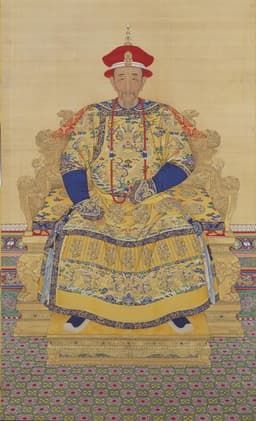
Kangxi Emperor
Emperor · Modern
73.4Total

Yeshwantrao Holkar
Emperor · Modern
59.3Total
Basic Information
Born
1654
1776
Died
1722
1811
Era
Modern
Modern
Nationality
China
India
Occupation
Emperor
Emperor
Civilization
Eastern
Indian
Score Comparison
Military (10%)
85.0
70.0
Political (20%)
78.0
68.0
Influence (20%)
69.8
53.3
Legacy (20%)
65.0
44.2
Leadership (15%)
81.3
74.0
Strategy (15%)
72.7
66.3
TOTAL
73.4
59.3
Kangxi Emperor — Complete Timeline
1673 AD
Suppression of the Revolt of the Three FeudatoriesWar
The Kangxi Emperor faced a major rebellion led by three powerful Han Chinese feudatories in southern China, including Wu Sangui. He personally directed military campaigns, and by 1681 the revolt was crushed, consolidating Qing control over the south.
RebellionFeudatoriesQing Dynasty
Impact: national
1683 AD
Conquest of TaiwanWar◆ Major
Kangxi ordered the invasion of Taiwan, then held by the Ming loyalist Zheng Keshuang. Qing naval forces defeated the Zheng fleet, and Taiwan was incorporated into the Qing Empire as a prefecture, ending the last major Ming resistance.
TaiwanConquestMing Loyalists
Impact: regional
1689 AD
Treaty of NerchinskPolitical Action◆ Major
The Kangxi Emperor negotiated the Treaty of Nerchinsk with the Russian Empire, establishing the border between Siberia and Manchuria. This was China's first treaty with a European power and secured the northern frontier, allowing trade and diplomatic relations.
TreatyRussiaBorder
Impact: globalconstructive
1691 AD
Incorporation of Outer MongoliaPolitical Action◆ Major
Kangxi personally met with Khalkha Mongol leaders at Dolon Nor, where they formally submitted to Qing authority. This brought Outer Mongolia under Qing control, ending the Dzungar threat and expanding the empire's northern borders.
MongoliaExpansionQing
Impact: regionalconstructive
1716 AD
Compilation of the Kangxi DictionaryCultural◆ Major
Kangxi commissioned the Kangxi Dictionary, a comprehensive dictionary of Chinese characters. It became the standard reference for Chinese lexicography, containing over 47,000 characters and influencing scholarship for centuries.
DictionaryLanguageScholarship
Impact: globalconstructive
Yeshwantrao Holkar — Complete Timeline
1802 AD
Battle of PoonaWar◆ Major
Yeshwantrao Holkar defeated the combined forces of the Peshwa and Scindia at the Battle of Poona. This victory made him the dominant Maratha power in the Deccan and forced the Peshwa to flee.
Maratha Civil WarBattlePoona
Impact: national
Treaty of BasseinPolitical Action◆ Major
The Peshwa Baji Rao II signed the Treaty of Bassein with the British, seeking their help against Yeshwantrao Holkar. This treaty brought the British into Maratha affairs and triggered the Second Anglo-Maratha War.
TreatyBritish InterventionMaratha Politics
Impact: nationaldestructive
1805 AD
Battle of BharatpurWar
Yeshwantrao Holkar besieged the British-held fort of Bharatpur but failed to capture it. The siege ended inconclusively, and Holkar was forced to retreat after British reinforcements arrived.
Second Anglo-Maratha WarSiegeBharatpur
Impact: regional
Treaty of RajghatPolitical Action◆ Major
Yeshwantrao Holkar signed the Treaty of Rajghat with the British, ending his participation in the Second Anglo-Maratha War. He ceded some territories but retained his kingdom's independence.
TreatyBritish East India CompanyHolkar Kingdom
Impact: regional
This comparison has not been analyzed yet.
One-time AI generation (~1 minute). Scores and timeline are already available below.
Rankings
🥇
Kangxi EmperorLeader
Mil: 85.0Pol: 78.0Inf: 69.8
73.4
🥈
Yeshwantrao Holkar
Mil: 70.0Pol: 68.0Inf: 53.3
59.3
+14.1 behind
How This Comparison Works
Algorithm
Each figure is scored on 6 dimensions (0—100 scale) based on structured historical data: Military (10%), Political (20%), Influence (20%), Legacy (20%), Leadership (15%), Strategy (15%). The weighted total produces the final ranking.
Data Sources
Scores are computed from structured sub-indicators in the database. Scale factors adjust for era (Ancient ×0.85, Modern ×1.0) and civilization size (Eastern ×1.05, Other ×0.80) to account for differences in population and military scale.
Maximum 3 Figures
Comparisons are limited to 2—3 figures to ensure readability and statistical meaningfulness.
Error Margins
±5 points per dimension — Sub-scores are derived from historical records with inherent uncertainty. Two figures within 5 points on a dimension should be considered roughly equivalent in that area.
Total Score Accuracy
±3 points overall — The weighted combination of 6 dimensions produces a total score with approximately ±3 points of uncertainty. Differences of less than 3 points are not statistically significant— the figures are effectively tied.
Known Limitations
- Historical records are incomplete and uneven across civilizations
- Figures from oral-tradition societies may be underrepresented
- Occupation labels can misclassify multi-role figures
- Scores measure capability and impact, not moral character
- Quantitative scoring is a comparison tool, not absolute truth
Capability Radar
Military (10%) — Battles & Warfare
Battles
85
65
Win Rate
88
60
Expansion
92
60
Political (20%) — Governance & Reform
Reform
88
45
Diplomacy
90
55
Economy
85
40
Influence (20%) — Cultural & Global Reach
Cultural
88
30
Global
80
20
Legacy (20%) — Historical Impact
Historical
90
40
Longevity
85
25
Leadership (15%) — Power & Stability
Tenure
95
50
Stability
92
35
Strategy (15%) — Tactics & Innovation
Strategy
90
65
Tactics
82
70
Reform
85
55
Similar Comparisons
Comments & Discussion
No comments yet. Be the first to share your thoughts!