Loading...
Jozef Pilsudski vs Julius Caesar
Julius Caesar leads by 17.1 pts · 2 figures compared
…
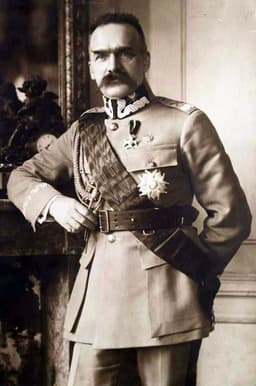
Jozef Pilsudski
General · Modern
65.7Total

Julius Caesar
General · Ancient
82.8Total
Basic Information
Born
1867
-100
Died
1935
-44
Era
Modern
Ancient
Nationality
Poland
Roman Republic
Occupation
General
General
Civilization
Western
Western
Score Comparison
Military (10%)
61.7
88.0
Political (20%)
72.0
78.0
Influence (20%)
72.0
85.0
Legacy (20%)
55.0
82.0
Leadership (15%)
68.0
80.0
Strategy (15%)
68.0
85.0
TOTAL
65.7
82.8
Jozef Pilsudski — Complete Timeline
1914 AD
Founded the Polish LegionsOther◆ Major
At the outbreak of World War I, Pilsudski formed the Polish Legions, volunteer military units fighting alongside Austria-Hungary against Russia. The Legions aimed to create a core for a future Polish army and advance the cause of Polish independence from partitioning powers.
Polish IndependenceWorld War IMilitary Formation
Impact: national
1918 AD
Proclaimed Independence of PolandOther◆ Major
On November 11, 1918, Pilsudski was released from German internment and returned to Warsaw. He assumed command of Polish forces and proclaimed the independence of the Second Polish Republic, becoming the nation's first Chief of State after 123 years of partition.
Polish IndependenceStatehoodNational Founding
Impact: nationalconstructive
1920 AD
Led the Battle of Warsaw (Miracle on the Vistula)War◆ Major
During the Polish-Soviet War, Pilsudski personally planned and commanded the counteroffensive at the Battle of Warsaw in August 1920. Polish forces repelled the advancing Red Army, securing Polish independence and halting the spread of Bolshevism into Central Europe.
Polish-Soviet WarMilitary VictoryNational Survival
Impact: regionalconstructive
1926 AD
Executed the May Coup d'ÉtatPolitical Action◆ Major
In May 1926, Pilsudski led a military coup against the Polish government, marching loyal troops into Warsaw. After three days of fighting, President Wojciechowski resigned and Pilsudski assumed de facto dictatorial power, establishing the Sanacja regime that ruled Poland until 1939.
Coup d'ÉtatAuthoritarianismPolish Politics
Impact: nationaldestructive
1932 AD
Signed the Polish-Soviet Non-Aggression PactOther◆ Major
Pilsudski's government signed a non-aggression pact with the Soviet Union on July 25, 1932. The treaty normalized relations between the two countries for ten years, though it was later broken by the Soviet invasion of Poland in 1939.
DiplomacySoviet-Polish RelationsTreaty
Impact: regional
Julius Caesar — Complete Timeline
58 BC
Gallic WarsWar◆ Major
Caesar, as proconsul of Gaul, launched a series of campaigns that conquered all of Gaul (modern France, Belgium, and parts of Switzerland). He fought numerous battles, including against the Helvetii, the Belgae, and the Gallic chieftain Vercingetorix. The wars brought immense wealth and a loyal army to Caesar.
Gallic WarsConquestRoman Expansion
Impact: regional
49 BC
Crossing the RubiconPolitical Action◆ Major
Caesar led Legio XIII across the Rubicon River into Italy, defying the Roman Senate's order to disband his army. This act triggered a civil war against Pompey and the Optimates, ultimately leading to Caesar's dictatorship and the end of the Roman Republic.
Roman Civil WarEnd of RepublicPower Struggle
Impact: global
48 BC
Battle of PharsalusWar◆ Major
Caesar's outnumbered army defeated the larger forces of Pompey the Great at Pharsalus in Greece. Caesar's tactical use of a reserve line to counter Pompey's cavalry charge proved decisive. Pompey fled to Egypt, where he was assassinated, leaving Caesar as the undisputed master of the Roman world.
Roman Civil WarBattleDecisive Victory
Impact: regional
44 BC
Appointment as Dictator for LifePolitical Action◆ Major
The Roman Senate appointed Caesar dictator perpetuo (dictator for life), granting him unprecedented personal power. This move concentrated military, legislative, and judicial authority in one person, effectively ending the Roman Republic's traditional system of checks and balances and alarming many senators.
DictatorshipEnd of RepublicPower Consolidation
Impact: regionaldestructive
Assassination on the Ides of MarchPolitical Action◆ Major
A group of Roman senators, led by Marcus Junius Brutus and Gaius Cassius Longinus, stabbed Caesar to death at a meeting of the Senate in the Theatre of Pompey. The assassination was intended to restore the Republic, but instead triggered another civil war that led to the rise of the Roman Empire.
AssassinationRoman PoliticsEnd of Republic
Impact: globaldestructive
Expert Analysis
jozef-pilsudski-vs-julius-caesar
# The Eagle and the Sceptre: Two Men Who Reshaped History
On a January morning in 49 BCE, a man in a general’s cloak stood at the bank of a small river in northern Italy. The Rubicon was little more than a stream, but it marked the boundary of a province—and the law of the Roman Republic forbade any general from crossing it with his army. Julius Caesar hesitated. Then he spoke: “The die is cast.” He crossed, and the Republic never recovered.
Nearly two thousand years later, in November 1918, another man arrived in Warsaw by train, released from a German prison. Józef Piłsudski stepped onto a platform in a city that had not existed as a national capital for over a century. Poland had been erased from the map in 1795. Now, with the Great War ending, its borders were blank pages. Piłsudski looked at the crowd and said little. He had work to do.
Both men were generals. Both became dictators. Both died in the shadow of their own contradictions. But their worlds were separated not only by centuries but by the very nature of power itself.
Origins
Julius Caesar was born into the patrician Julian clan, one of Rome’s oldest families, but not its wealthiest. The Rome of his youth was a republic in name only—a city of civil wars, street violence, and senatorial corruption. Caesar learned early that in such a world, a man needed three things: money, connections, and a reputation for audacity. He borrowed heavily, allied with the populist general Marius, and survived the purges of Sulla by hiding in the countryside. He was not born to greatness; he clawed his way toward it.
Józef Piłsudski came from a different kind of struggle. Born in 1867 in the Lithuanian village of Zułów, part of the Russian Empire, he grew up in a household where Polish was spoken in defiance of the Tsar. His father had fought in the failed January Uprising of 1863. Young Józef absorbed the romance of lost independence. Sent to school in Vilnius, he was arrested at twenty for plotting against the Tsar and exiled to Siberia. That five-year sentence hardened him into a revolutionary. Where Caesar saw opportunity in chaos, Piłsudski saw duty in suffering.
Rise to Power
Caesar’s rise was a masterpiece of calculated risk. He served as governor of Further Spain, then formed the First Triumvirate with Pompey and Crassus—an alliance of ambition disguised as friendship. The conquest of Gaul (58–50 BCE) gave him an army loyal to him personally, not to the Senate. When his rivals tried to strip his command, he gambled everything on the Rubicon. Within four years, he had defeated Pompey’s forces, been named dictator, and begun remaking Rome. His path was one of conquest: he took power by taking provinces, armies, and lives.
Piłsudski’s road was longer and more patient. He spent decades in the underground Polish Socialist Party, printing newspapers, smuggling weapons, and organizing strikes. In 1908, he founded secret paramilitary units, training men in Austrian Galicia. When the First World War erupted in 1914, he led Polish Legions alongside the Central Powers, hoping to use the war to win autonomy. It was a dangerous game: he was arrested by the Germans in 1917 for refusing to swear loyalty. Only the collapse of all three partitioning empires—Russia, Germany, Austria—in 1918 opened the door. Piłsudski did not conquer his nation; he conjured it from the wreckage of empires.
Leadership & Governance
As dictator, Caesar moved with breathtaking speed. He reformed the calendar, granted citizenship to Gauls, initiated public works, and packed the Senate with his supporters. His military genius was undeniable—the siege of Alesia (52 BCE) remains a textbook example of envelopment—but his political wisdom was brittle. He pardoned his enemies, only to have them stab him. He centralized power, but never built a stable succession. He ruled by force of personality, not institutions.
Piłsudski governed differently. After Poland’s independence, he served as Chief of State, then led the Polish Army to a stunning victory in the 1920 Battle of Warsaw—dubbed the “Miracle on the Vistula”—where his strategic instincts routed the advancing Red Army. Yet his political reforms were hesitant. In 1926, disillusioned with parliamentary chaos, he launched a coup. But instead of a dictatorship, he created a “sanacja” (purification) regime that was authoritarian but not totalitarian. He never abolished elections, never created a cult of personality, and never sought personal wealth. He was a reluctant dictator, one who hated the very power he held.
Triumph & Tragedy
Caesar’s greatest triumph was his own life: he conquered Gaul, defeated his rivals, and became master of the Roman world. His tragedy was that he could not imagine his own death. On the Ides of March, 44 BCE, sixty senators surrounded him in the Theatre of Pompey. He fell with twenty-three wounds. His last act was to pull his toga over his face, as if ashamed of how little his power had meant.
Piłsudski’s triumph was the resurrection of Poland—a nation that had been dead for 123 years. His tragedy was that he could not make it strong enough to survive. He died in 1935 of liver cancer, haunted by the rise of Nazi Germany and Soviet Russia. Only four years later, both would invade Poland, and the independence he had built would be crushed again. He had given his country a heartbeat, but not the armor to protect it.
Character & Destiny
Caesar was a man of the sun: ambitious, charismatic, and utterly pragmatic. He believed in his own star. He wrote his own commentaries, staged his own triumphs, and even had his own statue placed in the temple of Quirinus. He was not cruel for cruelty’s sake, but he was ruthless for destiny’s sake. He saw history as a stage, and himself as the lead actor.
Piłsudski was a man of shadow and smoke. He chain-smoked cigarettes, slept little, and spoke in riddles. He was melancholic, suspicious, and deeply conscious of Poland’s vulnerability. He once said, “To be defeated and not submit, that is victory; to be victorious and rest on one’s laurels, that is defeat.” He saw history as a burden, and himself as a caretaker.
Legacy
Caesar’s legacy is the Roman Empire. His name became a title—Kaiser, Tsar—and his reforms shaped Western governance for millennia. But his assassination also proved that even the greatest man cannot outrun the consequences of breaking a republic.
Piłsudski’s legacy is more fragile. Poland remembers him as its founding father, and his tomb in Kraków’s Wawel Cathedral is a pilgrimage site. But outside Poland, he is barely known. His failure was not personal but geographical: he tried to build a strong, independent state between two predatory empires. That was a task for which no genius was sufficient.
Conclusion
Standing at the Rubicon, Caesar saw a line that, once crossed, could never be uncrossed. He crossed it anyway, and the Republic bled out. Standing on the Warsaw platform, Piłsudski saw a nation that had been erased and needed to be written back into existence. He wrote it in ink, but the paper was thin.
Both men understood that history is not made by the cautious. Caesar broke the world to remake it in his image. Piłsudski pieced together a world that had been shattered. One built an empire; the other built a home. Both were great. Both were flawed. And both remind us that the difference between a conqueror and a liberator is often just a matter of which side of the river you stand on.
Rankings
🥇
Julius CaesarLeader
Mil: 88.0Pol: 78.0Inf: 85.0
82.8
🥈
Jozef Pilsudski
Mil: 61.7Pol: 72.0Inf: 72.0
65.7
+17.1 behind
How This Comparison Works
Algorithm
Each figure is scored on 6 dimensions (0—100 scale) based on structured historical data: Military (10%), Political (20%), Influence (20%), Legacy (20%), Leadership (15%), Strategy (15%). The weighted total produces the final ranking.
Data Sources
Scores are computed from structured sub-indicators in the database. Scale factors adjust for era (Ancient ×0.85, Modern ×1.0) and civilization size (Eastern ×1.05, Other ×0.80) to account for differences in population and military scale.
Maximum 3 Figures
Comparisons are limited to 2—3 figures to ensure readability and statistical meaningfulness.
Error Margins
±5 points per dimension — Sub-scores are derived from historical records with inherent uncertainty. Two figures within 5 points on a dimension should be considered roughly equivalent in that area.
Total Score Accuracy
±3 points overall — The weighted combination of 6 dimensions produces a total score with approximately ±3 points of uncertainty. Differences of less than 3 points are not statistically significant— the figures are effectively tied.
Known Limitations
- Historical records are incomplete and uneven across civilizations
- Figures from oral-tradition societies may be underrepresented
- Occupation labels can misclassify multi-role figures
- Scores measure capability and impact, not moral character
- Quantitative scoring is a comparison tool, not absolute truth
Capability Radar
Military (10%) — Battles & Warfare
Battles
70
95
Win Rate
65
92
Expansion
60
97
Political (20%) — Governance & Reform
Reform
75
90
Diplomacy
80
85
Economy
55
82
Influence (20%) — Cultural & Global Reach
Cultural
65
88
Global
60
94
Legacy (20%) — Historical Impact
Historical
75
95
Longevity
60
96
Leadership (15%) — Power & Stability
Tenure
70
75
Stability
50
60
Strategy (15%) — Tactics & Innovation
Strategy
80
94
Tactics
75
96
Reform
85
88
Similar Comparisons
Comments & Discussion
1. **CenturionSkeptic6/17/2026
** "Caesar crossed the Rubicon with one legion—that's bold. Piłsudski had nothing but a train ticket and a dream. Caesar conquered Gaul in eight years; Piłsudski resurrected a nation in eight weeks. Don't tell me steel is mightier than will."
2. **TheDataPharaoh6/17/2026
** "Source reliability check: Caesar's 'Gallic Wars' is self-serving propaganda. Piłsudski's memoirs were censored in interwar Poland. Both are selling you something. One claimed to write history; the other tried to rewrite a continent. I need better primary sources before I crown either."
3. 罗马骑士6/17/2026
恺撒刺杀前握住了匕首:独裁者死在元老院台阶上。毕苏斯基逃离监狱后重建了国家:独裁者死在病床上。搞政治的人总爱吹嘘结局,但看看过程——一个征服高卢、另一个逆写地图。时空不同,野心共通。
4. 史海纠错官6/17/2026
都吹毕苏斯基“波兰复国者”,但他1926年政变后搞的就是军事独裁。恺撒至少知道共和国是假的就撕了伪装。毕苏斯基呢?一边喊民主一边软禁反对派。少拿“19世纪理想主义”当遮羞布,专制的臭味穿越两千年都一个样。
5. **RevisionistRemix6/17/2026
** "You worship Caesar's crossing of the Rubicon but ignore that he started a civil war for personal ambition. Piłsudski's march on Warsaw was against Russian invaders, not countrymen. One man broke his republic to rule it; the other built his from rubble. Pick your hero carefully."