Loading...
Joseph Stalin vs Julius Caesar
Julius Caesar leads by 14.0 pts · 2 figures compared
…
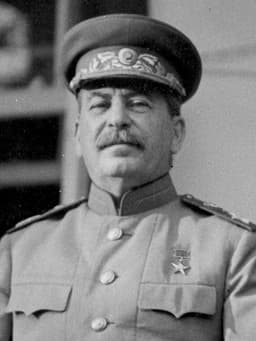
Joseph Stalin
Politician · Modern
68.8Total

Julius Caesar
General · Ancient
82.8Total
Basic Information
Born
1878
-100
Died
1953
-44
Era
Modern
Ancient
Nationality
Russia
Roman Republic
Occupation
Politician
General
Civilization
Western
Western
Score Comparison
Military (10%)
75.0
88.0
Political (20%)
70.0
78.0
Influence (20%)
72.0
85.0
Legacy (20%)
55.0
82.0
Leadership (15%)
80.0
80.0
Strategy (15%)
70.0
85.0
TOTAL
68.8
82.8
Joseph Stalin — Complete Timeline
1928 AD
Launched the First Five-Year PlanReform
Stalin initiated a series of centralized economic plans aimed at rapid industrialization and collectivization of agriculture. The First Five-Year Plan set ambitious targets for heavy industry, leading to significant growth but also severe shortages and human cost.
Impact: global
1929 AD
Implemented forced collectivization of agricultureReform
Stalin ordered the consolidation of individual peasant farms into collective farms (kolkhozy). This was met with resistance, leading to the liquidation of kulaks (wealthy peasants) as a class. The policy caused a catastrophic famine, particularly in Ukraine (Holodomor), resulting in millions of deaths.
Impact: nationaldestructive
1937 AD
Conducted the Great Purge (Great Terror)Political Action
Stalin orchestrated a campaign of political repression against alleged enemies of the state. Millions were arrested, executed, or sent to the Gulag labor camps. The purges targeted the Communist Party, military leadership, intellectuals, and ordinary citizens, consolidating Stalin's absolute power.
Impact: nationaldestructive
1945 AD
Led the Soviet Union to victory in World War IIWar
Stalin served as Supreme Commander of the Soviet armed forces. The Soviet Union bore the brunt of the war against Nazi Germany, suffering immense casualties. The Red Army's victory at Stalingrad and the capture of Berlin were key turning points. The war ended with Soviet domination of Eastern Europe.
Impact: global
Established the Eastern Bloc and the Iron CurtainPolitical Action◆ Major
After WWII, Stalin imposed communist governments in Eastern European countries occupied by the Red Army, creating a buffer zone against the West. This division of Europe into Soviet and Western spheres of influence marked the beginning of the Cold War.
Impact: globaldestructive
Julius Caesar — Complete Timeline
58 BC
Gallic WarsWar◆ Major
Caesar, as proconsul of Gaul, launched a series of campaigns that conquered all of Gaul (modern France, Belgium, and parts of Switzerland). He fought numerous battles, including against the Helvetii, the Belgae, and the Gallic chieftain Vercingetorix. The wars brought immense wealth and a loyal army to Caesar.
Gallic WarsConquestRoman Expansion
Impact: regional
49 BC
Crossing the RubiconPolitical Action◆ Major
Caesar led Legio XIII across the Rubicon River into Italy, defying the Roman Senate's order to disband his army. This act triggered a civil war against Pompey and the Optimates, ultimately leading to Caesar's dictatorship and the end of the Roman Republic.
Roman Civil WarEnd of RepublicPower Struggle
Impact: global
48 BC
Battle of PharsalusWar◆ Major
Caesar's outnumbered army defeated the larger forces of Pompey the Great at Pharsalus in Greece. Caesar's tactical use of a reserve line to counter Pompey's cavalry charge proved decisive. Pompey fled to Egypt, where he was assassinated, leaving Caesar as the undisputed master of the Roman world.
Roman Civil WarBattleDecisive Victory
Impact: regional
44 BC
Appointment as Dictator for LifePolitical Action◆ Major
The Roman Senate appointed Caesar dictator perpetuo (dictator for life), granting him unprecedented personal power. This move concentrated military, legislative, and judicial authority in one person, effectively ending the Roman Republic's traditional system of checks and balances and alarming many senators.
DictatorshipEnd of RepublicPower Consolidation
Impact: regionaldestructive
Assassination on the Ides of MarchPolitical Action◆ Major
A group of Roman senators, led by Marcus Junius Brutus and Gaius Cassius Longinus, stabbed Caesar to death at a meeting of the Senate in the Theatre of Pompey. The assassination was intended to restore the Republic, but instead triggered another civil war that led to the rise of the Roman Empire.
AssassinationRoman PoliticsEnd of Republic
Impact: globaldestructive
Expert Analysis
Julius Caesar vs Joseph Stalin
# The Rubicon and the Kremlin: Two Paths to Absolute Power
On a January morning in 44 BCE, Gaius Julius Caesar stood at the edge of a small river in northern Italy, the Rubicon, knowing that crossing it meant civil war and the death of the Roman Republic. Nineteen centuries later, in a cramped Moscow office, Joseph Vissarionovich Stalin stared at a map of the Soviet Union, preparing to launch a Five-Year Plan that would transform a peasant nation into an industrial colossus—at the cost of millions of lives. Both men sought absolute power. Both reshaped their worlds. But where Caesar’s ambition ended in a Senate chamber drenched in blood, Stalin’s ended in a mausoleum where his embalmed body would be venerated for decades. Why did these two paths diverge so dramatically? The answer lies not just in their eras, but in the very nature of power itself.
Origins
Caesar was born into the twilight of the Roman Republic, a world of senatorial intrigue, slave revolts, and endless frontier wars. His family, the Julii, claimed descent from the goddess Venus, but they were politically marginal—patricians with dwindling influence. Young Caesar grew up in a Rome where a man’s worth was measured by his military glory and his ability to manipulate the Senate. He learned early that survival required both a sword and a silver tongue.
Stalin, by contrast, emerged from the gritty margins of the Russian Empire. Born Ioseb Besarionis dze Jughashvili in 1878 in the Georgian town of Gori, his father was a cobbler, his mother a washerwoman. He was beaten by his father, adored by his mother, and marked by smallpox that left scars on his face. Where Caesar was bred for public life, Stalin was forged in the crucible of poverty, Orthodox seminary discipline, and revolutionary underground. He learned that trust was a weakness and that power came from controlling the levers of fear.
Rise to Power
Caesar’s ascent was a masterclass in political theater. He borrowed fortunes to fund lavish games for the Roman populace, forged the First Triumvirate with Pompey and Crassus, and then conquered Gaul in a nine-year war that made him the richest and most feared man in the Republic. His military brilliance—capturing over 800 cities and defeating three million Gauls—was matched only by his political cunning. When the Senate ordered him to disband his army, he crossed the Rubicon in 49 BCE, gambling everything on a single throw of the dice. Within four years, he was dictator for life.
Stalin’s rise was quieter, more bureaucratic, and far more ruthless. After the Bolshevik Revolution of 1917, he worked his way through the Party machinery, accumulating power in roles that others dismissed as clerical—overseeing the Commissariat of Nationalities, editing *Pravda*, and becoming General Secretary of the Communist Party. By the time Vladimir Lenin died in 1924, Stalin had placed his loyalists in every key position. He outmaneuvered Trotsky, Zinoviev, and Kamenev not through battlefield valor, but through patient, methodical control of appointments, files, and secrets. By 1928, when he launched the First Five-Year Plan, no one in the Soviet Union could challenge him.
Leadership & Governance
Caesar governed as a reformer who understood that power required legitimacy. He expanded the Senate to include provincials, reformed the calendar (giving us the Julian calendar), granted citizenship to Gauls, and initiated massive public works. His rule was autocratic, but it was also popular—he knew that the Roman mob could make or break a ruler. On the battlefield, he led from the front, sharing his soldiers’ rations and risks. His *Commentaries on the Gallic War* remain a masterpiece of military propaganda and self-fashioning.
Stalin governed through terror and industrialization. The First Five-Year Plan, launched in 1928, aimed to transform the Soviet Union from a backward agrarian state into a modern industrial power. Steel mills rose, dams were built, and the countryside was forced into collective farms under the 1929 collectivization campaign. The human cost was staggering: millions starved in the Holodomor of Ukraine, and millions more were sent to the Gulag. The Great Purge of 1937–1938 saw the arrest of over 1.5 million people, with at least 700,000 executed. Stalin’s military strategy during World War II was brutal but effective—he sacrificed entire armies to buy time, then crushed the Wehrmacht at Stalingrad and Kursk. Where Caesar inspired loyalty, Stalin demanded obedience.
Triumph & Tragedy
Caesar’s greatest triumph was the conquest of Gaul, which brought immense wealth and territory to Rome. His most devastating tragedy was his own assassination on the Ides of March, 44 BCE, when senators he had pardoned stabbed him to death. He died at the foot of a statue of Pompey, his former ally and enemy, his blood pooling on the Senate floor. His final act—covering himself with his toga so that even in death he appeared dignified—was pure theater.
Stalin’s greatest triumph was leading the Soviet Union to victory in World War II in 1945, crushing Nazi Germany at a cost of 27 million Soviet lives. His most devastating tragedy was the human catastrophe of his domestic policies: the famine of 1932–1933, the purges, the labor camps. He died in 1953 of a cerebral hemorrhage, surrounded by terrified aides who dared not call a doctor without his permission. His body was embalmed and placed in Lenin’s Mausoleum—only to be removed in 1961 during de-Stalinization.
Character & Destiny
Caesar was a gambler who believed in his own star. He was generous to his enemies, perhaps fatally so—he pardoned Brutus and Cassius, who repaid him with daggers. His vanity and ambition drove him to accept the title of dictator for life, a step too far for a Republic that had not had a king for 500 years. He died because he could not imagine that anyone would dare to kill him.
Stalin was a paranoid who believed in no one. He slept in different rooms each night, had his food tested for poison, and saw enemies everywhere. His cruelty was not impulsive but systematic—he signed death lists by the thousands while watching movies in his private cinema. His character shaped his destiny: he created a system of total control that consumed millions, but also left him utterly alone, the most powerful man in the world with no one he could trust.
Legacy
Caesar’s legacy is paradoxical. He destroyed the Roman Republic, yet his name became synonymous with imperial power—*Kaiser* in German, *Tsar* in Russian. His reforms laid the foundation for the Roman Empire that lasted another 500 years. He is remembered as a military genius, a prose stylist, and a cautionary tale about ambition.
Stalin’s legacy is darker and more contested. He industrialized a backward nation and defeated Hitler, but at a cost that defies moral accounting. In Russia today, polls show that nearly half the population views him favorably, crediting him with victory and order, while others see only a tyrant. His name is a synonym for state terror, but the system he built—the centralized, secretive, paranoid state—outlived him by decades.
Conclusion
Standing on opposite sides of history, Caesar and Stalin shared a hunger for absolute power that consumed everything in its path. Caesar’s power was personal, theatrical, and ultimately fragile—it died with him on the Senate floor. Stalin’s power was institutional, bureaucratic, and terrifyingly durable—it outlasted him, embedded in the DNA of a superpower. One died because he trusted too much; the other died because he trusted too little. In the end, both men teach us the same lesson: that power, whether won by the sword or the Party card, is always a pact with fate. And fate, as Caesar might have said, always collects its due.
Rankings
🥇
Julius CaesarLeader
Mil: 88.0Pol: 78.0Inf: 85.0
82.8
🥈
Joseph Stalin
Mil: 75.0Pol: 70.0Inf: 72.0
68.8
+14.0 behind
How This Comparison Works
Algorithm
Each figure is scored on 6 dimensions (0—100 scale) based on structured historical data: Military (10%), Political (20%), Influence (20%), Legacy (20%), Leadership (15%), Strategy (15%). The weighted total produces the final ranking.
Data Sources
Scores are computed from structured sub-indicators in the database. Scale factors adjust for era (Ancient ×0.85, Modern ×1.0) and civilization size (Eastern ×1.05, Other ×0.80) to account for differences in population and military scale.
Maximum 3 Figures
Comparisons are limited to 2—3 figures to ensure readability and statistical meaningfulness.
Error Margins
±5 points per dimension — Sub-scores are derived from historical records with inherent uncertainty. Two figures within 5 points on a dimension should be considered roughly equivalent in that area.
Total Score Accuracy
±3 points overall — The weighted combination of 6 dimensions produces a total score with approximately ±3 points of uncertainty. Differences of less than 3 points are not statistically significant— the figures are effectively tied.
Known Limitations
- Historical records are incomplete and uneven across civilizations
- Figures from oral-tradition societies may be underrepresented
- Occupation labels can misclassify multi-role figures
- Scores measure capability and impact, not moral character
- Quantitative scoring is a comparison tool, not absolute truth
Capability Radar
Military (10%) — Battles & Warfare
Battles
85
95
Win Rate
80
92
Expansion
85
97
Political (20%) — Governance & Reform
Reform
90
90
Diplomacy
70
85
Economy
85
82
Influence (20%) — Cultural & Global Reach
Cultural
70
88
Global
95
94
Legacy (20%) — Historical Impact
Historical
95
95
Longevity
80
96
Leadership (15%) — Power & Stability
Tenure
95
75
Stability
60
60
Strategy (15%) — Tactics & Innovation
Strategy
85
94
Tactics
60
96
Reform
90
88
Similar Comparisons
Comments & Discussion
RUBICON_RATTLER6/16/2026
Caesar was a gambler who bet on glory; Stalin was a bookkeeper who bet on terror. Caesar crossed one river once. Stalin redrew every border on the map—and the people inside them. Caesar’s enemies were aristocrats with daggers; Stalin’s were peasants with grain quotas. The difference between a coup and a purge is body count. Stalin killed more in a Tuesday morning than Caesar did in the Gallic Wars. Don’t conflate ambition with butchery.
铁幕铁杆6/16/2026
拿凯撒跟斯大林比,就像拿雷暴雨跟毒气室比。凯撒打仗为了声望,斯大林搞工业化是为了权力机器本身。罗马元老院至少还能刺杀独裁者;斯大林的官僚系统连他死后都不敢动他一根汗毛。凯撒死时元老院还在,斯大林死时整个国家就是他的纪念碑。这不是两种风格,是两个物种。
ASSASSIN_ANALYST6/16/2026
You’re missing the structural difference. Caesar’s power was personal, built on client armies and charisma. Stalin’s was institutional, built on the Bolshevik party and the NKVD. Caesar could be killed and the Republic could try to come back—it didn’t, but it tried. Stalin couldn’t be removed without tearing down the entire system. That’s why Caesar died on the Senate floor and Stalin died in bed. One was a man; the other was a system wearing a mustache.
历史秤砣6/16/2026
数据上两人根本不在一个量级。凯撒的高卢战争死了约一百万高卢人,他自己还觉得残忍。斯大林的大饥荒三年之内饿死三百万乌克兰人。凯撒统治罗马不到五年,斯大林统治苏联快三十年。凯撒死后罗马内战继续了十三年;斯大林死后苏联平稳过渡。效率不同,后果不同。说到底,凯撒是野心家,斯大林是系统化灭绝的工程师。