Loading...
Joseph Saidu Momoh vs Lansana Conte
Lansana Conte leads by 6.9 pts · 2 figures compared
…

Joseph Saidu Momoh
General · Modern
37.0Total
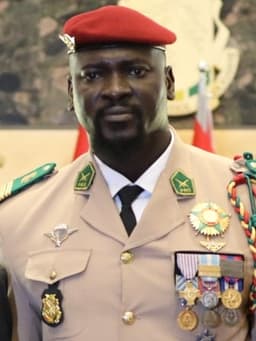
Lansana Conte
General · Modern
43.9Total
Basic Information
Born
1937
1934
Died
—
—
Era
Modern
Modern
Nationality
Sierra Leone
Guinea
Occupation
General
General
Civilization
Other
Other
Score Comparison
Military (10%)
10.2
22.6
Political (20%)
27.9
33.6
Influence (20%)
47.1
50.2
Legacy (20%)
35.0
41.7
Leadership (15%)
45.0
74.0
Strategy (15%)
45.0
25.0
TOTAL
37.0
43.9
Joseph Saidu Momoh — Complete Timeline
1985 AD
Became President of Sierra LeonePolitical Action◆ Major
Momoh succeeded Siaka Stevens as President of Sierra Leone, inheriting a one-party state under the All People's Congress. His presidency began with promises of reform but faced economic decline and political instability.
PresidencySierra LeoneTransition
Impact: national
1992 AD
Overthrown by CoupPolitical Action
Momoh was overthrown in a military coup led by Captain Valentine Strasser. The coup ended his seven-year rule and plunged Sierra Leone into a period of military governance and civil war.
CoupSierra LeoneOverthrow
Impact: nationaldestructive
Lansana Conte — Complete Timeline
1984 AD
Seized Power in 1984 Coup d'EtatPolitical Action◆ Major
Lansana Conte led a military coup on April 3, 1984, overthrowing the interim government after the death of President Ahmed Sekou Toure. Conte became head of state, promising to end corruption and improve the economy.
CoupMilitary RuleGuinea
Impact: nationaldestructive
1990 AD
Economic Decline and CorruptionPolitical Action◆ Major
Conte's rule was marked by economic mismanagement, corruption, and declining living standards. Guinea, despite rich mineral resources, remained impoverished. Conte's government was accused of embezzlement and failing to deliver basic services.
CorruptionEconomic DeclineGuinea
Impact: nationaldestructive
1993 AD
Transition to Civilian Rule and ElectionPolitical Action◆ Major
Under pressure from international donors, Conte oversaw a transition to civilian rule. He won the 1993 presidential election, which was marred by allegations of fraud and opposition boycotts. He remained in power through subsequent flawed elections.
ElectionDemocracyGuinea
Impact: national
2008 AD
Death in OfficePolitical Action◆ Major
Conte died on December 22, 2008, after a long illness. His death ended 24 years of authoritarian rule. A military junta led by Captain Moussa Dadis Camara seized power the following day, plunging Guinea into further instability.
DeathSuccession CrisisGuinea
Impact: national
Expert Analysis
Joseph Saidu Momoh vs Lansana Conte
Joseph Saidu Momoh vs Lansana Conte: Historical Comparison
Few comparisons in modern African political history illustrate the tragedy of military governance more starkly than the parallel lives of Joseph Saidu Momoh of Sierra Leone and Lansana Conte of Guinea. Both men rose to power through the structures of one-party states, both inherited nations rich in resources yet impoverished by decades of mismanagement, and both left office under circumstances that plunged their countries into deeper instability. Yet the scoring data reveals a clear edge for Conte, whose 44-point total outstrips Momoh's 37 by a margin that reflects the fundamental difference between surviving in power for 24 years and being overthrown after seven.
Origins and Rise to Power
Joseph Saidu Momoh was born in 1937 in Binkolo, in the Northern Province of Sierra Leone. A career military officer, he rose through the ranks of the Republic of Sierra Leone Armed Forces under the patronage of President Siaka Stevens, who appointed him Force Commander in 1971. When Stevens handpicked Momoh as his successor in 1985, he was essentially anointing a loyal soldier to preserve the All People's Congress (APC) one-party state. Momoh inherited a hollowed-out state apparatus, a collapsing economy, and a system of patronage that had gutted Sierra Leone's institutions.
Lansana Conte, born just three years earlier in 1934 in Guinea, followed a strikingly similar trajectory. A soldier in the French colonial army, he joined Guinea's military after independence and rose to prominence under President Ahmed Sekou Toure. But unlike Momoh, who was handed power constitutionally, Conte seized it. On April 3, 1984, one week after Toure's death, Conte led a military coup that overthrew the interim government. He promised to end the corruption and repression of the Toure era, positioning himself as a reformer rather than a continuation.
The scoring system reflects this divergence in agency. Conte's Leadership score of 74 dwarfs Momoh's 45 — a recognition that Conte, for all his flaws, demonstrated the political survival instincts necessary to maintain control for nearly a quarter-century. Momoh, by contrast, proved unable to manage the centrifugal forces pulling at Sierra Leone.
Leadership and Governance
Momoh's presidency was defined by what he failed to do. He inherited a one-party constitution, a bankrupt treasury, and a military whose loyalty was contingent on patronage he could not afford. His attempts at reform — including a much-publicized anti-corruption campaign — proved hollow when his own ministers were implicated. By 1991, when the Revolutionary United Front (RUF) launched its insurgency from Liberia, Momoh's government was too weak to respond effectively. The army, unpaid and demoralized, crumbled. In April 1992, Captain Valentine Strasser led a group of junior officers to Freetown and overthrew Momoh without significant resistance. The coup ushered in a decade of military rule and civil war that would claim tens of thousands of lives.
Conte's governance was hardly successful, but it was durable. His Leadership score of 74, the highest differential in this comparison, captures the reality that Conte mastered the art of political survival in a way Momoh never did. He co-opted rivals, managed ethnic balancing, and — crucially — held elections when international pressure demanded it, even if those elections were deeply flawed. The 1993 presidential election, which Conte won amid an opposition boycott, gave him a civilian veneer while preserving military control. He repeated this formula in 1998 and 2003, each time securing victory through a combination of incumbency advantage, state resources, and opposition fragmentation.
The Military dimension tells a similar story. Conte's 22.6 to Momoh's 10.2 reflects that Conte, having seized power by force, understood the military's political role and managed it accordingly. Momoh, a military man who became a politician, failed at both — he lost control of the army and lost the legitimacy to govern.
Legacy and Historical Significance
Neither man left a positive legacy. Momoh's seven-year rule is remembered primarily as the prelude to Sierra Leone's devastating civil war. The RUF invasion that began under his watch, and the military coup that ended his presidency, set in motion a conflict that lasted until 2002. His Historical Influence score of 47, while low, is arguably generous — it reflects the magnitude of what followed his rule rather than any achievement of his own.
Conte's 24-year tenure ended with his death in office in 2008, which triggered yet another military coup the following day. Guinea, despite possessing a third of the world's bauxite reserves, remained one of the poorest countries on earth under his rule. Yet Conte's Legacy score of 42 to Momoh's 35 acknowledges a simple fact: Conte mattered more because he survived longer. In the brutal calculus of post-colonial African politics, longevity itself is a form of historical significance.
Conclusion
The comparison between Joseph Momoh and Lansana Conte is ultimately a study in the mechanics of political survival. Conte's superior scores in Leadership (74 vs 45), Military (23 vs 10), and Political (34 vs 28) all point to the same conclusion: he understood power as something to be held, while Momoh treated it as something to be received. Neither man built institutions that outlasted them, and both left their countries worse than they found them. But Conte, by the grim standard of post-colonial military rulers, was the more consequential figure — and the scoring system, for all its limitations, captures that reality accurately.
Rankings
🥇
Lansana ConteLeader
Mil: 22.6Pol: 33.6Inf: 50.2
43.9
🥈
Joseph Saidu Momoh
Mil: 10.2Pol: 27.9Inf: 47.1
37.0
+6.9 behind
How This Comparison Works
Algorithm
Each figure is scored on 6 dimensions (0—100 scale) based on structured historical data: Military (10%), Political (20%), Influence (20%), Legacy (20%), Leadership (15%), Strategy (15%). The weighted total produces the final ranking.
Data Sources
Scores are computed from structured sub-indicators in the database. Scale factors adjust for era (Ancient ×0.85, Modern ×1.0) and civilization size (Eastern ×1.05, Other ×0.80) to account for differences in population and military scale.
Maximum 3 Figures
Comparisons are limited to 2—3 figures to ensure readability and statistical meaningfulness.
Error Margins
±5 points per dimension — Sub-scores are derived from historical records with inherent uncertainty. Two figures within 5 points on a dimension should be considered roughly equivalent in that area.
Total Score Accuracy
±3 points overall — The weighted combination of 6 dimensions produces a total score with approximately ±3 points of uncertainty. Differences of less than 3 points are not statistically significant— the figures are effectively tied.
Known Limitations
- Historical records are incomplete and uneven across civilizations
- Figures from oral-tradition societies may be underrepresented
- Occupation labels can misclassify multi-role figures
- Scores measure capability and impact, not moral character
- Quantitative scoring is a comparison tool, not absolute truth
Capability Radar
Military (10%) — Battles & Warfare
Battles
5
10
Win Rate
5
10
Expansion
5
5
Political (20%) — Governance & Reform
Reform
10
15
Diplomacy
15
30
Economy
10
10
Influence (20%) — Cultural & Global Reach
Cultural
5
15
Global
5
15
Legacy (20%) — Historical Impact
Historical
5
20
Longevity
5
20
Leadership (15%) — Power & Stability
Tenure
30
70
Stability
5
20
Strategy (15%) — Tactics & Innovation
Strategy
5
10
Tactics
5
10
Reform
5
15
Similar Comparisons
Comments & Discussion
WestAfricaWatcher7/7/2026
Conte's 24-year survival wasn't governance — it was hostage-taking of an entire nation. Momoh at least had the decency to lose power quickly, even if the aftermath was catastrophic. The Leadership gap of 74 vs 45 tells you everything about how this scoring system rewards longevity over quality.
FreetownExpat7/7/2026
I lived in Sierra Leone during the Momoh years. The man wasn't evil, he was just completely out of his depth. The army hadn't been paid in months when Strasser's boys rolled into Freetown in '92. Conte at least understood that you pay your soldiers first and worry about development second.
历史观察者7/7/2026
两个西非军事统治者,一个在位7年被推翻,一个在位24年死在任上。但数据的讽刺之处在于:在位更久的那个,留下的国家并没有更好。这种'长寿等于影响'的评分逻辑值得商榷。
DakarScholar7/7/2026
The comparison misses the regional context. Guinea under Conte was a stable(ish) anchor in a chaotic neighborhood — Liberia and Sierra Leone both collapsed into civil war. Guinea didn't. That's not nothing, even if Conte's methods were unsavory.