Loading...
Jose Luis Rodriguez Zapatero vs Solomon Mamaloni
Jose Luis Rodriguez Zapatero leads by 8.7 pts · 2 figures compared
…
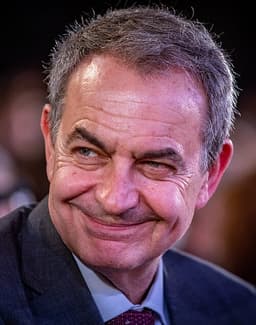
Jose Luis Rodriguez Zapatero
Politician · Modern
55.2Total

Solomon Mamaloni
Politician · Modern
46.5Total
Basic Information
Born
1960
1943
Died
—
—
Era
Modern
Modern
Nationality
Spain
Solomon Islands
Occupation
Politician
Politician
Civilization
Western
Other
Score Comparison
Military (10%)
50.0
28.0
Political (20%)
60.0
68.0
Influence (20%)
58.3
49.4
Legacy (20%)
50.0
40.8
Leadership (15%)
66.0
40.0
Strategy (15%)
42.7
49.5
TOTAL
55.2
46.5
Jose Luis Rodriguez Zapatero — Complete Timeline
2004 AD
Election as Prime Minister of SpainPolitical Action◆ Major
Zapatero's Spanish Socialist Workers' Party won the 2004 general election three days after the Madrid train bombings. He became Prime Minister on April 17, 2004, and immediately withdrew Spanish troops from Iraq.
ElectionGovernment
Impact: national
2005 AD
Legalization of Same-Sex MarriageReform◆ Major
Zapatero's government passed a law legalizing same-sex marriage on July 3, 2005, making Spain one of the first countries to do so. The law also granted adoption rights to same-sex couples, sparking opposition from the Catholic Church.
Social ReformLGBTQ Rights
Impact: nationalprogressive
2007 AD
Law of Historical MemoryReform◆ Major
Zapatero's government enacted the Law of Historical Memory on October 31, 2007, which recognized victims of the Spanish Civil War and Francoist regime. It provided for the removal of Francoist symbols and support for exhumations of mass graves.
Historical JusticeCivil War
Impact: nationalconstructive
2010 AD
Economic Crisis and AusterityPolitical Action◆ Major
Facing the Eurozone crisis, Zapatero's government implemented austerity measures in May 2010, including public sector wage cuts and pension freezes. This reversed his earlier expansionary policies and led to protests and a loss of popularity.
Economic CrisisAusterity
Impact: nationaldestructive
Solomon Mamaloni — Complete Timeline
1981 AD
First elected Prime Minister of Solomon IslandsPolitical Action◆ Major
Solomon Mamaloni became Prime Minister for the first time, leading the country after independence. His tenure focused on economic development and infrastructure.
ElectionLeadership
Impact: national
1982 AD
Signed the Solomon Islands–Papua New Guinea Border AgreementPolitical Action
Mamaloni signed a border agreement with Papua New Guinea, resolving maritime boundaries. The treaty aimed to prevent disputes over resources.
TreatyBorder
Impact: regionalconstructive
1994 AD
Third term as Prime MinisterPolitical Action◆ Major
Mamaloni became Prime Minister for the third time, serving until 1997. His later terms were marked by economic challenges and political instability.
LeadershipThird Term
Impact: national
Expert Analysis
Origins
**Jose Luis Rodriguez Zapatero** was born on August 4, 1960, in Valladolid, Spain, into a family with Republican sympathies; his grandfather was executed by Francoist forces. He studied law at the University of Leon and became involved in socialist politics early, joining the Spanish Socialist Workers' Party (PSOE) in 1979. His family background deeply influenced his commitment to social justice and historical memory.
**Solomon Mamaloni** was born on January 23, 1943, in Makira, Solomon Islands, then a British protectorate. He attended local schools and later studied at the University of Papua New Guinea, where he earned a degree in economics. Returning to the Solomons, he entered politics through the local council system, eventually becoming a key figure in the push for independence.
Rise to Power
Zapatero's rise was steady within the PSOE. He was elected to the Spanish Congress in 1986 at age 26. In 2000, he became Secretary-General of the PSOE, revitalizing the party after electoral defeats. His major breakthrough came in the 2004 general election, held just three days after the Madrid train bombings (March 11, 2004). The PSOE won 42.6% of the vote, and Zapatero became Prime Minister on April 17, 2004, at age 43.
Mamaloni first became Prime Minister in 1981, shortly after Solomon Islands' independence in 1978. He was a member of the People's Alliance Party and formed a coalition government. His rise was facilitated by his role in the independence movement and his appeal to rural constituents. He served three non-consecutive terms: 1981-1984, 1989-1993, and 1994-1997, often navigating unstable parliamentary coalitions.
Leadership & Governance
Zapatero's leadership style was reformist and progressive. His government legalized same-sex marriage (July 3, 2005), granting adoption rights, and enacted the Law of Historical Memory (October 31, 2007) to recognize victims of the Civil War and Franco regime. He also pursued gender equality, appointing a cabinet with equal numbers of men and women. However, his response to the 2008 financial crisis was criticized; austerity measures in May 2010 (public sector wage cuts, pension freezes) led to protests and a loss of support.
Mamaloni focused on economic development and infrastructure, but his tenure was marred by corruption allegations and political instability. He signed the Solomon Islands–Papua New Guinea Border Agreement to resolve maritime disputes. His governance score is 40.0, reflecting limited institutional strength. He struggled to maintain coalition unity, and his later terms saw declining economic conditions and rising ethnic tensions.
Triumph & Tragedy
Zapatero's greatest triumph was the legalization of same-sex marriage, making Spain a global leader in LGBTQ+ rights. The Law of Historical Memory also addressed long-ignored injustices. However, his tragedy was the economic crisis: unemployment rose to over 20%, and his austerity policies angered his base. His Political score of 60.0 reflects these mixed results.
Mamaloni's triumph was guiding the Solomon Islands through its early post-independence years and securing the border agreement. His tragedy was the failure to build stable institutions; ethnic violence erupted in the late 1990s after his tenure, partly due to weak governance. His Leadership score of 40.0 indicates his inability to sustain effective rule.
Character & Destiny
Zapatero was idealistic and principled, often pushing social reforms despite opposition. His character shaped his fate: his progressive agenda won him international acclaim but domestic polarization. He stepped down in 2011 after the PSOE's electoral defeat, accepting responsibility for the economic situation.
Mamaloni was pragmatic and adept at coalition politics, but criticized for cronyism. His character led to short-term gains but long-term instability. He died in 2000 at age 57, leaving a mixed legacy of independence leadership but failed governance.
Legacy
Zapatero's legacy includes lasting social reforms: same-sex marriage remains law, and historical memory laws have been expanded. His influence on Spanish politics is significant, though his economic record tarnished his reputation. He scored 50.0 in Legacy.
Mamaloni's legacy is more limited; he is remembered as a founding father but also as a symbol of the corruption and instability that plagued the Solomon Islands. His Influence score of 49.4 is modest, reflecting his limited global impact.
Conclusion
While both were prime ministers, Zapatero had greater impact due to his transformative social policies and Spain's larger global role. His total score of 55.2 surpasses Mamaloni's 46.5, and his reforms have endured. Mamaloni's influence was constrained by the small scale of his nation and governance failures. Thus, Zapatero stands as the more significant historical figure.
Rankings
🥇
Jose Luis Rodriguez ZapateroLeader
Mil: 50.0Pol: 60.0Inf: 58.3
55.2
🥈
Solomon Mamaloni
Mil: 28.0Pol: 68.0Inf: 49.4
46.5
+8.7 behind
How This Comparison Works
Algorithm
Each figure is scored on 6 dimensions (0—100 scale) based on structured historical data: Military (10%), Political (20%), Influence (20%), Legacy (20%), Leadership (15%), Strategy (15%). The weighted total produces the final ranking.
Data Sources
Scores are computed from structured sub-indicators in the database. Scale factors adjust for era (Ancient ×0.85, Modern ×1.0) and civilization size (Eastern ×1.05, Other ×0.80) to account for differences in population and military scale.
Maximum 3 Figures
Comparisons are limited to 2—3 figures to ensure readability and statistical meaningfulness.
Error Margins
±5 points per dimension — Sub-scores are derived from historical records with inherent uncertainty. Two figures within 5 points on a dimension should be considered roughly equivalent in that area.
Total Score Accuracy
±3 points overall — The weighted combination of 6 dimensions produces a total score with approximately ±3 points of uncertainty. Differences of less than 3 points are not statistically significant— the figures are effectively tied.
Known Limitations
- Historical records are incomplete and uneven across civilizations
- Figures from oral-tradition societies may be underrepresented
- Occupation labels can misclassify multi-role figures
- Scores measure capability and impact, not moral character
- Quantitative scoring is a comparison tool, not absolute truth
Capability Radar
Military (10%) — Battles & Warfare
Battles
31
25
Win Rate
29
27
Expansion
33
31
Political (20%) — Governance & Reform
Reform
75
45
Diplomacy
60
55
Economy
45
40
Influence (20%) — Cultural & Global Reach
Cultural
55
20
Global
55
15
Legacy (20%) — Historical Impact
Historical
50
25
Longevity
40
20
Leadership (15%) — Power & Stability
Tenure
65
60
Stability
50
35
Strategy (15%) — Tactics & Innovation
Strategy
37
35
Tactics
42
37
Reform
44
43
Similar Comparisons
Comments & Discussion
No comments yet. Be the first to share your thoughts!