Loading...
John Major vs Napoleon Bonaparte
Napoleon Bonaparte leads by 12.9 pts · 2 figures compared
…
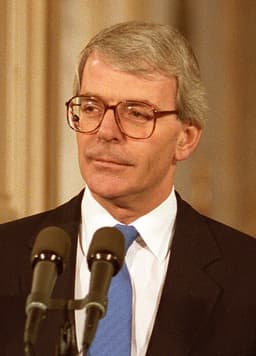
John Major
Politician · Modern
58.0Total

Napoleon Bonaparte
General · Modern
70.9Total
Basic Information
Born
1943
1769
Died
—
1821
Era
Modern
Modern
Nationality
United Kingdom
France
Occupation
Politician
General
Civilization
Western
Western
Score Comparison
Military (10%)
50.0
94.0
Political (20%)
72.0
72.0
Influence (20%)
58.0
40.0
Legacy (20%)
50.0
80.0
Leadership (15%)
72.0
78.0
Strategy (15%)
43.7
90.0
TOTAL
58.0
70.9
John Major — Complete Timeline
1991 AD
Negotiated the Maastricht TreatyPolitical Action
Major negotiated the Maastricht Treaty, which created the European Union and established the euro currency. He secured opt-outs for the UK from the single currency and social chapter, a major achievement in European integration.
European UnionTreatyUK Opt-Outs
Impact: globalconstructive
1992 AD
Black WednesdayOther
The UK was forced to withdraw the pound sterling from the European Exchange Rate Mechanism after a speculative attack. The government spent billions trying to defend the currency, a major economic and political failure for Major's government.
Economic CrisisERMCurrency Crisis
Impact: nationaldestructive
Won the 1992 General ElectionPolitical Action◆ Major
Major led the Conservative Party to an unexpected victory in the 1992 general election, winning a majority of 21 seats. This was the Conservatives' fourth consecutive election win, despite predictions of a hung parliament.
General ElectionConservative VictoryPolitical Surprise
Impact: national
1993 AD
Signed the Downing Street DeclarationPolitical Action◆ Major
Major and Irish Taoiseach Albert Reynolds signed the Downing Street Declaration, a joint peace initiative for Northern Ireland. The declaration affirmed the principle of consent and opened the way for peace negotiations.
Northern IrelandPeace ProcessAnglo-Irish Relations
Impact: regionalconstructive
1997 AD
Resigned as Prime MinisterPolitical Action◆ Major
Major resigned as prime minister after the Conservative Party suffered a landslide defeat in the 1997 general election to Tony Blair's Labour Party. The defeat ended 18 years of Conservative government.
General ElectionConservative DefeatPolitical Transition
Impact: nationaltragic
Napoleon Bonaparte — Complete Timeline
1799 AD
Coup of 18 BrumaireOther◆ Major
Napoleon Bonaparte, with support from his brother Lucien and key political figures, overthrew the Directory in a bloodless coup. He established the Consulate with himself as First Consul, effectively becoming the ruler of France. This event ended the French Revolution's most unstable period.
French RevolutionCoupRise to Power
Impact: regional
1804 AD
Promulgation of the Napoleonic CodeOther◆ Major
Napoleon enacted the Civil Code of the French, known as the Napoleonic Code, a comprehensive set of laws that replaced the fragmented feudal legal systems. The code established legal equality, protected property rights, and secularized law. It became the basis for legal systems in many European and world countries.
Legal ReformNapoleonic CodeCivil Law
Impact: globalconstructive
1805 AD
Battle of AusterlitzWar◆ Major
Napoleon's Grande Arm
Napoleonic WarsBattleDecisive Victory
Impact: global
1812 AD
Invasion of RussiaWar◆ Major
Napoleon led the Grande Arm
Napoleonic WarsInvasionDisaster
Impact: globaldestructive
1815 AD
Battle of WaterlooWar◆ Major
Napoleon's French army was defeated by the combined forces of the Duke of Wellington's Anglo-Allied army and Gebhard Leberecht von Bl
Napoleonic WarsBattleFinal Defeat
Impact: globaldestructive
Expert Analysis
john-major-vs-napoleon-bonaparte
# The Emperor and the Accountant: Napoleon Bonaparte and John Major
The contrast could hardly be more stark. On one side stands Napoleon Bonaparte, crowned emperor in Notre-Dame, his hand resting on Charlemagne’s sword, his gaze fixed on Moscow. On the other sits John Major, a bespectacled former banker, sipping tea in Number 10 Downing Street, negotiating the fine print of the Maastricht Treaty. One conquered Europe; the other conquered a budget. Yet both men shaped the modern West. Why did one end his days on a remote Atlantic island while the other retired to write his memoirs in a Surrey suburb? The answer lies not in the grandeur of their ambitions but in the soil from which they grew.
Origins
Napoleon was born in 1769 on Corsica, an island the French had purchased from Genoa just months before. His family were minor nobility, but they were poor—and resentful. The young Napoleon devoured Plutarch’s *Lives* and dreamed of Alexander. Corsica taught him that the world was a place of conquest and survival, where a man with a sword could rewrite his destiny. By contrast, John Major was born in 1943 in the London suburb of Merton. His father was a music-hall performer turned garden-ornament maker—a man who, like Napoleon’s father, struggled with debt. But Major’s England was not a battlefield; it was a welfare state. He left school at sixteen to work as a clerk, then a bank teller. Where Napoleon learned to command armies, Major learned to balance ledgers. Their eras shaped them: the French Revolution had shattered the old order, offering glory to the ambitious; post-war Britain offered stability, security, and slow promotion.
Rise to Power
Napoleon’s ascent was a lightning strike. At twenty-four, he drove the British from Toulon; at twenty-six, he crushed a royalist uprising in Paris with a “whiff of grapeshot.” By thirty, he was First Consul; by thirty-five, Emperor. His path was paved with cannon fire and audacity. Major’s rise was a staircase. He entered Parliament in 1979, served as a whip, a minister, and then Chancellor of the Exchequer under Margaret Thatcher. When Thatcher fell in 1990, Major emerged as the compromise candidate—not the boldest, but the safest. He won the leadership not by storming the gates but by being the last man standing. Napoleon seized his moment; Major was handed his.
Leadership & Governance
Their ruling styles could not have differed more. Napoleon governed with a sword in one hand and a code of laws in the other. His Napoleonic Code—still the foundation of civil law across Europe—standardized justice, abolished feudalism, and protected property rights. Yet he also censored the press, restored slavery, and crowned himself emperor. He was a reformer and a tyrant in one uniform. Major governed by consensus and caution. He negotiated the Maastricht Treaty in 1991, which created the European Union and launched the euro—a political achievement of lasting significance. But he also presided over Black Wednesday in 1992, when speculators forced Britain out of the European Exchange Rate Mechanism, costing taxpayers billions and shattering the government’s economic credibility. Major’s greatest strength—his moderation—became his weakness. He tried to hold together a Conservative Party tearing itself apart over Europe, and he failed.
Militarily, the comparison is absurd. Napoleon fought more than sixty battles; Major never commanded a single soldier. But strategy was their common language. Napoleon’s genius lay in speed and concentration—dividing his enemies and crushing them piecemeal. Major’s strategy was political: in 1992, against all polls, he led the Conservatives to an unexpected general election victory, winning a majority of twenty-one seats. It was his Austerlitz. But he had no Waterloo to follow it—only the slow erosion of authority.
Triumph & Tragedy
Napoleon’s greatest moment was Austerlitz in 1805, where he destroyed the combined armies of Austria and Russia. His worst was the retreat from Moscow in 1812—the loss of half a million men to winter, hunger, and Cossacks. Major’s triumph was the Downing Street Declaration of 1993, signed with Irish Taoiseach Albert Reynolds, which laid the groundwork for the Good Friday Agreement and peace in Northern Ireland. His tragedy was Black Wednesday, a single day that defined his premiership as incompetent, though it was the system that failed, not the man. Napoleon’s tragedies were epic; Major’s were bureaucratic.
Character & Destiny
Napoleon was restless, brilliant, and insatiable. “I am not a man,” he once said, “I am a thing.” He saw himself as an instrument of history, which meant he could justify any ambition. Major was cautious, decent, and dull—a man who reminded the British public of their own suburban virtues. He once said, “I want to see a country that is at ease with itself.” That was not a line that would ever appear on Napoleon’s lips. Their personalities shaped their fates: Napoleon’s hunger drove him to conquer Europe and then to lose it; Major’s caution kept Britain stable but left him remembered as a caretaker, not a shaper.
Legacy
Napoleon left behind a transformed Europe: the Code, the metric system, the modern state structure, and the myth of the self-made emperor. He is remembered as both liberator and tyrant, genius and megalomaniac. Major left behind the Maastricht Treaty, the peace process in Northern Ireland, and a Conservative Party in ruins. His legacy is modest but real—a bridge between Thatcher and Blair, between Cold War and European Union. Where Napoleon’s shadow stretches across centuries, Major’s barely reaches the next election.
Conclusion
The historian looks at both men and sees the same question: what does it mean to lead? Napoleon proved that a single man can change the world, but also that the world will eventually break him. Major proved that a decent man can survive the fall, but also that survival is not the same as greatness. Their scores—Napoleon’s 82.4, Major’s 64.2—measure not their worth but their weight on history. One shook the earth; the other steadied the ground. Both were necessary. But only one will be remembered in the songs.
Rankings
🥇
Napoleon BonaparteLeader
Mil: 94.0Pol: 72.0Inf: 40.0
70.9
🥈
John Major
Mil: 50.0Pol: 72.0Inf: 58.0
58.0
+12.9 behind
How This Comparison Works
Algorithm
Each figure is scored on 6 dimensions (0—100 scale) based on structured historical data: Military (10%), Political (20%), Influence (20%), Legacy (20%), Leadership (15%), Strategy (15%). The weighted total produces the final ranking.
Data Sources
Scores are computed from structured sub-indicators in the database. Scale factors adjust for era (Ancient ×0.85, Modern ×1.0) and civilization size (Eastern ×1.05, Other ×0.80) to account for differences in population and military scale.
Maximum 3 Figures
Comparisons are limited to 2—3 figures to ensure readability and statistical meaningfulness.
Error Margins
±5 points per dimension — Sub-scores are derived from historical records with inherent uncertainty. Two figures within 5 points on a dimension should be considered roughly equivalent in that area.
Total Score Accuracy
±3 points overall — The weighted combination of 6 dimensions produces a total score with approximately ±3 points of uncertainty. Differences of less than 3 points are not statistically significant— the figures are effectively tied.
Known Limitations
- Historical records are incomplete and uneven across civilizations
- Figures from oral-tradition societies may be underrepresented
- Occupation labels can misclassify multi-role figures
- Scores measure capability and impact, not moral character
- Quantitative scoring is a comparison tool, not absolute truth
Capability Radar
Military (10%) — Battles & Warfare
Battles
27
95
Win Rate
29
90
Expansion
36
95
Political (20%) — Governance & Reform
Reform
55
95
Diplomacy
70
80
Economy
50
85
Influence (20%) — Cultural & Global Reach
Cultural
30
85
Global
50
90
Legacy (20%) — Historical Impact
Historical
55
95
Longevity
40
90
Leadership (15%) — Power & Stability
Tenure
65
85
Stability
45
70
Strategy (15%) — Tactics & Innovation
Strategy
39
95
Tactics
43
98
Reform
44
92
Similar Comparisons
Comments & Discussion
No comments yet. Be the first to share your thoughts!