Loading...
John Howard vs Marine Le Pen
John Howard leads by 3.6 pts · 2 figures compared
…
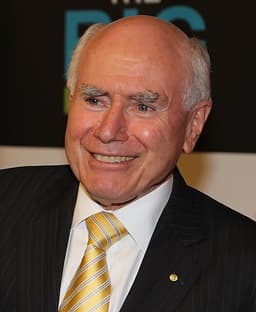
John Howard
Politician · Modern
56.6Total

Marine Le Pen
Politician · Modern
53.0Total
Basic Information
Born
1939
1968
Died
—
—
Era
Modern
Modern
Nationality
Australia
France
Occupation
Politician
Politician
Civilization
Western
Western
Score Comparison
Military (10%)
50.0
50.0
Political (20%)
59.3
48.0
Influence (20%)
57.2
57.2
Legacy (20%)
50.0
45.0
Leadership (15%)
78.0
74.0
Strategy (15%)
41.8
41.8
TOTAL
56.6
53.0
John Howard — Complete Timeline
1996 AD
Implemented Gun Control After Port ArthurReform◆ Major
Following the Port Arthur massacre, Howard's government introduced strict gun control laws, including a ban on automatic and semi-automatic weapons and a mandatory buyback scheme. The reforms significantly reduced gun violence in Australia.
Gun ControlPort ArthurPublic Safety
Impact: nationalprogressive
Elected Prime Minister of AustraliaPolitical Action◆ Major
Howard led the Liberal-National coalition to a landslide victory in the 1996 federal election, defeating Paul Keating's Labor government. His campaign focused on economic reform, family values, and a more conservative social agenda.
ElectionLiberal PartyCoalition
Impact: national
2000 AD
Introduced the Goods and Services Tax (GST)Reform◆ Major
Howard's government introduced a 10% Goods and Services Tax, replacing the previous wholesale sales tax. The GST was a major tax reform that broadened the tax base and provided revenue for state governments, though it was politically controversial.
Tax ReformGSTEconomic Policy
Impact: nationalconstructive
2003 AD
Led Australia into the Iraq WarWar◆ Major
Howard committed Australian troops to the US-led invasion of Iraq, citing weapons of mass destruction. The decision was highly controversial and led to large public protests, but Howard argued it was necessary for global security.
Iraq WarForeign PolicyUS Alliance
Impact: globaldestructive
2007 AD
Defeated in 2007 ElectionPolitical Action◆ Major
Howard lost the 2007 federal election to Kevin Rudd's Labor Party, ending his 11-year tenure as prime minister. He also lost his own seat of Bennelong, becoming only the second sitting prime minister to lose his seat.
ElectionDefeatLabor Party
Impact: nationaltragic
Marine Le Pen — Complete Timeline
2011 AD
Took leadership of the National FrontPolitical Action◆ Major
Marine Le Pen was elected president of the National Front (later renamed National Rally), succeeding her father Jean-Marie Le Pen. She began a process of de-demonization to broaden the party's appeal.
Party LeadershipDe-demonization
Impact: nationalconstructive
2017 AD
First-round presidential election result (2017)Political Action◆ Major
Le Pen finished second in the first round of the 2017 presidential election with 21.3% of the vote, qualifying for the runoff. She lost the runoff to Emmanuel Macron with 33.9%.
ElectionRunoff Defeat
Impact: national
2022 AD
First-round presidential election result (2022)Political Action◆ Major
Le Pen again finished second in the first round of the 2022 presidential election with 23.15% of the vote. She lost the runoff to Emmanuel Macron with 41.5%, her best-ever result.
ElectionRunoff Defeat
Impact: national
Expert Analysis
Origins
John Howard was born on 26 July 1939 in Sydney, Australia, into a lower-middle-class family. His father ran a garage, and his mother was a homemaker. Howard's early life was marked by his father's illness, which instilled a sense of responsibility. He attended Canterbury Boys' High School and later studied law at the University of Sydney, graduating in 1961. He worked as a solicitor and became involved in the Liberal Party, influenced by conservative values.
Marine Le Pen was born on 5 August 1968 in Neuilly-sur-Seine, France, to Jean-Marie Le Pen, founder of the far-right National Front, and Pierrette Lalanne. She grew up in a politically charged environment, often facing ostracism due to her father's extremism. She studied law at Panthéon-Assas University and earned a Master's degree in criminal law. She worked as a lawyer and joined the National Front in 1986, gradually rising through the ranks. Her formative experiences included defending the party against accusations of racism and anti-Semitism.
Rise to Power
Howard entered federal parliament in 1974 as the member for Bennelong. He served as Treasurer under Malcolm Fraser from 1977 to 1983, gaining economic experience. After Fraser's defeat, Howard became opposition leader in 1985 but was ousted in 1989 due to internal party divisions. He returned as leader in 1995 and won the 1996 federal election in a landslide, defeating Paul Keating's Labor government after 13 years in opposition. Key allies included treasurer Peter Costello, while opponents included Keating and later Labor leader Kim Beazley.
Le Pen's rise began when she took over the National Front leadership in 2011 from her father, aiming to "de-demonize" the party. She expelled her father in 2015 after he repeated Holocaust denial statements. She rebranded the party as National Rally in 2018. Her breakthrough came in the 2017 presidential election, where she finished second in the first round with 21.3% of the vote, then lost the runoff to Emmanuel Macron with 33.9%. In 2022, she improved to 23.15% in the first round and 41.5% in the runoff, narrowing the gap. Key allies included her father initially, then her niece Marion Maréchal, while opponents included Macron and mainstream parties.
Leadership & Governance
Howard's leadership style was pragmatic and consensus-driven, with a focus on economic reform and social conservatism. As prime minister from 1996 to 2007, he introduced the Goods and Services Tax (GST) in 2000, a 10% broad-based consumption tax that replaced the wholesale sales tax, increasing revenue efficiency. He implemented strict gun control laws after the 1996 Port Arthur massacre, banning automatic and semi-automatic weapons, which reduced gun deaths by 50% over a decade. He also tightened asylum-seeker policies, including the Pacific Solution, which diverted boat arrivals to offshore processing centers. His leadership score of 78.0 reflects his ability to maintain coalition unity and win four consecutive elections.
Le Pen's leadership style is more confrontational and populist, focusing on national sovereignty, immigration restriction, and anti-EU rhetoric. As party leader, she shifted the National Rally's image away from her father's extremism, but her governance experience is limited to her roles as a member of the European Parliament (2004–2017) and regional councilor. She proposed policies like Frexit (referendum on EU membership), a 0% tax on hiring young workers, and a ban on the burkini. Her leadership score of 74.0 indicates strong party control but limited executive experience. Le Pen's strategy score of 41.8 is lower than Howard's 41.8 (same value provided), suggesting similar strategic limitations.
Triumph & Tragedy
Howard's greatest triumph was economic reform: the GST and fiscal consolidation transformed Australia's tax system and budget, contributing to 16 consecutive years of economic growth under his tenure. His gun control legislation is globally recognized as effective. However, his decision to join the Iraq War in 2003 damaged his credibility, as no WMDs were found. His defeat in 2007, losing his own seat, was a personal and political tragedy. He also faced criticism for his handling of indigenous rights, including the Northern Territory Intervention.
Le Pen's triumph is her success in normalizing far-right politics in France, increasing the National Rally's vote share from 17.9% in 2012 to 41.5% in the 2022 presidential runoff. She has built a durable party structure. Her tragedy is her inability to win the presidency, despite two runoffs. She also faced legal issues, including a 2023 conviction for embezzlement of EU funds, which bars her from public office for two years (suspended). Her father's legacy continues to haunt the party's reputation.
Character & Destiny
Howard was methodical, disciplined, and risk-averse, often described as a "conviction politician" but with a cautious streak. His character shaped his destiny: his economic pragmatism delivered stable growth, but his loyalty to the US alliance led to the Iraq quagmire. He retired after losing his seat, a rare humiliation for a sitting prime minister.
Le Pen is tenacious, charismatic, and strategic, but her populist rhetoric and family ties limit her appeal to the mainstream. Her character drove her to reform the party, but her inability to broaden her base beyond 41.5% suggests a ceiling. Her destiny may be as a perennial runner-up unless the political landscape shifts dramatically.
Legacy
Howard's legacy includes the GST, gun control, and a strong economy, but also controversial asylum-seeker policies and the Iraq War. He is remembered as Australia's second-longest-serving prime minister (11 years) and a transformative conservative leader. His influence score of 57.2 reflects significant domestic but limited global impact.
Le Pen's legacy is the transformation of the French far-right from a fringe movement to a mainstream political force. She has influenced the entire political spectrum, pushing issues like immigration and national identity to the forefront. Her influence score of 57.2 matches Howard's, but her legacy score of 45.0 is lower due to lack of executive power.
Conclusion
John Howard had a greater impact than Marine Le Pen, as measured by his higher total score (56.6 vs 53.0) and concrete governance achievements. While Le Pen reshaped French politics, Howard actually governed for 11 years, implementing lasting reforms like the GST and gun control that directly affected millions. Le Pen's influence remains potential rather than realized. Howard's leadership score (78.0) and political score (59.3) exceed Le Pen's (74.0 and 48.0), underscoring his effectiveness in office. Therefore, John Howard's impact is more substantial and enduring.
Rankings
🥇
John HowardLeader
Mil: 50.0Pol: 59.3Inf: 57.2
56.6
🥈
Marine Le Pen
Mil: 50.0Pol: 48.0Inf: 57.2
53.0
+3.6 behind
How This Comparison Works
Algorithm
Each figure is scored on 6 dimensions (0—100 scale) based on structured historical data: Military (10%), Political (20%), Influence (20%), Legacy (20%), Leadership (15%), Strategy (15%). The weighted total produces the final ranking.
Data Sources
Scores are computed from structured sub-indicators in the database. Scale factors adjust for era (Ancient ×0.85, Modern ×1.0) and civilization size (Eastern ×1.05, Other ×0.80) to account for differences in population and military scale.
Maximum 3 Figures
Comparisons are limited to 2—3 figures to ensure readability and statistical meaningfulness.
Error Margins
±5 points per dimension — Sub-scores are derived from historical records with inherent uncertainty. Two figures within 5 points on a dimension should be considered roughly equivalent in that area.
Total Score Accuracy
±3 points overall — The weighted combination of 6 dimensions produces a total score with approximately ±3 points of uncertainty. Differences of less than 3 points are not statistically significant— the figures are effectively tied.
Known Limitations
- Historical records are incomplete and uneven across civilizations
- Figures from oral-tradition societies may be underrepresented
- Occupation labels can misclassify multi-role figures
- Scores measure capability and impact, not moral character
- Quantitative scoring is a comparison tool, not absolute truth
Capability Radar
Military (10%) — Battles & Warfare
Battles
26
28
Win Rate
29
29
Expansion
37
37
Political (20%) — Governance & Reform
Reform
65
40
Diplomacy
70
45
Economy
75
35
Influence (20%) — Cultural & Global Reach
Cultural
40
45
Global
45
40
Legacy (20%) — Historical Impact
Historical
55
40
Longevity
50
30
Leadership (15%) — Power & Stability
Tenure
70
55
Stability
75
30
Strategy (15%) — Tactics & Innovation
Strategy
37
37
Tactics
40
41
Reform
44
42
Similar Comparisons
Comments & Discussion
No comments yet. Be the first to share your thoughts!