Loading...
John Howard vs Ronald Reagan
Ronald Reagan leads by 1.2 pts · 2 figures compared
…
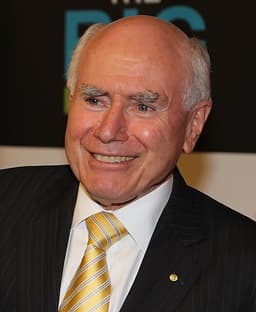
John Howard
Politician · Modern
56.6Total

Ronald Reagan
Politician · Modern
57.8Total
Basic Information
Born
1939
1911
Died
—
2004
Era
Modern
Modern
Nationality
Australia
United States
Occupation
Politician
Politician
Civilization
Western
Western
Score Comparison
Military (10%)
50.0
18.0
Political (20%)
59.3
82.0
Influence (20%)
57.2
65.0
Legacy (20%)
50.0
52.0
Leadership (15%)
78.0
78.0
Strategy (15%)
41.8
27.8
TOTAL
56.6
57.8
John Howard — Complete Timeline
1996 AD
Implemented Gun Control After Port ArthurReform◆ Major
Following the Port Arthur massacre, Howard's government introduced strict gun control laws, including a ban on automatic and semi-automatic weapons and a mandatory buyback scheme. The reforms significantly reduced gun violence in Australia.
Gun ControlPort ArthurPublic Safety
Impact: nationalprogressive
Elected Prime Minister of AustraliaPolitical Action◆ Major
Howard led the Liberal-National coalition to a landslide victory in the 1996 federal election, defeating Paul Keating's Labor government. His campaign focused on economic reform, family values, and a more conservative social agenda.
ElectionLiberal PartyCoalition
Impact: national
2000 AD
Introduced the Goods and Services Tax (GST)Reform◆ Major
Howard's government introduced a 10% Goods and Services Tax, replacing the previous wholesale sales tax. The GST was a major tax reform that broadened the tax base and provided revenue for state governments, though it was politically controversial.
Tax ReformGSTEconomic Policy
Impact: nationalconstructive
2003 AD
Led Australia into the Iraq WarWar◆ Major
Howard committed Australian troops to the US-led invasion of Iraq, citing weapons of mass destruction. The decision was highly controversial and led to large public protests, but Howard argued it was necessary for global security.
Iraq WarForeign PolicyUS Alliance
Impact: globaldestructive
2007 AD
Defeated in 2007 ElectionPolitical Action◆ Major
Howard lost the 2007 federal election to Kevin Rudd's Labor Party, ending his 11-year tenure as prime minister. He also lost his own seat of Bennelong, becoming only the second sitting prime minister to lose his seat.
ElectionDefeatLabor Party
Impact: nationaltragic
Ronald Reagan — Complete Timeline
1981 AD
Survived an assassination attemptOther
John Hinckley Jr. shot Reagan outside the Washington Hilton Hotel. A bullet lodged near Reagan's heart, but he recovered after surgery. The incident boosted his popularity and highlighted the need for gun control debates.
Assassination AttemptGun ViolencePresidency
Impact: nationaltragic
1983 AD
Ordered the invasion of GrenadaWar
Reagan launched Operation Urgent Fury, a U.S. invasion of the Caribbean island of Grenada, citing the protection of American medical students and concerns about Cuban influence. The invasion succeeded in overthrowing the Marxist government within days.
Military InterventionCold WarGrenada
Impact: regional
Proposed the Strategic Defense Initiative (SDI)Political Action◆ Major
Reagan announced a research program to develop a missile defense system that could intercept intercontinental ballistic missiles. SDI, nicknamed 'Star Wars,' was never fully deployed but escalated the arms race and pressured the Soviet economy.
Cold WarMissile DefenseArms Race
Impact: global
1986 AD
Signed the Tax Reform Act of 1986Reform◆ Major
Reagan signed a major tax reform bill that simplified the tax code, reduced the number of tax brackets, and lowered the top marginal rate from 50% to 28%. It also eliminated many deductions. The act was designed to stimulate economic growth.
Tax ReformEconomic PolicySupply-Side
Impact: nationalconstructive
1987 AD
Delivered the 'Tear down this wall' speech at the Brandenburg GatePolitical Action◆ Major
Reagan challenged Soviet leader Mikhail Gorbachev to open the Berlin Wall. The speech became a symbol of Western resolve during the Cold War. Two years later, the wall fell, contributing to the end of communist rule in Eastern Europe.
Cold WarBerlin WallSpeech
Impact: globalconstructive
Expert Analysis
Origins
John Howard was born on July 26, 1939, in Sydney, Australia. His father ran a garage and his mother was a homemaker. Howard studied law at the University of Sydney and became a solicitor. His early political involvement began in the Liberal Party, and he was elected to the House of Representatives in 1974.
Ronald Reagan was born on February 6, 1911, in Tampico, Illinois. His father was a shoe salesman and his mother a devout Christian. Reagan attended Eureka College, where he studied economics and sociology. He worked as a radio sports announcer before becoming a Hollywood actor in the 1930s. His political career began as president of the Screen Actors Guild and later as Governor of California (1967-1975).
Rise to Power
Howard rose through the Liberal Party ranks, serving as Treasurer under Malcolm Fraser from 1977 to 1983. After Fraser's defeat, Howard became Opposition Leader in 1985 but was deposed in 1989. He returned to lead the party in 1995 and won the 1996 federal election, defeating Paul Keating's Labor government. Key to his victory was a focus on economic reform and a promise to introduce a Goods and Services Tax (GST).
Reagan's political rise began with a televised speech supporting Barry Goldwater in 1964, which drew national attention. He was elected Governor of California in 1966, serving two terms. He ran for president in 1976, losing the Republican nomination to Gerald Ford, but won the nomination in 1980 and defeated incumbent Jimmy Carter. His victory was fueled by a conservative coalition and dissatisfaction with the economy.
Leadership & Governance
Howard's leadership style was pragmatic and disciplined. He focused on economic reforms: introducing the GST in 2000, deregulating the labor market, and privatizing government assets. He also implemented strict gun control after the 1996 Port Arthur massacre, banning automatic and semi-automatic weapons. In foreign policy, he strengthened ties with the US, committing troops to the Iraq War in 2003. His governance scored 78.0 in leadership, reflecting his ability to maintain coalition unity and win four elections.
Reagan's leadership was charismatic and ideological. He championed tax cuts, deregulation, and anti-communism. He signed the Tax Reform Act of 1986, simplifying the tax code and lowering top rates. He also proposed the Strategic Defense Initiative (SDI) and escalated military spending. His leadership score is also 78.0, but his political score of 82.0 is higher than Howard's 59.3, reflecting his national influence.
Triumph & Tragedy
Howard's greatest triumph was overseeing a period of economic prosperity and implementing the GST, which broadened the tax base. His gun control laws after Port Arthur significantly reduced gun violence. However, his decision to join the Iraq War damaged his reputation, and he lost the 2007 election, even losing his own seat. His legacy score of 50.0 reflects mixed views.
Reagan's triumphs include economic recovery from stagflation, the fall of the Berlin Wall in 1989, and the end of the Cold War, partly due to his policies. His 'Tear down this wall' speech is iconic. However, the Iran-Contra affair, where his administration sold arms to Iran to fund Nicaraguan Contras, tarnished his presidency. He also survived an assassination attempt in 1981, which boosted his popularity. His legacy score is 52.0.
Character & Destiny
Howard was methodical and risk-averse, often described as a 'conviction politician'. His determination to introduce the GST despite initial unpopularity showed persistence. However, his loyalty to the US alliance led to strategic missteps in Iraq. His character shaped his fate: his cautious approach kept him in power for 11 years, but his inability to adapt to changing public sentiment led to his downfall.
Reagan was optimistic and persuasive, earning the nickname 'The Great Communicator'. His ideological consistency drove his policies, but his hands-off management style led to scandals like Iran-Contra. His character allowed him to connect with the American public and project confidence, which was crucial during the Cold War. His destiny was to be a transformative figure who reshaped the Republican Party and global politics.
Legacy
Howard's legacy includes a reformed tax system, tighter gun laws, and a closer alignment with US foreign policy. However, his Iraq War decision and industrial relations reforms remain controversial. He is remembered as a successful but divisive leader who shaped modern Australia. His influence score is 57.2.
Reagan's legacy is immense: he is credited with revitalizing the US economy, winning the Cold War, and shifting the political landscape to the right. His policies influenced generations of conservatives. He is often ranked among the top US presidents. His influence score of 65.0 reflects his global impact.
Conclusion
While both leaders scored similarly in leadership (78.0 each), Reagan had a greater overall impact due to his role in ending the Cold War and reshaping global politics. His political and influence scores (82.0 and 65.0) exceed Howard's (59.3 and 57.2). Howard's achievements were significant but mostly domestic, whereas Reagan's actions had worldwide consequences. Therefore, Ronald Reagan had a greater historical impact.
Rankings
🥇
Ronald ReaganLeader
Mil: 18.0Pol: 82.0Inf: 65.0
57.8
🥈
John Howard
Mil: 50.0Pol: 59.3Inf: 57.2
56.6
+1.2 behind
How This Comparison Works
Algorithm
Each figure is scored on 6 dimensions (0—100 scale) based on structured historical data: Military (10%), Political (20%), Influence (20%), Legacy (20%), Leadership (15%), Strategy (15%). The weighted total produces the final ranking.
Data Sources
Scores are computed from structured sub-indicators in the database. Scale factors adjust for era (Ancient ×0.85, Modern ×1.0) and civilization size (Eastern ×1.05, Other ×0.80) to account for differences in population and military scale.
Maximum 3 Figures
Comparisons are limited to 2—3 figures to ensure readability and statistical meaningfulness.
Error Margins
±5 points per dimension — Sub-scores are derived from historical records with inherent uncertainty. Two figures within 5 points on a dimension should be considered roughly equivalent in that area.
Total Score Accuracy
±3 points overall — The weighted combination of 6 dimensions produces a total score with approximately ±3 points of uncertainty. Differences of less than 3 points are not statistically significant— the figures are effectively tied.
Known Limitations
- Historical records are incomplete and uneven across civilizations
- Figures from oral-tradition societies may be underrepresented
- Occupation labels can misclassify multi-role figures
- Scores measure capability and impact, not moral character
- Quantitative scoring is a comparison tool, not absolute truth
Capability Radar
Military (10%) — Battles & Warfare
Battles
26
8
Win Rate
29
14
Expansion
37
15
Political (20%) — Governance & Reform
Reform
65
80
Diplomacy
70
85
Economy
75
70
Influence (20%) — Cultural & Global Reach
Cultural
40
65
Global
45
75
Legacy (20%) — Historical Impact
Historical
55
75
Longevity
50
60
Leadership (15%) — Power & Stability
Tenure
70
75
Stability
75
65
Strategy (15%) — Tactics & Innovation
Strategy
37
20
Tactics
40
24
Reform
44
24
Similar Comparisons
Comments & Discussion
No comments yet. Be the first to share your thoughts!