Loading...
John Frederick I of Saxony vs Julius Caesar
Julius Caesar leads by 36.3 pts · 2 figures compared
…
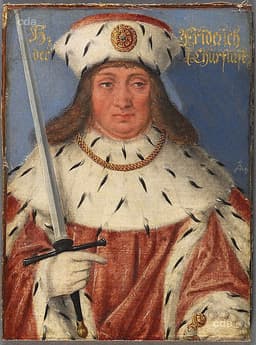
John Frederick I of Saxony
Emperor · Modern
46.5Total

Julius Caesar
General · Ancient
82.8Total
Basic Information
Born
1503
-100
Died
1554
-44
Era
Modern
Ancient
Nationality
Saxony
Roman Republic
Occupation
Emperor
General
Civilization
Western
Western
Score Comparison
Military (10%)
50.0
88.0
Political (20%)
39.4
78.0
Influence (20%)
51.8
85.0
Legacy (20%)
43.3
82.0
Leadership (15%)
62.2
80.0
Strategy (15%)
25.0
85.0
TOTAL
46.5
82.8
John Frederick I of Saxony — Complete Timeline
1532 AD
Became Elector of SaxonyPolitical Action◆ Major
John Frederick I succeeded his father John the Constant as Elector of Saxony, becoming the head of the Ernestine line. He inherited a leading role in the Schmalkaldic League and the defense of Lutheranism in the Holy Roman Empire.
ElectorateSuccession
Impact: regional
1542 AD
Led the Schmalkaldic LeaguePolitical Action◆ Major
John Frederick I became the military leader of the Schmalkaldic League, the Protestant alliance against Emperor Charles V. He commanded the league's forces in several campaigns, including the conquest of the Duchy of Brunswick-Wolfenb
Schmalkaldic LeagueLeadership
Impact: regional
1547 AD
Defeated at the Battle of MühlbergWar◆ Major
John Frederick I was decisively defeated and captured by Imperial forces under Charles V at the Battle of M
Schmalkaldic WarDefeat
Impact: regionaltragic
Lost the Electorate to Maurice of SaxonyPolitical Action◆ Major
After his capture at M
Capitulation of WittenbergLoss of Power
Impact: regionaldestructive
Imprisoned by Charles VPolitical Action◆ Major
John Frederick I was imprisoned by Emperor Charles V after the Battle of M
ImprisonmentReligious Conviction
Impact: regionaltragic
1552 AD
Released under the Treaty of PassauPolitical Action◆ Major
John Frederick I was released from Imperial imprisonment as part of the Treaty of Passau, which granted religious toleration to Lutherans. He returned to his reduced territories but never regained the electoral title, dying in 1554.
Treaty of PassauRelease
Impact: regionalconstructive
Julius Caesar — Complete Timeline
58 BC
Gallic WarsWar◆ Major
Caesar, as proconsul of Gaul, launched a series of campaigns that conquered all of Gaul (modern France, Belgium, and parts of Switzerland). He fought numerous battles, including against the Helvetii, the Belgae, and the Gallic chieftain Vercingetorix. The wars brought immense wealth and a loyal army to Caesar.
Gallic WarsConquestRoman Expansion
Impact: regional
49 BC
Crossing the RubiconPolitical Action◆ Major
Caesar led Legio XIII across the Rubicon River into Italy, defying the Roman Senate's order to disband his army. This act triggered a civil war against Pompey and the Optimates, ultimately leading to Caesar's dictatorship and the end of the Roman Republic.
Roman Civil WarEnd of RepublicPower Struggle
Impact: global
48 BC
Battle of PharsalusWar◆ Major
Caesar's outnumbered army defeated the larger forces of Pompey the Great at Pharsalus in Greece. Caesar's tactical use of a reserve line to counter Pompey's cavalry charge proved decisive. Pompey fled to Egypt, where he was assassinated, leaving Caesar as the undisputed master of the Roman world.
Roman Civil WarBattleDecisive Victory
Impact: regional
44 BC
Appointment as Dictator for LifePolitical Action◆ Major
The Roman Senate appointed Caesar dictator perpetuo (dictator for life), granting him unprecedented personal power. This move concentrated military, legislative, and judicial authority in one person, effectively ending the Roman Republic's traditional system of checks and balances and alarming many senators.
DictatorshipEnd of RepublicPower Consolidation
Impact: regionaldestructive
Assassination on the Ides of MarchPolitical Action◆ Major
A group of Roman senators, led by Marcus Junius Brutus and Gaius Cassius Longinus, stabbed Caesar to death at a meeting of the Senate in the Theatre of Pompey. The assassination was intended to restore the Republic, but instead triggered another civil war that led to the rise of the Roman Empire.
AssassinationRoman PoliticsEnd of Republic
Impact: globaldestructive
Expert Analysis
john-frederick-i-of-saxony-vs-julius-caesar
# The Crossing and the Captivity
On a January morning in 49 BCE, Julius Caesar stood at the banks of the Rubicon, a small river that marked the boundary between his province and Italy proper. To cross with his army was treason, a declaration of civil war. He paused, then uttered a phrase that would echo through millennia: *“Alea iacta est”*—the die is cast. He crossed. Nearly sixteen centuries later, another ruler faced his own Rubicon in the fields of Saxony. John Frederick I, Elector of Saxony, had long defied the Holy Roman Emperor Charles V in defense of the Protestant Reformation. But when the Emperor’s army cornered him at Mühlberg in April 1547, John Frederick did not cross into glory. He was crushed, captured, and stripped of his power. Two men, both leaders of their age, yet one built an empire while the other lost a principality. What drove such different outcomes?
Origins
Julius Caesar was born into the patrician Julian clan, but his family’s political influence had long been in decline. The Roman Republic of the first century BCE was a cauldron of ambition, corruption, and class conflict. Caesar grew up in the shadow of Sulla’s proscriptions and the rivalry between populists and optimates. His uncle Marius had been a great general; his aunt Julia had married Marius. From childhood, Caesar absorbed the lesson that power came not from birth alone but from military glory, popular support, and ruthless calculation.
John Frederick I, by contrast, was born a prince in the heart of Reformation Germany. His father, John the Constant, was a devoted ally of Martin Luther. The Electorate of Saxony was the political shield of the Protestant movement. Young John Frederick was raised in a world where faith and politics were inseparable. He learned that a ruler’s duty was not merely to expand territory but to defend the true religion. His era was one of religious schism, imperial ambition, and the fragile balance between dozens of German states. While Caesar’s world was collapsing into civil war, John Frederick’s was fragmenting into confessional camps.
Rise to Power
Caesar’s path was a masterclass in strategic patience. He gained military fame in Spain, then formed the First Triumvirate with Pompey and Crassus. His consulship in 59 BCE was followed by the governorship of Gaul, where he spent nearly a decade conquering a vast territory and building a loyal army. Every campaign—from the Helvetii to Vercingetorix at Alesia—was a step toward ultimate power. He wrote his own commentaries, shaping his image for posterity.
John Frederick’s rise was more conventional. He became Elector of Saxony in 1532, succeeding his father. He inherited a role as the leading Protestant prince in the Holy Roman Empire. In 1542, he became military leader of the Schmalkaldic League, the alliance of Protestant states formed to resist Emperor Charles V. But unlike Caesar, John Frederick did not create his own army from scratch; he commanded a coalition of princes with competing interests. His authority was always contingent, never absolute.
Leadership & Governance
Caesar governed as a revolutionary reformer. As dictator, he overhauled the Roman calendar, expanded citizenship to provincials, initiated public works, and centralized power in his own hands. His military genius lay in speed and improvisation—crossing the Rhine on a pontoon bridge, besieging Alesia with double fortifications, and always leading from the front. He understood that clemency could win former enemies, as he showed to Brutus and Cassius—a decision that would later cost him everything.
John Frederick governed as a pious prince. He was called “the Magnanimous” for his generosity, but also for his stubbornness. He funded Lutheran churches, supported universities, and maintained the Ernestine line’s prestige. Yet his military strategy was reactive. At Mühlberg, he was caught by surprise. Charles V’s forces crossed the Elbe at dawn, catching the Saxon army disorganized. John Frederick was wounded in the face and captured. His political wisdom failed to match his religious conviction.
Triumph & Tragedy
Caesar’s greatest triumph was the conquest of Gaul, a feat that doubled Rome’s territory and made him the richest man in the Republic. His greatest tragedy was the Ides of March, 44 BCE, when senators he had pardoned stabbed him to death in the Senate chamber. He fell at the foot of Pompey’s statue, the man he had defeated.
John Frederick’s triumph was his role as a defender of the Reformation. For fifteen years, he embodied Protestant resistance. His tragedy was complete at Mühlberg. He lost the Battle, his freedom, and his electoral title. The Capitulation of Wittenberg forced him to cede the Electorate to his cousin Maurice, who had betrayed the League. He spent five years in imperial prison. Released under the Treaty of Passau in 1552, he returned to a diminished domain, dying two years later.
Character & Destiny
Caesar was audacious, calculating, and charismatic. He took risks that seemed reckless but were carefully timed. His ambition was boundless, but so was his ability to inspire loyalty. His assassination was the result of his own success—he had concentrated so much power that the Republic’s defenders saw no other option.
John Frederick was principled, devout, and inflexible. He believed that God would protect the righteous cause. At Mühlberg, he reportedly refused to flee when the battle turned, saying he would rather die fighting than live in shame. That courage was admirable, but it was also a strategic failure. Unlike Caesar, who knew when to retreat and when to strike, John Frederick could not adapt.
Legacy
Caesar’s legacy is the Roman Empire. His name became a title—Kaiser, Tsar—and his reforms outlived him. He transformed the Republic into a monarchy in all but name, and his adopted heir, Octavian, completed the work. His writings remain military classics. He is remembered as both a tyrant and a visionary.
John Frederick’s legacy is more modest but no less significant. He lost his throne but kept his faith. The Ernestine line, though diminished, continued to support Lutheranism. The Peace of Passau and later the Peace of Augsburg established the principle that each prince could determine the religion of his territory—a direct result of the resistance John Frederick led. He is remembered in Saxony as a martyr of the Reformation, a prince who chose conscience over power.
Conclusion
Standing at the Rubicon, Caesar gambled everything on a single crossing. John Frederick, facing the Emperor’s army, gambled everything on a single battle. One won an empire; the other lost a principality. Yet both men were products of their age—Caesar of a dying Republic that demanded a strongman, John Frederick of a fractured Christendom that demanded a confessor. Their differences are not merely personal but epochal. Caesar’s ambition built a world empire; John Frederick’s conviction preserved a religious movement. In the end, the die is cast for every leader. The question is not whether it lands well, but what it reveals about the man who threw it.
Rankings
🥇
Julius CaesarLeader
Mil: 88.0Pol: 78.0Inf: 85.0
82.8
🥈
John Frederick I of Saxony
Mil: 50.0Pol: 39.4Inf: 51.8
46.5
+36.3 behind
How This Comparison Works
Algorithm
Each figure is scored on 6 dimensions (0—100 scale) based on structured historical data: Military (10%), Political (20%), Influence (20%), Legacy (20%), Leadership (15%), Strategy (15%). The weighted total produces the final ranking.
Data Sources
Scores are computed from structured sub-indicators in the database. Scale factors adjust for era (Ancient ×0.85, Modern ×1.0) and civilization size (Eastern ×1.05, Other ×0.80) to account for differences in population and military scale.
Maximum 3 Figures
Comparisons are limited to 2—3 figures to ensure readability and statistical meaningfulness.
Error Margins
±5 points per dimension — Sub-scores are derived from historical records with inherent uncertainty. Two figures within 5 points on a dimension should be considered roughly equivalent in that area.
Total Score Accuracy
±3 points overall — The weighted combination of 6 dimensions produces a total score with approximately ±3 points of uncertainty. Differences of less than 3 points are not statistically significant— the figures are effectively tied.
Known Limitations
- Historical records are incomplete and uneven across civilizations
- Figures from oral-tradition societies may be underrepresented
- Occupation labels can misclassify multi-role figures
- Scores measure capability and impact, not moral character
- Quantitative scoring is a comparison tool, not absolute truth
Capability Radar
Military (10%) — Battles & Warfare
Battles
25
95
Win Rate
20
92
Expansion
10
97
Political (20%) — Governance & Reform
Reform
30
90
Diplomacy
30
85
Economy
30
82
Influence (20%) — Cultural & Global Reach
Cultural
30
88
Global
20
94
Legacy (20%) — Historical Impact
Historical
40
95
Longevity
30
96
Leadership (15%) — Power & Stability
Tenure
40
75
Stability
20
60
Strategy (15%) — Tactics & Innovation
Strategy
20
94
Tactics
20
96
Reform
10
88
Similar Comparisons
Comments & Discussion
RUBICON_RULES6/17/2026
Comparing John Frederick to Caesar is like comparing a chess piece to the player. Caesar crossed the Rubicon knowing exactly what he wanted—absolute power. John Frederick got cornered at Mühlberg because he had no strategic exit plan. Caesar commanded loyal legions; John Frederick trusted local militias that melted away. One chose his battlefield, the other had it chosen for him.
历史倒带6/17/2026
说穿了,约翰·腓特烈就是个宗教狂热分子,把自己当马丁·路德第二,结果被查理五世在米尔贝格一锅端。凯撒过卢比孔河时至少算过政治账,这位选帝侯却以为上帝会替他打仗。事实证明,神学救不了军事盲——他的军队连帝国骑兵的冲锋都挡不住十分钟。
古典学者6/17/2026
真正有趣的对比不在战场,而在失败后的命运。凯撒被布鲁图斯们刺杀,约翰·腓特烈却活到1554年,甚至保留了一部分领土和宗教权利。这说明16世纪的帝国政治比罗马的元老院要有人情味?还是说,查理五世比布鲁图斯更懂得妥协的价值?历史从不简单。
Chronicler76546/17/2026
Spare me the "great man" nonsense. Caesar crossed the Rubicon because he was a power-hungry imperialist with zero respect for republican law. John Frederick was defending a cause—religious reform against Catholic tyranny. But history loves winners, so Caesar gets called a genius while John Frederick gets called a loser. The real difference? One had better PR for two thousand years.
Chronicler36256/17/2026
Fact check: Caesar's army at the Rubicon was about 5,000 men—not some massive horde. John Frederick had 7,000 at Mühlberg. So numerically, the Saxon actually had an edge. But Caesar understood logistics: he moved fast, seized initiative. John Frederick sat in a defensive position for weeks, letting Charles V encircle him. Numbers mean nothing without speed.