Loading...
Julius Caesar vs Pedro I of Brazil
Julius Caesar leads by 28.2 pts · 2 figures compared
…

Julius Caesar
General · Ancient
82.8Total
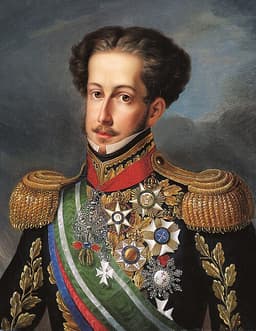
Pedro I of Brazil
Emperor · Modern
54.6Total
Basic Information
Born
-100
1798
Died
-44
1834
Era
Ancient
Modern
Nationality
Roman Republic
Brazil
Occupation
General
Emperor
Civilization
Western
Western
Score Comparison
Military (10%)
88.0
55.0
Political (20%)
78.0
62.7
Influence (20%)
85.0
59.0
Legacy (20%)
82.0
50.0
Leadership (15%)
80.0
53.2
Strategy (15%)
85.0
45.0
TOTAL
82.8
54.6
Julius Caesar — Complete Timeline
58 BC
Gallic WarsWar◆ Major
Caesar, as proconsul of Gaul, launched a series of campaigns that conquered all of Gaul (modern France, Belgium, and parts of Switzerland). He fought numerous battles, including against the Helvetii, the Belgae, and the Gallic chieftain Vercingetorix. The wars brought immense wealth and a loyal army to Caesar.
Gallic WarsConquestRoman Expansion
Impact: regional
49 BC
Crossing the RubiconPolitical Action◆ Major
Caesar led Legio XIII across the Rubicon River into Italy, defying the Roman Senate's order to disband his army. This act triggered a civil war against Pompey and the Optimates, ultimately leading to Caesar's dictatorship and the end of the Roman Republic.
Roman Civil WarEnd of RepublicPower Struggle
Impact: global
48 BC
Battle of PharsalusWar◆ Major
Caesar's outnumbered army defeated the larger forces of Pompey the Great at Pharsalus in Greece. Caesar's tactical use of a reserve line to counter Pompey's cavalry charge proved decisive. Pompey fled to Egypt, where he was assassinated, leaving Caesar as the undisputed master of the Roman world.
Roman Civil WarBattleDecisive Victory
Impact: regional
44 BC
Appointment as Dictator for LifePolitical Action◆ Major
The Roman Senate appointed Caesar dictator perpetuo (dictator for life), granting him unprecedented personal power. This move concentrated military, legislative, and judicial authority in one person, effectively ending the Roman Republic's traditional system of checks and balances and alarming many senators.
DictatorshipEnd of RepublicPower Consolidation
Impact: regionaldestructive
Assassination on the Ides of MarchPolitical Action◆ Major
A group of Roman senators, led by Marcus Junius Brutus and Gaius Cassius Longinus, stabbed Caesar to death at a meeting of the Senate in the Theatre of Pompey. The assassination was intended to restore the Republic, but instead triggered another civil war that led to the rise of the Roman Empire.
AssassinationRoman PoliticsEnd of Republic
Impact: globaldestructive
Pedro I of Brazil — Complete Timeline
1822 AD
Declaration of Independence of BrazilPolitical Action
Pedro I declared Brazil's independence from Portugal on September 7, 1822, at the Ipiranga River in S
Impact: globalprogressive
Coronation as Emperor of BrazilPolitical Action◆ Major
Pedro I was crowned Emperor of Brazil on December 1, 1822, in Rio de Janeiro. The coronation formalized the new imperial government, with Pedro I as constitutional monarch, though he retained significant executive powers.
Impact: nationalconstructive
1823 AD
War of Independence of BrazilWar◆ Major
Pedro I led Brazilian forces against Portuguese loyalists in the War of Independence. Key battles occurred in Bahia, Maranh
Impact: national
Dissolution of the Constituent AssemblyPolitical Action◆ Major
Pedro I dissolved the Constituent Assembly after conflicts over the constitution's limits on imperial power. He then imposed the 1824 Constitution, which granted the emperor extensive powers, including the Moderating Power, centralizing authority.
Impact: nationaldestructive
1831 AD
Abdication of the Brazilian ThronePolitical Action
Pedro I abdicated the Brazilian throne in favor of his five-year-old son Pedro II on April 7, 1831. He returned to Portugal to claim the Portuguese throne, leaving Brazil under a regency until his son came of age.
Impact: national
Expert Analysis
Julius Caesar vs Pedro I of Brazil
# The Emperor and the Dictator: Two Paths from Chaos to Power
On a September morning in 1822, Pedro de Alcântara stood at the banks of the Ipiranga River in São Paulo, tore the Portuguese insignia from his uniform, and shouted “Independence or Death!” Nearly nineteen centuries earlier, on a January day in 49 BCE, another man in a general’s cloak paused at the Rubicon River in northern Italy, weighed the fate of the Roman Republic, and crossed into history. Both men were defying their worlds. One would become the founder of an empire; the other would become its destroyer. Why did Caesar’s gamble create an immortal legend, while Pedro’s triumph dissolved into tragedy?
Origins
Julius Caesar was born into the chaos of a dying republic. The year 100 BCE found Rome bleeding from civil wars, its old aristocratic order crumbling under the weight of empire. Caesar’s family, the Julii, claimed descent from the goddess Venus, but they were political outsiders in a system that rewarded money and connections. His father died when Caesar was sixteen, leaving him to navigate a world where survival meant ambition. He learned early that in Rome, the only thing worse than losing was being forgotten.
Pedro I of Brazil was born in 1798 into a very different kind of chaos. His father was King João VI of Portugal, but the royal family had fled Napoleon’s armies and taken refuge in Brazil, transforming Rio de Janeiro into the capital of the Portuguese Empire. Young Pedro grew up not in a palace of ancient marble but in a tropical court where European manners clashed with American realities. He was impetuous, charming, and poorly educated—a prince who preferred horses and women to books. Where Caesar had been forged in the fires of a republic’s death throes, Pedro was born into a monarchy’s desperate attempt to survive.
Rise to Power
Caesar’s ascent was a masterpiece of calculated risk. He climbed the Roman political ladder—the *cursus honorum*—with relentless precision, borrowing fortunes to buy influence, forging alliances with the richest men in Rome, and using his military commands to build an army loyal to him alone. His conquest of Gaul between 58 and 50 BCE was not just a war of expansion; it was a personal power project that gave him wealth, veterans, and a reputation that made the Senate tremble. When the Senate ordered him to disband his army and return to Rome as a private citizen—vulnerable to prosecution—Caesar chose war. Crossing the Rubicon was the moment a general became a revolutionary.
Pedro’s path was simpler and stranger. He did not conquer his empire; he inherited it. When his father returned to Portugal in 1821, leaving Pedro as regent in Brazil, the Brazilian elites saw their chance. They wanted independence from Portugal, but they feared the chaos of republicanism that had torn apart Spanish America. Pedro was their solution: a prince who could become an emperor. On September 7, 1822, he declared independence with a dramatic gesture that suited his theatrical nature. Two months later, he was crowned Emperor of Brazil. He had not fought for power; power had sought him.
Leadership & Governance
Caesar governed like a man who understood that politics was war by other means. As dictator, he reformed the calendar, granted citizenship to provincials, launched public works that employed the poor, and centralized authority in ways that made the old Republic obsolete. His military genius was inseparable from his political vision: every campaign, from Gaul to Egypt to the final civil war, was designed to consolidate his personal rule. He was ruthless when necessary—he ordered the massacre of 60,000 Gauls at Avaricum—but also magnanimous, pardoning former enemies like Brutus and Cassius. This combination of steel and silk was his greatest strength and, ultimately, his fatal flaw.
Pedro governed like a man who never quite understood that ruling was harder than declaring independence. He fought the War of Brazilian Independence in 1823 with genuine courage, leading troops against Portuguese loyalists in Bahia and Maranhão. But peace revealed his weaknesses. He dissolved the Constituent Assembly in 1823 when it tried to limit his power, imposing a constitution that gave him more authority than the Brazilian elites wanted. His rule became a series of conflicts: with the legislature, with the provinces, with his own ministers. Unlike Caesar, who built his power on a foundation of military loyalty and popular support, Pedro alienated everyone. He was a better warrior than a statesman, and in the end, that was not enough.
Triumph & Tragedy
Caesar’s greatest moment was also his most dangerous. After defeating his rivals—Pompey, Cato, the sons of the old Republic—he stood alone at the summit of the Roman world. He was made dictator for life, his face stamped on coins, his statues in every temple. But the tragedy was already written. The men he had pardoned, the senators he had trusted, gathered in the Senate chamber on the Ides of March, 44 BCE. They stabbed him twenty-three times. His last words, according to tradition, were not a cry of betrayal but of resignation: “*Et tu, Brute?*” He died because he had become what the Republic feared most: a king in all but name.
Pedro’s triumph was the independence he had declared. His tragedy was everything that followed. He could not govern the country he had created. The Brazilian people, who had cheered him as a liberator, turned against him as a tyrant. After nine years of mounting crisis, he abdicated the throne on April 7, 1831, in favor of his five-year-old son, Pedro II. He returned to Portugal, where he died three years later, exhausted and forgotten by the nation he had founded. Caesar was assassinated at the height of his power; Pedro abdicated at the depth of his failure.
Character & Destiny
What drove these two men so far apart? Caesar’s character was a study in controlled ambition. He was cold, calculating, and endlessly patient. He could wait years for the right moment, then strike with devastating speed. His famous phrase “*Veni, vidi, vici*”—“I came, I saw, I conquered”—was not just a boast; it was a philosophy. He saw the world as a chessboard and himself as the only player who mattered.
Pedro was the opposite: impulsive, emotional, and unable to delay gratification. He acted on instinct, whether in love or war. He had Caesar’s ambition but not his discipline. Where Caesar built institutions that outlasted him—the Roman Empire, the Julian calendar, a legacy that would echo through two millennia—Pedro built nothing that could survive his own flaws. He left behind a son who would become Brazil’s greatest emperor, but that was an accident of birth, not design.
Legacy
Caesar’s legacy is the Western world itself. His name became a title—*Kaiser*, *Tsar*—used by emperors for centuries. His military campaigns are still studied in war colleges. His reforms laid the foundation for the Roman Empire, which shaped Europe, law, language, and culture. He is remembered as both a hero and a tyrant, but never as a failure.
Pedro’s legacy is more modest. He is remembered in Brazil as the “Father of the Nation,” a statue on horseback in São Paulo, a date on the calendar. But his reign was a failure, and his abdication a humiliation. He is not studied alongside Caesar; he is a footnote in the history of Latin American independence, a prince who tried to be an emperor and could not manage it.
Conclusion
Standing at opposite ends of history, Caesar and Pedro I reveal a profound truth about power. Caesar understood that power is not a destination but a process—a constant struggle to build, consolidate, and defend. Pedro believed that power was a gift, something to be worn like a crown, not earned like a victory. One crossed a river and changed the world; the other shouted at a river and changed a country. The difference between them is not just time or circumstance. It is the difference between a man who knew what he wanted and a man who only knew what he did not want. Caesar wanted everything; Pedro wanted freedom from Portugal. One succeeded beyond death; the other failed within a decade. In the end, the measure of a leader is not what he declares, but what he builds.
Rankings
🥇
Julius CaesarLeader
Mil: 88.0Pol: 78.0Inf: 85.0
82.8
🥈
Pedro I of Brazil
Mil: 55.0Pol: 62.7Inf: 59.0
54.6
+28.2 behind
How This Comparison Works
Algorithm
Each figure is scored on 6 dimensions (0—100 scale) based on structured historical data: Military (10%), Political (20%), Influence (20%), Legacy (20%), Leadership (15%), Strategy (15%). The weighted total produces the final ranking.
Data Sources
Scores are computed from structured sub-indicators in the database. Scale factors adjust for era (Ancient ×0.85, Modern ×1.0) and civilization size (Eastern ×1.05, Other ×0.80) to account for differences in population and military scale.
Maximum 3 Figures
Comparisons are limited to 2—3 figures to ensure readability and statistical meaningfulness.
Error Margins
±5 points per dimension — Sub-scores are derived from historical records with inherent uncertainty. Two figures within 5 points on a dimension should be considered roughly equivalent in that area.
Total Score Accuracy
±3 points overall — The weighted combination of 6 dimensions produces a total score with approximately ±3 points of uncertainty. Differences of less than 3 points are not statistically significant— the figures are effectively tied.
Known Limitations
- Historical records are incomplete and uneven across civilizations
- Figures from oral-tradition societies may be underrepresented
- Occupation labels can misclassify multi-role figures
- Scores measure capability and impact, not moral character
- Quantitative scoring is a comparison tool, not absolute truth
Capability Radar
Military (10%) — Battles & Warfare
Battles
95
35
Win Rate
92
40
Expansion
97
30
Political (20%) — Governance & Reform
Reform
90
45
Diplomacy
85
50
Economy
82
30
Influence (20%) — Cultural & Global Reach
Cultural
88
40
Global
94
45
Legacy (20%) — Historical Impact
Historical
95
55
Longevity
96
50
Leadership (15%) — Power & Stability
Tenure
75
55
Stability
60
25
Strategy (15%) — Tactics & Innovation
Strategy
94
35
Tactics
96
30
Reform
88
20
Similar Comparisons
Comments & Discussion
GladiatorGuru6/16/2026
Caesar crossing the Rubicon was a calculated gamble with a Senate he knew was rotten from within—Pedro shouting at a river was pure theater. Caesar had legions hardened by Gaul; Pedro had farmers with pitchforks. One built an empire on military discipline, the other on borrowed nationalist fervor. Let’s be honest: Pedro’s “Independence or Death” worked only because Portugal was too weak to fight back. Rome would’ve crushed him in a week.|历史侦探|zh|说佩德罗一世和凯撒一样伟大?这简直是笑话。凯撒在高卢打了八年硬仗,征服了八百座城池;佩德罗跟葡萄牙打