Loading...
This comparison has not been analyzed yet.
One-time AI generation (~1 minute). Scores and timeline are already available below.
Jia Yi vs Zhuge Jin
Jia Yi leads by 3.1 pts · 2 figures compared
…
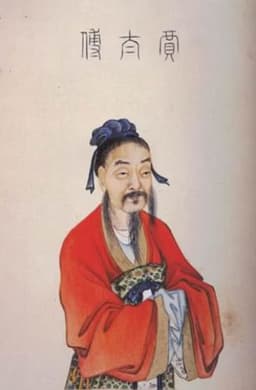
Jia Yi
Politician · Ancient
50.8Total

Zhuge Jin
Politician · Ancient
47.7Total
Basic Information
Born
-200
174
Died
-169
241
Era
Ancient
Ancient
Nationality
China
China
Occupation
Politician
Politician
Civilization
Eastern
Eastern
Score Comparison
Military (10%)
38.5
36.6
Political (20%)
39.4
45.1
Influence (20%)
57.2
49.4
Legacy (20%)
54.0
39.2
Leadership (15%)
48.4
65.0
Strategy (15%)
60.0
53.5
TOTAL
50.8
47.7
Jia Yi — Complete Timeline
176 BC
Exile to ChangshaPolitical Action
Jia Yi was exiled to serve as tutor to the Prince of Changsha after offending powerful officials at court. During his exile, he wrote the famous poem 'The Owl' (Funiao Fu), expressing his philosophical reflections on fate and mortality.
ExileChangshaPoetry
Impact: nationaltragic
174 BC
Memorial on Over-CentralizationPolitical Action◆ Major
Jia Yi submitted a memorial to Emperor Wen of Han warning against the dangers of over-centralization and the concentration of power in the hands of the emperor. He advocated for a balance between central authority and local autonomy, but his advice was not fully heeded.
Political MemorialHan DynastyCentralization
Impact: nationalconstructive
170 BC
Composition of the XinshuCultural◆ Major
Jia Yi wrote the Xinshu (New Writings), a collection of essays on political philosophy, statecraft, and history. The work criticized the Qin dynasty's harsh Legalism and advocated for a Confucian-inspired governance based on virtue and ritual.
Political PhilosophyConfucianismHan Dynasty
Impact: nationalconstructive
169 BC
Death from GriefOther
Jia Yi died at the age of 33, reportedly from grief and disappointment after his advice was ignored and his career stalled. His early death cut short a promising career, but his writings continued to influence Han political thought.
DeathGriefHan Dynasty
Impact: nationaltragic
Zhuge Jin — Complete Timeline
215 AD
Negotiated Alliance with ShuPolitical Action◆ Major
Zhuge Jin served as a diplomat for Sun Quan, traveling to Shu to negotiate the division of Jing Province after Liu Bei's conquest. His efforts helped maintain the fragile Wu-Shu alliance, though tensions over territory persisted.
DiplomacyThree KingdomsAlliance
Impact: regionalconstructive
219 AD
Mediated Between Sun Quan and Zhuge LiangPolitical Action
Zhuge Jin used his family connection to Zhuge Liang to mediate disputes between Sun Quan and Liu Bei. He exchanged letters with his brother to ease tensions over Jing Province, though the conflict eventually led to war.
DiplomacyFamilyThree Kingdoms
Impact: regionalconstructive
222 AD
Served as General of the LeftPolitical Action
Zhuge Jin was appointed General of the Left (Zuo Jiangjun) in Wu, a high military rank. He commanded troops in border regions and participated in campaigns against Wei, though his primary role remained diplomatic.
Military AppointmentWu DynastyGeneral
Impact: national
This comparison has not been analyzed yet.
One-time AI generation (~1 minute). Scores and timeline are already available below.
Rankings
🥇
Jia YiLeader
Mil: 38.5Pol: 39.4Inf: 57.2
50.8
🥈
Zhuge Jin
Mil: 36.6Pol: 45.1Inf: 49.4
47.7
+3.1 behind
How This Comparison Works
Algorithm
Each figure is scored on 6 dimensions (0—100 scale) based on structured historical data: Military (10%), Political (20%), Influence (20%), Legacy (20%), Leadership (15%), Strategy (15%). The weighted total produces the final ranking.
Data Sources
Scores are computed from structured sub-indicators in the database. Scale factors adjust for era (Ancient ×0.85, Modern ×1.0) and civilization size (Eastern ×1.05, Other ×0.80) to account for differences in population and military scale.
Maximum 3 Figures
Comparisons are limited to 2—3 figures to ensure readability and statistical meaningfulness.
Error Margins
±5 points per dimension — Sub-scores are derived from historical records with inherent uncertainty. Two figures within 5 points on a dimension should be considered roughly equivalent in that area.
Total Score Accuracy
±3 points overall — The weighted combination of 6 dimensions produces a total score with approximately ±3 points of uncertainty. Differences of less than 3 points are not statistically significant— the figures are effectively tied.
Known Limitations
- Historical records are incomplete and uneven across civilizations
- Figures from oral-tradition societies may be underrepresented
- Occupation labels can misclassify multi-role figures
- Scores measure capability and impact, not moral character
- Quantitative scoring is a comparison tool, not absolute truth
Capability Radar
Military (10%) — Battles & Warfare
Battles
43
5
Win Rate
41
5
Expansion
46
5
Political (20%) — Governance & Reform
Reform
30
20
Diplomacy
25
60
Economy
35
30
Influence (20%) — Cultural & Global Reach
Cultural
45
15
Global
30
10
Legacy (20%) — Historical Impact
Historical
50
20
Longevity
55
15
Leadership (15%) — Power & Stability
Tenure
20
40
Stability
20
40
Strategy (15%) — Tactics & Innovation
Strategy
51
5
Tactics
50
5
Reform
56
5
Similar Comparisons
Comments & Discussion
No comments yet. Be the first to share your thoughts!