Loading...
Jia Yi vs Lord Pingyuan of Zhao
Lord Pingyuan of Zhao leads by 1.8 pts · 2 figures compared
…
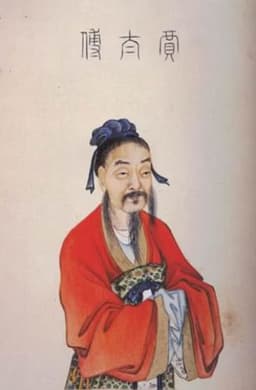
Jia Yi
Politician · Ancient
50.8Total

Lord Pingyuan of Zhao
Politician · Ancient
52.6Total
Basic Information
Born
-200
-308
Died
-169
-251
Era
Ancient
Ancient
Nationality
China
Zhao
Occupation
Politician
Politician
Civilization
Eastern
Eastern
Score Comparison
Military (10%)
38.5
20.0
Political (20%)
39.4
61.3
Influence (20%)
57.2
57.2
Legacy (20%)
54.0
48.3
Leadership (15%)
48.4
74.0
Strategy (15%)
60.0
39.6
TOTAL
50.8
52.6
Jia Yi — Complete Timeline
176 BC
Exile to ChangshaPolitical Action
Jia Yi was exiled to serve as tutor to the Prince of Changsha after offending powerful officials at court. During his exile, he wrote the famous poem 'The Owl' (Funiao Fu), expressing his philosophical reflections on fate and mortality.
ExileChangshaPoetry
Impact: nationaltragic
174 BC
Memorial on Over-CentralizationPolitical Action◆ Major
Jia Yi submitted a memorial to Emperor Wen of Han warning against the dangers of over-centralization and the concentration of power in the hands of the emperor. He advocated for a balance between central authority and local autonomy, but his advice was not fully heeded.
Political MemorialHan DynastyCentralization
Impact: nationalconstructive
170 BC
Composition of the XinshuCultural◆ Major
Jia Yi wrote the Xinshu (New Writings), a collection of essays on political philosophy, statecraft, and history. The work criticized the Qin dynasty's harsh Legalism and advocated for a Confucian-inspired governance based on virtue and ritual.
Political PhilosophyConfucianismHan Dynasty
Impact: nationalconstructive
169 BC
Death from GriefOther
Jia Yi died at the age of 33, reportedly from grief and disappointment after his advice was ignored and his career stalled. His early death cut short a promising career, but his writings continued to influence Han political thought.
DeathGriefHan Dynasty
Impact: nationaltragic
Lord Pingyuan of Zhao — Complete Timeline
290 BC
Patronage of three thousand retainersCultural
Lord Pingyuan maintained a household of three thousand retainers, including scholars, strategists, and assassins. This patronage network made him one of the Four Lords of the Warring States and a center of political and intellectual activity.
ZhaoRetainersPatronage
Impact: regionalconstructive
257 BC
Siege of HandanWar◆ Major
Lord Pingyuan (Zhao Sheng) organized the defense of Handan, the Zhao capital, during a prolonged siege by Qin forces. He sent envoys to Wei and Chu for aid, and the city was eventually relieved by allied forces, preserving Zhao's independence.
ZhaoSiegeHandan
Impact: regional
Expert Analysis
Origins
Jia Yi (200–168 BCE) was born in Luoyang during the early Han dynasty. He was recognized as a prodigy in his youth, mastering classical texts and legal philosophy. His father, a minor official, supported his education, and Jia Yi soon gained fame for his essays on governance. He entered the court of Emperor Wen of Han in his early twenties, becoming the youngest member of the academician corps.
Lord Pingyuan of Zhao (Zhao Sheng, ?–251 BCE) was a younger son of King Wuling of Zhao, a powerful state during the Warring States period. Born into nobility, he was enfeoffed as Lord Pingyuan and inherited a tradition of warrior aristocracy. His early life was shaped by the constant warfare among the Seven Warring States, particularly the rising threat of Qin.
Rise to Power
Jia Yi rose rapidly due to his intellectual brilliance. At age 22, he was appointed as a libationer (court scholar) and soon caught the attention of Emperor Wen. His memorials on statecraft, including the famous "Memorial on Over-Centralization" (c. 174 BCE), argued that the Han court had concentrated too much power, risking rebellion from feudal kings. His ideas impressed the emperor, who promoted him to Grand Master of the Palace. However, his frank criticism of powerful ministers like Zhou Bo and Guan Ying led to his exile in 173 BCE to serve as tutor to the Prince of Changsha.
Lord Pingyuan rose through noble lineage and patronage. He became a key minister in Zhao, managing diplomatic and military affairs. His pivotal moment came during the Siege of Handan (259–257 BCE), when Qin forces besieged the Zhao capital. As the prime minister, he organized the city's defense, coordinated supplies, and sent envoys to Wei and Chu for reinforcements. He famously executed his own concubine to shame a reluctant general into action, securing Wei's aid. This event cemented his reputation as a decisive leader.
Leadership & Governance
Jia Yi's leadership was intellectual and advisory. He scored 48.4 in leadership, reflecting his inability to implement his ideas directly. His governance philosophy, outlined in the Xinshu, advocated for a balanced central government with strong local checks, drawing lessons from the Qin dynasty's collapse. He proposed dividing feudal kingdoms to weaken rebellious lords, a policy later adopted by Emperor Wu. However, his approach was theoretical; he lacked practical administrative experience and was sidelined by court factions.
Lord Pingyuan scored 74.0 in leadership, the highest among his scores. He governed through personal networks and patronage, maintaining 3,000 retainers who served as spies, diplomats, and warriors. His leadership was hands-on during crises, such as personally leading negotiations and military logistics. He was known for his generosity but also for nepotism, promoting relatives over merit. This led to strategic blunders, such as appointing his brother Zhao Kuo as commander in the Battle of Changping (260 BCE), which ended in disaster for Zhao.
Triumph & Tragedy
Jia Yi's greatest triumph was his memorial on over-centralization, which influenced Han policy for decades. His political score of 39.4, while modest, reflects his role as a precursor to later reforms. His Xinshu became a classic of political philosophy, studied by generations of officials. However, his tragedy was his early death at 33, reportedly from grief after his advice was ignored. He never saw his ideas implemented, and his career ended in exile.
Lord Pingyuan's triumph was the successful defense of Handan, which preserved Zhao's independence for another two decades. His strategy of securing alliances with Wei and Chu demonstrated diplomatic skill, scoring 39.6 in strategy. However, his tragedy was his role in the Battle of Changping, where his appointment of the inexperienced Zhao Kuo led to the slaughter of 400,000 Zhao soldiers. This catastrophic defeat weakened Zhao irreversibly, and Lord Pingyuan died soon after, in 251 BCE, with his state in decline.
Character & Destiny
Jia Yi was idealistic and melancholic, driven by a vision of perfect governance. His exile produced the poem "Lament for Qu Yuan," expressing despair at unrecognized talent. His character—principled but tactless—led to his political isolation. Historians like Sima Qian praised his intellect but noted his inability to navigate court intrigue. His total score of 50.8 reflects a mind ahead of its time but mismatched with his era.
Lord Pingyuan was pragmatic and charismatic, adept at social manipulation. He valued loyalty and generosity, but his nepotism and trust in flatterers caused strategic errors. His character—decisive in crisis but complacent in peace—shaped Zhao's fate. His total score of 52.6 edges out Jia Yi, but his legacy is marred by the Changping disaster.
Legacy
Jia Yi's legacy endured through his writings, which influenced Han Confucian statecraft and later Chinese political thought. His warnings against over-centralization resonated in later dynasties, earning him a score of 54.0 in legacy. He is remembered as a martyr of intellectual integrity.
Lord Pingyuan's legacy is mixed. He is celebrated as one of the "Four Lords of the Warring States" for his patronage and defense of Handan, scoring 48.3 in legacy. However, his role in Changping paints him as a cautionary figure. His retainers, like Mao Sui, became symbols of self-recommendation, but his state's collapse overshadowed his achievements.
Conclusion
While Lord Pingyuan scored higher overall (52.6 vs 50.8), Jia Yi's impact on Chinese political theory was more profound. Jia Yi's ideas shaped governance for centuries, whereas Lord Pingyuan's actions, though dramatic, were ultimately ephemeral. Jia Yi's legacy of critical thought against centralized power offers a timeless lesson, making him the more significant figure in the long arc of history.
Rankings
🥇
Lord Pingyuan of ZhaoLeader
Mil: 20.0Pol: 61.3Inf: 57.2
52.6
🥈
Jia Yi
Mil: 38.5Pol: 39.4Inf: 57.2
50.8
+1.8 behind
How This Comparison Works
Algorithm
Each figure is scored on 6 dimensions (0—100 scale) based on structured historical data: Military (10%), Political (20%), Influence (20%), Legacy (20%), Leadership (15%), Strategy (15%). The weighted total produces the final ranking.
Data Sources
Scores are computed from structured sub-indicators in the database. Scale factors adjust for era (Ancient ×0.85, Modern ×1.0) and civilization size (Eastern ×1.05, Other ×0.80) to account for differences in population and military scale.
Maximum 3 Figures
Comparisons are limited to 2—3 figures to ensure readability and statistical meaningfulness.
Error Margins
±5 points per dimension — Sub-scores are derived from historical records with inherent uncertainty. Two figures within 5 points on a dimension should be considered roughly equivalent in that area.
Total Score Accuracy
±3 points overall — The weighted combination of 6 dimensions produces a total score with approximately ±3 points of uncertainty. Differences of less than 3 points are not statistically significant— the figures are effectively tied.
Known Limitations
- Historical records are incomplete and uneven across civilizations
- Figures from oral-tradition societies may be underrepresented
- Occupation labels can misclassify multi-role figures
- Scores measure capability and impact, not moral character
- Quantitative scoring is a comparison tool, not absolute truth
Capability Radar
Military (10%) — Battles & Warfare
Battles
43
20
Win Rate
41
15
Expansion
46
10
Political (20%) — Governance & Reform
Reform
30
30
Diplomacy
25
60
Economy
35
40
Influence (20%) — Cultural & Global Reach
Cultural
45
45
Global
30
30
Legacy (20%) — Historical Impact
Historical
50
50
Longevity
55
40
Leadership (15%) — Power & Stability
Tenure
20
55
Stability
20
35
Strategy (15%) — Tactics & Innovation
Strategy
51
20
Tactics
50
25
Reform
56
10
Similar Comparisons
Comments & Discussion
No comments yet. Be the first to share your thoughts!