Loading...
Jia Yi vs Xun You
Xun You leads by 4.9 pts · 2 figures compared
…
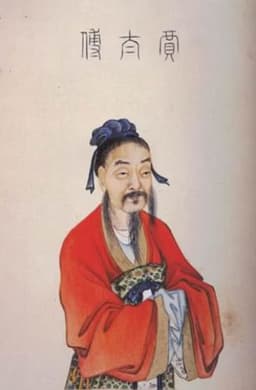
Jia Yi
Politician · Ancient
50.8Total

Xun You
Politician · Ancient
55.7Total
Basic Information
Born
-200
157
Died
-169
214
Era
Ancient
Ancient
Nationality
China
China
Occupation
Politician
Politician
Civilization
Eastern
Eastern
Score Comparison
Military (10%)
38.5
40.0
Political (20%)
39.4
68.0
Influence (20%)
57.2
53.3
Legacy (20%)
54.0
49.2
Leadership (15%)
48.4
66.0
Strategy (15%)
60.0
60.0
TOTAL
50.8
55.7
Jia Yi — Complete Timeline
176 BC
Exile to ChangshaPolitical Action
Jia Yi was exiled to serve as tutor to the Prince of Changsha after offending powerful officials at court. During his exile, he wrote the famous poem 'The Owl' (Funiao Fu), expressing his philosophical reflections on fate and mortality.
ExileChangshaPoetry
Impact: nationaltragic
174 BC
Memorial on Over-CentralizationPolitical Action◆ Major
Jia Yi submitted a memorial to Emperor Wen of Han warning against the dangers of over-centralization and the concentration of power in the hands of the emperor. He advocated for a balance between central authority and local autonomy, but his advice was not fully heeded.
Political MemorialHan DynastyCentralization
Impact: nationalconstructive
170 BC
Composition of the XinshuCultural◆ Major
Jia Yi wrote the Xinshu (New Writings), a collection of essays on political philosophy, statecraft, and history. The work criticized the Qin dynasty's harsh Legalism and advocated for a Confucian-inspired governance based on virtue and ritual.
Political PhilosophyConfucianismHan Dynasty
Impact: nationalconstructive
169 BC
Death from GriefOther
Jia Yi died at the age of 33, reportedly from grief and disappointment after his advice was ignored and his career stalled. His early death cut short a promising career, but his writings continued to influence Han political thought.
DeathGriefHan Dynasty
Impact: nationaltragic
Xun You — Complete Timeline
198 AD
Campaign against Lü BuWar◆ Major
Xun You advised Cao Cao during the siege of Xiapi against L
Three KingdomsSiegeLü Bu
Impact: nationalconstructive
200 AD
Battle of GuanduWar
Xun You served as Cao Cao's chief strategist at Guandu. He devised the plan to burn Yuan Shao's supplies at Wuchao, a decisive move.
Three KingdomsStrategySupply Raid
Impact: nationalconstructive
202 AD
Campaign against Yuan ShaoWar◆ Major
Xun You continued to advise Cao Cao in the post-Guangdu campaigns against Yuan Shao's sons. He helped plan the conquest of Hebei.
Three KingdomsCampaignYuan Shao
Impact: nationalconstructive
214 AD
Death from IllnessOther
Xun You died from illness while serving as a senior advisor. Cao Cao mourned his loss, calling him a key architect of Wei's rise.
Three KingdomsDeathIllness
Impact: national
Expert Analysis
Origins
Jia Yi (200–168 BCE) was born in Luoyang during the early Western Han dynasty. His father, a minor official, ensured Jia Yi received a classical education. By age 18, he was renowned for his mastery of the Confucian classics and legal texts. His talent caught the attention of Governor Wu Gong, who recommended him to Emperor Wen. Jia Yi was appointed as a court academician, the youngest among his peers.
Xun You (157–214 CE) hailed from the illustrious Xun clan of Yingchuan, a family known for producing scholars and officials. His grandfather Xun Shuang served as a high minister under the Eastern Han. Xun You lost his father early and was raised by his uncle Xun Yu. He showed early brilliance in statecraft and military strategy. Unlike Jia Yi's rise through merit, Xun You's family connections opened doors, but his own intellect secured his position.
Rise to Power
Jia Yi's rise was swift. In 179 BCE, Emperor Wen promoted him to Grand Master of the Palace. Jia Yi submitted a series of memorials advocating for stricter control over the feudal kingdoms. His most famous warning came in 174 BCE, when he argued that the kingdoms of Huainan and Qi were growing too powerful. However, his reforms offended senior officials like Zhou Bo and Guan Ying. In 173 BCE, they orchestrated his exile to Changsha as tutor to the Prince of Changsha. He never regained imperial favor.
Xun You's ascent began when he joined Cao Cao's camp in 196 CE. Initially a minor advisor, he proved his worth during the campaign against Zhang Xiu in 197 CE. After Cao Cao's defeat at Wancheng, Xun You advised against pursuing Zhang Xiu, a counsel ignored, leading to another loss. His breakthrough came at the Battle of Guandu (200 CE). He devised the plan to raid Yuan Shao's supply depot at Wuchao, a stroke that turned the tide. After Guandu, he became Cao Cao's chief strategist, directing campaigns against Lü Bu, Yuan Tan, and Yuan Shang.
Leadership & Governance
Jia Yi's governance philosophy was rooted in Confucian idealism tempered by Legalist pragmatism. In his Xinshu, he argued that the Qin dynasty fell due to over-reliance on harsh laws and neglect of moral education. He proposed a balance: strict laws for the state, but moral cultivation for officials. Politically, he scored 39.4, reflecting his limited practical influence. His advice on centralization was prescient but not implemented during his lifetime.
Xun You was a master of realpolitik. He focused on tactical and strategic victories rather than long-term governance. His political score of 68.0 reflects his effectiveness within Cao Cao's administration. He advocated for decisive action but also knew when to show mercy. For instance, after capturing Lü Bu, he urged Cao Cao to execute him to prevent future rebellion. Xun You's leadership score of 66.0 indicates his ability to command respect and execute complex campaigns.
Triumph & Tragedy
Jia Yi's greatest triumph was his intellectual legacy. His memorials and essays, particularly "On the Faults of Qin" and "The Owl Rhapsody," influenced Han policy for centuries. His warnings about feudal kingdoms proved accurate when the Rebellion of the Seven States erupted in 154 BCE, 14 years after his death. However, his tragedy was his inability to effect change while alive. Exiled and ignored, he died at 33, reportedly from grief. His total score of 50.8 reflects unrealized potential.
Xun You's triumph was the Battle of Guandu, where his strategy secured Cao Cao's dominance over northern China. He also masterminded the siege of Xiapi, using a flood to defeat Lü Bu. His tragedy came in 212 CE when he opposed Cao Cao's ambition to become Duke of Wei. Though he did not suffer Jia Yi's fate, his influence waned. He died of illness in 214 CE, with Cao Cao mourning him as a key architect of Wei. Xun You's total score of 55.7 reflects his concrete achievements.
Character & Destiny
Jia Yi was idealistic, passionate, and melancholic. His writings reveal a man tormented by the gap between his vision and reality. He believed that virtue alone should guide rulers, but court politics crushed him. His early death was a direct result of his inability to adapt. Historical assessments often view him as a martyr for reform.
Xun You was pragmatic, calculating, and reserved. He understood power dynamics and operated within them. His strategy score of 60.0 matches Jia Yi's, but his political acumen was higher. He knew when to push and when to retreat. His character allowed him to survive in the treacherous world of the Three Kingdoms, but his ultimate loyalty to the Han dynasty limited his ambition.
Legacy
Jia Yi's legacy is as a thinker rather than a doer. His Xinshu became a foundational text for political philosophy. His critique of Qin shaped Han Confucian orthodoxy. The Han dynasty adopted his centralization proposals after his death, leading to the consolidation of imperial power. His influence score of 57.2 reflects his long-term impact on Chinese governance.
Xun You's legacy is as a strategist. His tactics at Guandu are studied in military academies. He helped lay the groundwork for the Cao Wei dynasty, which unified northern China. However, his contributions were often overshadowed by his uncle Xun Yu and by Cao Cao himself. His legacy score of 49.2 is lower because his achievements were tied to a single regime.
Conclusion
While Jia Yi scored higher in influence (57.2 vs. 53.3) and legacy (54.0 vs. 49.2), Xun You had a greater immediate impact. His political score of 68.0 dwarfed Jia Yi's 39.4, and his leadership score of 66.0 contrasted with Jia Yi's 48.4. Xun You's strategies directly shaped the course of the Three Kingdoms era, while Jia Yi's ideas took decades to materialize. In terms of total score, Xun You leads 55.7 to 50.8. Therefore, Xun You had a more decisive impact on his own time, but Jia Yi's intellectual contributions arguably shaped Chinese history more profoundly. The verdict: Xun You wins on practical achievement, but Jia Yi's vision proved more enduring.
Rankings
🥇
Xun YouLeader
Mil: 40.0Pol: 68.0Inf: 53.3
55.7
🥈
Jia Yi
Mil: 38.5Pol: 39.4Inf: 57.2
50.8
+4.9 behind
How This Comparison Works
Algorithm
Each figure is scored on 6 dimensions (0—100 scale) based on structured historical data: Military (10%), Political (20%), Influence (20%), Legacy (20%), Leadership (15%), Strategy (15%). The weighted total produces the final ranking.
Data Sources
Scores are computed from structured sub-indicators in the database. Scale factors adjust for era (Ancient ×0.85, Modern ×1.0) and civilization size (Eastern ×1.05, Other ×0.80) to account for differences in population and military scale.
Maximum 3 Figures
Comparisons are limited to 2—3 figures to ensure readability and statistical meaningfulness.
Error Margins
±5 points per dimension — Sub-scores are derived from historical records with inherent uncertainty. Two figures within 5 points on a dimension should be considered roughly equivalent in that area.
Total Score Accuracy
±3 points overall — The weighted combination of 6 dimensions produces a total score with approximately ±3 points of uncertainty. Differences of less than 3 points are not statistically significant— the figures are effectively tied.
Known Limitations
- Historical records are incomplete and uneven across civilizations
- Figures from oral-tradition societies may be underrepresented
- Occupation labels can misclassify multi-role figures
- Scores measure capability and impact, not moral character
- Quantitative scoring is a comparison tool, not absolute truth
Capability Radar
Military (10%) — Battles & Warfare
Battles
43
45
Win Rate
41
55
Expansion
46
55
Political (20%) — Governance & Reform
Reform
30
30
Diplomacy
25
65
Economy
35
40
Influence (20%) — Cultural & Global Reach
Cultural
45
30
Global
30
20
Legacy (20%) — Historical Impact
Historical
50
45
Longevity
55
40
Leadership (15%) — Power & Stability
Tenure
20
60
Stability
20
55
Strategy (15%) — Tactics & Innovation
Strategy
51
70
Tactics
50
60
Reform
56
20
Similar Comparisons
Comments & Discussion
No comments yet. Be the first to share your thoughts!