Loading...
This comparison has not been analyzed yet.
One-time AI generation (~1 minute). Scores and timeline are already available below.
Jean-Bedel Bokassa vs Yuhi III Mazimpaka
Yuhi III Mazimpaka leads by 7.3 pts · 2 figures compared
…
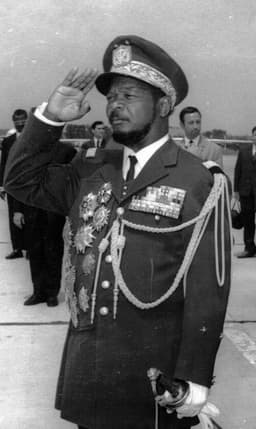
Jean-Bedel Bokassa
Emperor · Modern
39.5Total

Yuhi III Mazimpaka
Emperor · Modern
46.8Total
Basic Information
Born
1921
1650
Died
—
1700
Era
Modern
Modern
Nationality
Central African Republic
Rwanda
Occupation
Emperor
Emperor
Civilization
Other
Other
Score Comparison
Military (10%)
20.0
43.3
Political (20%)
29.3
35.1
Influence (20%)
47.1
49.4
Legacy (20%)
36.7
37.5
Leadership (15%)
45.0
67.0
Strategy (15%)
54.3
54.3
TOTAL
39.5
46.8
Jean-Bedel Bokassa — Complete Timeline
1966 AD
Seized Power in Central African Republic CoupPolitical Action◆ Major
Jean-Bédel Bokassa led a military coup against President David Dacko, his cousin. He suspended the constitution, dissolved the National Assembly, and declared himself president, beginning a repressive regime.
Central African RepublicCoupDacko
Impact: nationaldestructive
1976 AD
Proclaimed Emperor of Central AfricaPolitical Action◆ Major
Bokassa declared the Central African Republic a monarchy and crowned himself Emperor Bokassa I in a lavish ceremony costing millions of dollars. The event was modeled on Napoleon's coronation and widely criticized as extravagant.
Central African RepublicMonarchyExtravagance
Impact: nationaldestructive
1979 AD
Overthrown by French Operation BarracudaWar◆ Major
French paratroopers, in Operation Barracuda, overthrew Bokassa while he was in Libya. David Dacko was reinstalled as president. Bokassa went into exile in France and later C
Central African RepublicFrench InterventionExile
Impact: regional
Bangui Student MassacrePolitical Action◆ Major
Bokassa ordered the arrest and killing of schoolchildren protesting compulsory school uniforms. Approximately 100 children were killed, leading to international condemnation and accelerating the end of his regime.
Central African RepublicHuman Rights AbusesMassacre
Impact: nationaltragic
1986 AD
Convicted and Sentenced to DeathPolitical Action◆ Major
Bokassa returned to CAR voluntarily and was put on trial for crimes including murder, cannibalism, and embezzlement. He was convicted and sentenced to death, later commuted to life imprisonment.
Central African RepublicJusticeTrial
Impact: nationalconstructive
Yuhi III Mazimpaka — Complete Timeline
1650 AD
Accession to the Rwandan thronePolitical Action◆ Major
Yuhi III Mazimpaka became the King of Rwanda, succeeding his father. His reign is noted for a focus on luxury and the arts, though specific military or administrative reforms are not well-documented in surviving records.
AccessionRwandan Kingdom
1660 AD
Patronage of arts and luxuryOther
King Yuhi III Mazimpaka became known for his patronage of the arts and his personal love of luxury. He encouraged elaborate court ceremonies and the production of fine crafts, which influenced Rwandan court culture during his reign.
Cultural PatronageArts
constructive
This comparison has not been analyzed yet.
One-time AI generation (~1 minute). Scores and timeline are already available below.
Rankings
🥇
Yuhi III MazimpakaLeader
Mil: 43.3Pol: 35.1Inf: 49.4
46.8
🥈
Jean-Bedel Bokassa
Mil: 20.0Pol: 29.3Inf: 47.1
39.5
+7.3 behind
How This Comparison Works
Algorithm
Each figure is scored on 6 dimensions (0—100 scale) based on structured historical data: Military (10%), Political (20%), Influence (20%), Legacy (20%), Leadership (15%), Strategy (15%). The weighted total produces the final ranking.
Data Sources
Scores are computed from structured sub-indicators in the database. Scale factors adjust for era (Ancient ×0.85, Modern ×1.0) and civilization size (Eastern ×1.05, Other ×0.80) to account for differences in population and military scale.
Maximum 3 Figures
Comparisons are limited to 2—3 figures to ensure readability and statistical meaningfulness.
Error Margins
±5 points per dimension — Sub-scores are derived from historical records with inherent uncertainty. Two figures within 5 points on a dimension should be considered roughly equivalent in that area.
Total Score Accuracy
±3 points overall — The weighted combination of 6 dimensions produces a total score with approximately ±3 points of uncertainty. Differences of less than 3 points are not statistically significant— the figures are effectively tied.
Known Limitations
- Historical records are incomplete and uneven across civilizations
- Figures from oral-tradition societies may be underrepresented
- Occupation labels can misclassify multi-role figures
- Scores measure capability and impact, not moral character
- Quantitative scoring is a comparison tool, not absolute truth
Capability Radar
Military (10%) — Battles & Warfare
Battles
5
5
Win Rate
5
5
Expansion
5
5
Political (20%) — Governance & Reform
Reform
10
20
Diplomacy
10
30
Economy
5
25
Influence (20%) — Cultural & Global Reach
Cultural
10
25
Global
10
10
Legacy (20%) — Historical Impact
Historical
15
20
Longevity
5
15
Leadership (15%) — Power & Stability
Tenure
30
40
Stability
5
30
Strategy (15%) — Tactics & Innovation
Strategy
5
5
Tactics
5
5
Reform
5
5
Similar Comparisons
Comments & Discussion
No comments yet. Be the first to share your thoughts!