Loading...
Jean-Bedel Bokassa vs Sayri Tupac
Jean-Bedel Bokassa leads by 2.3 pts · 2 figures compared
…
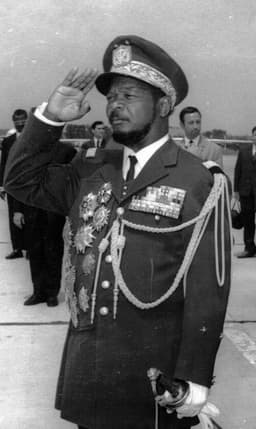
Jean-Bedel Bokassa
Emperor · Modern
39.5Total

Sayri Tupac
Emperor · Modern
37.2Total
Basic Information
Born
1921
1535
Died
—
1561
Era
Modern
Modern
Nationality
Central African Republic
Inca Empire
Occupation
Emperor
Emperor
Civilization
Other
Western
Score Comparison
Military (10%)
20.0
17.0
Political (20%)
29.3
25.0
Influence (20%)
47.1
47.1
Legacy (20%)
36.7
35.8
Leadership (15%)
45.0
34.6
Strategy (15%)
54.3
58.5
TOTAL
39.5
37.2
Jean-Bedel Bokassa — Complete Timeline
1966 AD
Seized Power in Central African Republic CoupPolitical Action◆ Major
Jean-Bédel Bokassa led a military coup against President David Dacko, his cousin. He suspended the constitution, dissolved the National Assembly, and declared himself president, beginning a repressive regime.
Central African RepublicCoupDacko
Impact: nationaldestructive
1976 AD
Proclaimed Emperor of Central AfricaPolitical Action◆ Major
Bokassa declared the Central African Republic a monarchy and crowned himself Emperor Bokassa I in a lavish ceremony costing millions of dollars. The event was modeled on Napoleon's coronation and widely criticized as extravagant.
Central African RepublicMonarchyExtravagance
Impact: nationaldestructive
1979 AD
Overthrown by French Operation BarracudaWar◆ Major
French paratroopers, in Operation Barracuda, overthrew Bokassa while he was in Libya. David Dacko was reinstalled as president. Bokassa went into exile in France and later C
Central African RepublicFrench InterventionExile
Impact: regional
Bangui Student MassacrePolitical Action◆ Major
Bokassa ordered the arrest and killing of schoolchildren protesting compulsory school uniforms. Approximately 100 children were killed, leading to international condemnation and accelerating the end of his regime.
Central African RepublicHuman Rights AbusesMassacre
Impact: nationaltragic
1986 AD
Convicted and Sentenced to DeathPolitical Action◆ Major
Bokassa returned to CAR voluntarily and was put on trial for crimes including murder, cannibalism, and embezzlement. He was convicted and sentenced to death, later commuted to life imprisonment.
Central African RepublicJusticeTrial
Impact: nationalconstructive
Sayri Tupac — Complete Timeline
1545 AD
Coronation as Sapa Inca of VilcabambaPolitical Action◆ Major
Sayri Tupac succeeded his father Manco Inca as the ruler of the Neo-Inca state in Vilcabamba. He inherited a small, isolated kingdom that continued resistance against Spanish rule in the Andes.
CoronationVilcabambaInca
Impact: regional
1557 AD
Negotiations with the Spanish ViceroyPolitical Action◆ Major
Sayri Tupac entered into negotiations with Spanish Viceroy Andr
NegotiationPeaceSpanish
Impact: regionalconstructive
1558 AD
Baptism and Acceptance of Spanish RuleCultural◆ Major
Sayri Tupac was baptized as a Christian in Lima, taking the name Diego. He formally accepted Spanish sovereignty and was granted the title of Prince of Yucay, along with encomiendas, ending the Vilcabamba resistance temporarily.
BaptismSubmissionInca
Impact: regional
1561 AD
Death of Sayri TupacOther◆ Major
Sayri Tupac died suddenly in Yucay, possibly poisoned by Spanish officials or by his own relatives. His death led to the succession of his brother Titu Cusi Yupanqui, who resumed resistance against Spanish rule.
DeathSuccessionInca
Impact: regionaltragic
Expert Analysis
Origins
Jean-Bedel Bokassa was born on February 22, 1921, in Bobangui, French Ubangi-Shari (now Central African Republic). His father was a village chief murdered by French colonial authorities, and his mother died soon after. Bokassa was raised by relatives and later attended missionary schools. He joined the French colonial army in 1939, serving in World War II and Indochina, rising to the rank of captain.
Sayri Tupac, born around 1535, was the son of Manco Inca Yupanqui, the first Inca ruler of the Neo-Inca state in Vilcabamba after the Spanish conquest. His mother was Cura Ocllo. Sayri Tupac grew up in the isolated jungle refuge of Vilcabamba, learning Inca traditions and resistance against Spanish colonizers.
Rise to Power
Bokassa rose through the French military, earning medals for bravery. After Central African independence in 1960, he became chief of staff of the army under President David Dacko (his cousin). On January 1, 1966, Bokassa led a coup, ousting Dacko. He suspended the constitution and ruled as president. In 1976, he proclaimed the Central African Empire and crowned himself Emperor Bokassa I in a lavish ceremony costing $20 million (about $100 million today).
Sayri Tupac became Sapa Inca in 1545 after his father Manco Inca was assassinated by Spanish deserters. He inherited a small, besieged kingdom in Vilcabamba. Initially continuing resistance, he soon sought peace. In 1557, he negotiated with Spanish Viceroy Andrés Hurtado de Mendoza, agreeing to leave Vilcabamba. He was baptized as Diego in Lima in 1558 and accepted Spanish sovereignty, receiving the title Prince of Yucay.
Leadership & Governance
Bokassa ruled with absolute power, combining traditional autocracy with personal extravagance. He implemented forced labor, executed political opponents, and engaged in embezzlement. His governance score of 29.3 reflects his erratic and brutal rule. He declared himself Emperor and modeled his coronation after Napoleon, but his regime lacked institutional stability. He attempted to centralize power but alienated France, his key patron.
Sayri Tupac chose diplomacy over war. His political score of 25.0 indicates limited effective governance, as he ceded authority to the Spanish. He accepted baptism and granted land to Spanish settlers, aiming to preserve Inca nobility. His strategy score of 58.5 suggests he calculated that cooperation was the only way to survive. However, his rule was short; he died in 1561, possibly poisoned.
Triumph & Tragedy
Bokassa's greatest triumph was seizing power and crowning himself emperor, briefly making the Central African Republic a monarchy. His tragedy was his downfall: the 1979 Bangui student massacre, where about 100 children were killed for protesting school uniforms, triggered international outrage. French Operation Barracuda overthrew him in 1979. He was convicted in absentia and later sentenced to death (commuted to life). He died in 1996.
Sayri Tupac's triumph was achieving a peaceful settlement with Spain, securing recognition and a title. His tragedy was his sudden death at age 26, possibly murdered, ending his line and leaving Vilcabamba to his more militant brother Titu Cusi. His acceptance of Spanish rule may have been pragmatic but failed to protect Inca autonomy.
Character & Destiny
Bokassa was ambitious, narcissistic, and ruthless. His military score of 20.0 reflects his reliance on force rather than strategy. He believed in his own destiny as emperor but lacked diplomatic skill. His character led him to overreach, provoking French intervention. He is often described as a brutal autocrat.
Sayri Tupac was cautious and conciliatory. His leadership score of 34.6 indicates he was not a strong ruler but a pragmatist. He prioritized survival over resistance. His strategy score of 58.5 suggests he understood the balance of power. His destiny was cut short by early death, likely due to Spanish or Inca rivalry.
Legacy
Bokassa's legacy is one of brutality and excessive rule. He scored 36.7 in legacy. The Central African Republic has struggled with instability since. His name is synonymous with corrupt, violent dictatorship. The lavish coronation remains a symbol of misplaced priorities.
Sayri Tupac's legacy is mixed. He scored 35.8 in legacy. He is remembered as the Inca who submitted to Spain, but also as a peacemaker. His acceptance of Spanish rule may have preserved some Inca traditions. However, his death led to renewed conflict. His influence score of 47.1 is similar to Bokassa's 47.1, indicating comparable historical awareness.
Conclusion
Who had greater impact? Bokassa scores 39.5 overall, slightly higher than Sayri Tupac's 37.2. Bokassa's impact is more direct: his coup, imperial pretensions, and massacre changed the course of the Central African Republic. Sayri Tupac's impact was more limited to the Inca resistance. Despite his brutality, Bokassa's actions had wider geopolitical consequences, including French intervention. Therefore, Bokassa had greater historical impact, albeit negative. His total score of 39.5 vs. 37.2 reflects this.
Rankings
🥇
Jean-Bedel BokassaLeader
Mil: 20.0Pol: 29.3Inf: 47.1
39.5
🥈
Sayri Tupac
Mil: 17.0Pol: 25.0Inf: 47.1
37.2
+2.3 behind
How This Comparison Works
Algorithm
Each figure is scored on 6 dimensions (0—100 scale) based on structured historical data: Military (10%), Political (20%), Influence (20%), Legacy (20%), Leadership (15%), Strategy (15%). The weighted total produces the final ranking.
Data Sources
Scores are computed from structured sub-indicators in the database. Scale factors adjust for era (Ancient ×0.85, Modern ×1.0) and civilization size (Eastern ×1.05, Other ×0.80) to account for differences in population and military scale.
Maximum 3 Figures
Comparisons are limited to 2—3 figures to ensure readability and statistical meaningfulness.
Error Margins
±5 points per dimension — Sub-scores are derived from historical records with inherent uncertainty. Two figures within 5 points on a dimension should be considered roughly equivalent in that area.
Total Score Accuracy
±3 points overall — The weighted combination of 6 dimensions produces a total score with approximately ±3 points of uncertainty. Differences of less than 3 points are not statistically significant— the figures are effectively tied.
Known Limitations
- Historical records are incomplete and uneven across civilizations
- Figures from oral-tradition societies may be underrepresented
- Occupation labels can misclassify multi-role figures
- Scores measure capability and impact, not moral character
- Quantitative scoring is a comparison tool, not absolute truth
Capability Radar
Military (10%) — Battles & Warfare
Battles
5
39
Win Rate
5
40
Expansion
5
45
Political (20%) — Governance & Reform
Reform
10
5
Diplomacy
10
15
Economy
5
5
Influence (20%) — Cultural & Global Reach
Cultural
10
5
Global
10
5
Legacy (20%) — Historical Impact
Historical
15
10
Longevity
5
5
Leadership (15%) — Power & Stability
Tenure
30
10
Stability
5
10
Strategy (15%) — Tactics & Innovation
Strategy
5
42
Tactics
5
51
Reform
5
50
Similar Comparisons
Comments & Discussion
No comments yet. Be the first to share your thoughts!