Loading...
This comparison has not been analyzed yet.
One-time AI generation (~1 minute). Scores and timeline are already available below.
Jayavarman II vs Stefan Dusan
Stefan Dusan leads by 4.7 pts · 2 figures compared
…
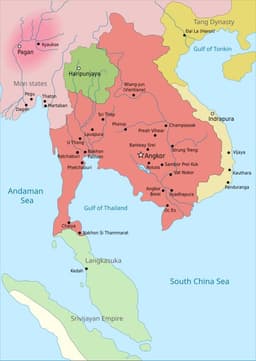
Jayavarman II
Emperor · Medieval
59.2Total
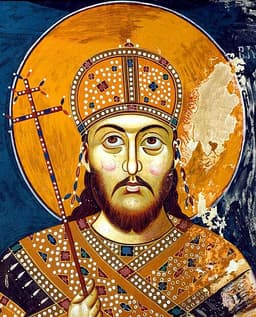
Stefan Dusan
Emperor · Medieval
63.9Total
Basic Information
Born
770
1308
Died
835
1355
Era
Medieval
Medieval
Nationality
Cambodia
Serbia
Occupation
Emperor
Emperor
Civilization
Eastern
Western
Score Comparison
Military (10%)
60.0
85.0
Political (20%)
72.0
70.0
Influence (20%)
68.0
56.7
Legacy (20%)
40.0
52.0
Leadership (15%)
66.0
72.0
Strategy (15%)
55.0
69.1
TOTAL
59.2
63.9
Jayavarman II — Complete Timeline
802 AD
Proclaimed Devaraja CultCultural
Jayavarman II performed a ritual on Mount Mahendraparvata proclaiming himself a 'devaraja' (god-king), establishing the cult of the divine ruler. This act unified the Khmer principalities and founded the Khmer Empire, legitimizing his rule through Hindu cosmology.
Khmer EmpireDevarajaFounding
Impact: regionalconstructive
Founded the Khmer EmpirePolitical Action
Jayavarman II unified the warring Khmer states under his rule, establishing the Khmer Empire with its capital at Mahendraparvata. This marked the beginning of a powerful empire that would dominate Southeast Asia for centuries.
Khmer EmpireUnificationFounding
Impact: regionalconstructive
Established Capital at MahendraparvataPolitical Action◆ Major
Jayavarman II established his capital at Mahendraparvata, a mountain temple complex in the Kulen Hills. This site became the ceremonial and political center of the early Khmer Empire.
Khmer EmpireCapitalMahendraparvata
Impact: regionalconstructive
Stefan Dusan — Complete Timeline
1346 AD
Coronation as Emperor of the Serbs and GreeksPolitical Action◆ Major
Stefan Dušan was crowned Emperor of the Serbs and Greeks in Skopje by the Serbian Patriarch, elevating the Serbian Kingdom to an Empire. This act asserted Serbian dominance in the Balkans and challenged Byzantine authority.
CoronationEmpireByzantine
Impact: regionalconstructive
1348 AD
Conquest of Macedonia and EpirusWar◆ Major
Dušan's forces captured key Byzantine territories including Serres, Thessaloniki (though not the city itself), and much of Epirus. These conquests expanded the Serbian Empire to its greatest territorial extent, controlling most of the Balkan Peninsula.
ConquestByzantineBalkans
Impact: regional
1349 AD
Promulgation of Dušan's CodeReform◆ Major
Dušan issued a comprehensive legal code, the Zakonik, at a state council in Skopje. The code standardized laws across the Serbian Empire, covering criminal, civil, and ecclesiastical matters, and reinforced the authority of the monarchy.
Legal CodeReformSerbia
Impact: nationalconstructive
1350 AD
Campaign against BosniaWar
Dušan launched a military campaign into Bosnia, aiming to expand Serbian influence westward. The campaign achieved limited success, failing to conquer significant territory, and was abandoned due to threats from Hungary.
CampaignBosniaHungary
Impact: regional
This comparison has not been analyzed yet.
One-time AI generation (~1 minute). Scores and timeline are already available below.
Rankings
🥇
Stefan DusanLeader
Mil: 85.0Pol: 70.0Inf: 56.7
63.9
🥈
Jayavarman II
Mil: 60.0Pol: 72.0Inf: 68.0
59.2
+4.7 behind
How This Comparison Works
Algorithm
Each figure is scored on 6 dimensions (0—100 scale) based on structured historical data: Military (10%), Political (20%), Influence (20%), Legacy (20%), Leadership (15%), Strategy (15%). The weighted total produces the final ranking.
Data Sources
Scores are computed from structured sub-indicators in the database. Scale factors adjust for era (Ancient ×0.85, Modern ×1.0) and civilization size (Eastern ×1.05, Other ×0.80) to account for differences in population and military scale.
Maximum 3 Figures
Comparisons are limited to 2—3 figures to ensure readability and statistical meaningfulness.
Error Margins
±5 points per dimension — Sub-scores are derived from historical records with inherent uncertainty. Two figures within 5 points on a dimension should be considered roughly equivalent in that area.
Total Score Accuracy
±3 points overall — The weighted combination of 6 dimensions produces a total score with approximately ±3 points of uncertainty. Differences of less than 3 points are not statistically significant— the figures are effectively tied.
Known Limitations
- Historical records are incomplete and uneven across civilizations
- Figures from oral-tradition societies may be underrepresented
- Occupation labels can misclassify multi-role figures
- Scores measure capability and impact, not moral character
- Quantitative scoring is a comparison tool, not absolute truth
Capability Radar
Military (10%) — Battles & Warfare
Battles
45
85
Win Rate
60
80
Expansion
65
90
Political (20%) — Governance & Reform
Reform
80
90
Diplomacy
65
75
Economy
60
70
Influence (20%) — Cultural & Global Reach
Cultural
75
70
Global
60
55
Legacy (20%) — Historical Impact
Historical
80
75
Longevity
75
60
Leadership (15%) — Power & Stability
Tenure
70
80
Stability
65
65
Strategy (15%) — Tactics & Innovation
Strategy
60
85
Tactics
55
75
Reform
70
70
Similar Comparisons
Comments & Discussion
No comments yet. Be the first to share your thoughts!