Loading...
Frederick II vs Stefan Dusan
Stefan Dusan leads by 2.2 pts · 2 figures compared
…
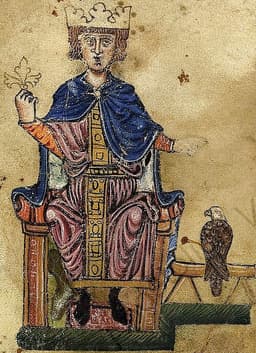
Frederick II
Emperor · Medieval
61.7Total
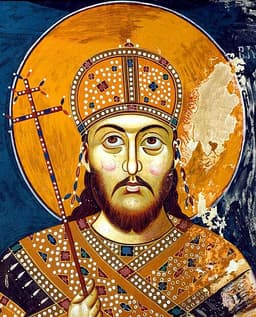
Stefan Dusan
Emperor · Medieval
63.9Total
Basic Information
Born
1194
1308
Died
1250
1355
Era
Medieval
Medieval
Nationality
Holy Roman Empire
Serbia
Occupation
Emperor
Emperor
Civilization
Western
Western
Score Comparison
Military (10%)
72.5
85.0
Political (20%)
70.3
70.0
Influence (20%)
40.0
56.7
Legacy (20%)
65.0
52.0
Leadership (15%)
72.0
72.0
Strategy (15%)
68.1
69.1
TOTAL
61.7
63.9
Frederick II — Complete Timeline
1224 AD
Foundation of the University of NaplesCultural◆ Major
Frederick II founded the University of Naples, the first state-run university in Europe. It was established to train administrators and lawyers for the kingdom, independent of papal control. The university became a center for legal and scientific studies.
EducationUniversitySicily
Impact: regionalconstructive
1228 AD
Sixth CrusadeWar◆ Major
Frederick II led the Sixth Crusade while excommunicated. Through diplomacy with Sultan al-Kamil, he secured the return of Jerusalem, Bethlehem, and Nazareth to Christian control without major battle. He crowned himself King of Jerusalem in the Church of the Holy Sepulchre.
CrusadeDiplomacyJerusalem
Impact: globalconstructive
1231 AD
Promulgation of the Constitutions of MelfiReform◆ Major
Frederick II issued the Constitutions of Melfi, a comprehensive legal code for the Kingdom of Sicily. The code centralized royal authority, reformed administration, and established a uniform legal system. It was one of the most advanced legal codes of the medieval period.
Legal ReformSicilyAdministration
Impact: regionalconstructive
1237 AD
Battle of CortenuovaWar◆ Major
Frederick II defeated the Lombard League at Cortenuova in northern Italy. He captured the League's carroccio and sent it to Rome as a trophy. The victory strengthened imperial control over northern Italy but did not end the League's resistance.
Lombard LeagueBattleItaly
Impact: regional
Stefan Dusan — Complete Timeline
1346 AD
Coronation as Emperor of the Serbs and GreeksPolitical Action◆ Major
Stefan Dušan was crowned Emperor of the Serbs and Greeks in Skopje by the Serbian Patriarch, elevating the Serbian Kingdom to an Empire. This act asserted Serbian dominance in the Balkans and challenged Byzantine authority.
CoronationEmpireByzantine
Impact: regionalconstructive
1348 AD
Conquest of Macedonia and EpirusWar◆ Major
Dušan's forces captured key Byzantine territories including Serres, Thessaloniki (though not the city itself), and much of Epirus. These conquests expanded the Serbian Empire to its greatest territorial extent, controlling most of the Balkan Peninsula.
ConquestByzantineBalkans
Impact: regional
1349 AD
Promulgation of Dušan's CodeReform◆ Major
Dušan issued a comprehensive legal code, the Zakonik, at a state council in Skopje. The code standardized laws across the Serbian Empire, covering criminal, civil, and ecclesiastical matters, and reinforced the authority of the monarchy.
Legal CodeReformSerbia
Impact: nationalconstructive
1350 AD
Campaign against BosniaWar
Dušan launched a military campaign into Bosnia, aiming to expand Serbian influence westward. The campaign achieved limited success, failing to conquer significant territory, and was abandoned due to threats from Hungary.
CampaignBosniaHungary
Impact: regional
Expert Analysis
Origins
Frederick II was born in 1194 in Jesi, Italy, to Holy Roman Emperor Henry VI and Constance of Sicily. Orphaned at age four, he was raised in Palermo under the guardianship of Pope Innocent III. His upbringing in multicultural Sicily exposed him to Arabic, Greek, and Latin learning, shaping his cosmopolitan worldview. He was crowned King of Sicily in 1198 and King of the Germans in 1212.
Stefan Dusan was born in 1308 in Serbia, the son of King Stefan Uros III Decanski. His early life was marked by court intrigue; his father was blinded and later killed, possibly with Dusan's involvement. Dusan was educated in Serbian Orthodox traditions and military arts. He became king in 1331 after deposing his father, a move that consolidated his power but stained his early reign.
Rise to Power
Frederick II's rise was contested. He was elected King of the Germans in 1212 with papal support, but faced opposition from Otto IV. He secured his position by promising to lead a crusade and to separate the Kingdom of Sicily from the Empire. After Otto's defeat at Bouvines (1214), Frederick was crowned Holy Roman Emperor in 1220. He spent much of his reign asserting imperial authority in Italy against the Lombard League and the papacy.
Stefan Dusan's rise was swift and ruthless. In 1331, he overthrew his father with the support of the Serbian nobility. He was crowned king and immediately began expanding Serbian territory. His major breakthrough came after the Byzantine civil war; he exploited the chaos to conquer Macedonia, Epirus, and Thessaly. In 1345, he captured Serres, and in 1346, he was crowned Emperor of the Serbs and Greeks in Skopje, elevating Serbia to an empire.
Leadership & Governance
Frederick II's governance was innovative. He centralized the Kingdom of Sicily through the Constitutions of Melfi (1231), a legal code that reduced feudal privileges and established a bureaucracy. He founded the University of Naples (1224) to train administrators. His leadership style was autocratic but pragmatic; he tolerated Muslims and Jews in his court, promoting cultural exchange. However, his conflict with the papacy weakened his position in Italy.
Stefan Dusan's governance was expansionist and legalistic. He promulgated Dusan's Code (1349), a comprehensive law code that standardized Serbian laws, covering criminal, civil, and church matters. He centralized the state by reducing noble autonomy and strengthening royal courts. His leadership was based on military conquest and the support of the Orthodox Church. He styled himself as the legitimate successor to the Byzantine Empire.
Triumph & Tragedy
Frederick II's greatest success was the Sixth Crusade (1228-1229), where through diplomacy he regained Jerusalem without battle. His Constitutions of Melfi created a sophisticated state. His tragedy was the ongoing conflict with the papacy, which excommunicated him and led to a propaganda war. His death in 1250 left the Hohenstaufen dynasty vulnerable, and his heirs were soon overthrown.
Stefan Dusan's greatest success was the expansion of Serbia into a major Balkan power. At its peak, his empire covered much of the Balkans. His code was a lasting legal achievement. His tragedy was that his empire fragmented after his death in 1355, as his son lacked the ability to hold it together. The Serbian Empire collapsed into feudal anarchy, leading to the Ottoman conquest.
Character & Destiny
Frederick II was intellectually curious and tolerant, earning the nickname "Stupor Mundi" (Wonder of the World). He wrote a book on falconry and corresponded with Muslim scholars. His pragmatic diplomacy often alienated the Church. His character led to both cultural flourishing and political isolation. He died excommunicated, yet his legacy as a Renaissance man before the Renaissance endures.
Stefan Dusan was ambitious and ruthless, willing to depose his father to achieve power. He was a capable military commander and lawgiver. His character drove him to build an empire, but his lack of a clear succession plan doomed it. He died suddenly at age 47, possibly from poison, leaving an unstable realm.
Legacy
Frederick II's legacy is mixed. His legal reforms influenced later European governance, and his patronage of learning contributed to the Renaissance. However, his empire disintegrated. In influence, he scored 40.0, reflecting his limited long-term impact. His legacy score of 65.0 is higher due to his cultural contributions.
Stefan Dusan's legacy is significant in Serbian history. His code remained in use until the Ottoman conquest, and his empire is remembered as a golden age. However, his influence score of 56.7 and legacy score of 52.0 reflect the ephemeral nature of his empire. His achievements were overshadowed by the subsequent Ottoman domination.
Conclusion
Stefan Dusan had a higher total score (63.9 vs 61.7) and a higher military score (85.0 vs 72.5). He built a larger empire and codified laws that lasted. Frederick II was more innovative in governance and culture but his political score (70.3) and strategy (68.1) were not enough to preserve his dynasty. Dusan's impact on the Balkans was more direct, though his empire was short-lived. Therefore, Stefan Dusan had greater impact in terms of territorial expansion and legal codification, while Frederick II excelled in institutional and cultural innovation. However, considering the durability of his legal code and the scale of his conquests, Stefan Dusan edges out Frederick II.
Rankings
🥇
Stefan DusanLeader
Mil: 85.0Pol: 70.0Inf: 56.7
63.9
🥈
Frederick II
Mil: 72.5Pol: 70.3Inf: 40.0
61.7
+2.2 behind
How This Comparison Works
Algorithm
Each figure is scored on 6 dimensions (0—100 scale) based on structured historical data: Military (10%), Political (20%), Influence (20%), Legacy (20%), Leadership (15%), Strategy (15%). The weighted total produces the final ranking.
Data Sources
Scores are computed from structured sub-indicators in the database. Scale factors adjust for era (Ancient ×0.85, Modern ×1.0) and civilization size (Eastern ×1.05, Other ×0.80) to account for differences in population and military scale.
Maximum 3 Figures
Comparisons are limited to 2—3 figures to ensure readability and statistical meaningfulness.
Error Margins
±5 points per dimension — Sub-scores are derived from historical records with inherent uncertainty. Two figures within 5 points on a dimension should be considered roughly equivalent in that area.
Total Score Accuracy
±3 points overall — The weighted combination of 6 dimensions produces a total score with approximately ±3 points of uncertainty. Differences of less than 3 points are not statistically significant— the figures are effectively tied.
Known Limitations
- Historical records are incomplete and uneven across civilizations
- Figures from oral-tradition societies may be underrepresented
- Occupation labels can misclassify multi-role figures
- Scores measure capability and impact, not moral character
- Quantitative scoring is a comparison tool, not absolute truth
Capability Radar
Military (10%) — Battles & Warfare
Battles
65
85
Win Rate
60
80
Expansion
55
90
Political (20%) — Governance & Reform
Reform
90
90
Diplomacy
85
75
Economy
80
70
Influence (20%) — Cultural & Global Reach
Cultural
85
70
Global
70
55
Legacy (20%) — Historical Impact
Historical
80
75
Longevity
75
60
Leadership (15%) — Power & Stability
Tenure
85
80
Stability
60
65
Strategy (15%) — Tactics & Innovation
Strategy
70
85
Tactics
75
75
Reform
80
70
Similar Comparisons
Comments & Discussion
No comments yet. Be the first to share your thoughts!