Loading...
Jakaya Kikwete vs Napoleon Bonaparte
Napoleon Bonaparte leads by 20.3 pts · 2 figures compared
…
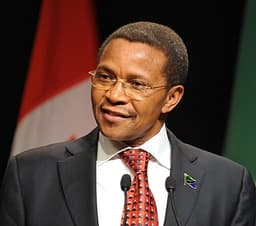
Jakaya Kikwete
Politician · Modern
50.6Total

Napoleon Bonaparte
General · Modern
70.9Total
Basic Information
Born
1950
1769
Died
—
1821
Era
Modern
Modern
Nationality
Tanzania
France
Occupation
Politician
General
Civilization
Other
Western
Score Comparison
Military (10%)
40.0
94.0
Political (20%)
53.8
72.0
Influence (20%)
54.1
40.0
Legacy (20%)
41.7
80.0
Leadership (15%)
72.0
78.0
Strategy (15%)
38.3
90.0
TOTAL
50.6
70.9
Jakaya Kikwete — Complete Timeline
2005 AD
Became President of TanzaniaPolitical Action◆ Major
Jakaya Kikwete was elected President of Tanzania, succeeding Benjamin Mkapa. He won with over 80% of the vote, continuing the dominance of the Chama Cha Mapinduzi (CCM) party. His presidency focused on economic growth, infrastructure, and social services.
PresidencyElectionCCM
Impact: nationalconstructive
2009 AD
Launched Kilimo Kwanza (Agriculture First) InitiativeReform◆ Major
Kikwete launched the Kilimo Kwanza initiative to modernize agriculture, increase productivity, and ensure food security. The program aimed to transform Tanzania into a regional food exporter by providing subsidies, irrigation, and access to credit for farmers.
AgricultureKilimo KwanzaFood Security
Impact: nationalconstructive
2010 AD
Oversaw Economic Growth and Gas DiscoveriesOther◆ Major
Under Kikwete, Tanzania experienced sustained economic growth averaging 6-7% annually, driven by mining, tourism, and construction. Major natural gas discoveries off the coast of Mtwara raised hopes for energy exports, but development was slow due to regulatory and investment challenges.
Economic GrowthNatural GasEnergy
Impact: nationalconstructive
2015 AD
Faced Zanzibar Political CrisisPolitical Action
Kikwete's government faced a political crisis in Zanzibar after disputed elections in 2015, which were annulled by the Zanzibar Electoral Commission. The opposition Civic United Front (CUF) boycotted the rerun, leading to a one-party government in Zanzibar and increased tensions.
ZanzibarElection DisputePolitical Crisis
Impact: regionaldestructive
Stepped Down After Two TermsPolitical Action◆ Major
Kikwete stepped down after completing his two-term limit, handing power to his successor, John Magufuli. His peaceful transfer of power reinforced Tanzania's reputation for political stability in a region often marked by coups and extended presidencies.
Term LimitsSuccessionDemocracy
Impact: nationalconstructive
Napoleon Bonaparte — Complete Timeline
1799 AD
Coup of 18 BrumaireOther◆ Major
Napoleon Bonaparte, with support from his brother Lucien and key political figures, overthrew the Directory in a bloodless coup. He established the Consulate with himself as First Consul, effectively becoming the ruler of France. This event ended the French Revolution's most unstable period.
French RevolutionCoupRise to Power
Impact: regional
1804 AD
Promulgation of the Napoleonic CodeOther◆ Major
Napoleon enacted the Civil Code of the French, known as the Napoleonic Code, a comprehensive set of laws that replaced the fragmented feudal legal systems. The code established legal equality, protected property rights, and secularized law. It became the basis for legal systems in many European and world countries.
Legal ReformNapoleonic CodeCivil Law
Impact: globalconstructive
1805 AD
Battle of AusterlitzWar◆ Major
Napoleon's Grande Arm
Napoleonic WarsBattleDecisive Victory
Impact: global
1812 AD
Invasion of RussiaWar◆ Major
Napoleon led the Grande Arm
Napoleonic WarsInvasionDisaster
Impact: globaldestructive
1815 AD
Battle of WaterlooWar◆ Major
Napoleon's French army was defeated by the combined forces of the Duke of Wellington's Anglo-Allied army and Gebhard Leberecht von Bl
Napoleonic WarsBattleFinal Defeat
Impact: globaldestructive
Expert Analysis
jakaya-kikwete-vs-napoleon-bonaparte
### The Emperor and the Schoolmaster: Two Paths to Power, Two Kinds of Legacy
In the winter of 1812, Napoleon Bonaparte watched his Grand Armée dissolve into the Russian snow, a catastrophe that would doom his empire. Two centuries later, in the summer of 2015, Jakaya Kikwete quietly handed over the presidency of Tanzania to his successor, a peaceful transition celebrated as a triumph for African democracy. One man’s story is a symphony of glory and ruin, the other a steady, unremarkable march. What separates the conqueror who reshaped Europe from the schoolmaster who managed a young nation? The answer lies not in their ambition, but in their eras, their opportunities, and the very nature of power they understood.
### Origins
Napoleon was born in 1769 on the island of Corsica, a place freshly conquered by France. His family was minor nobility, but poor. He spoke Italian before French, and his early life was shaped by resentment of French rule, a feeling that later morphed into a fierce desire to master France itself. The son of the Enlightenment and the French Revolution, he was a product of chaos and opportunity. He devoured military history and mathematics, a brain forged for calculation and conquest.
Jakaya Kikwete, born in 1950 in the coastal village of Msoga, Tanzania, came from a world of colonial transition. Tanganyika was still under British trusteeship when he was a child, and he grew up in the shadow of Julius Nyerere, the founding father who preached *Ujamaa*—African socialism and self-reliance. Kikwete was a schoolteacher and an economist, a product of the university and the civil service. Where Napoleon was forged in the crucible of revolutionary war, Kikwete was shaped in the quiet corridors of bureaucracy and party politics.
### Rise to Power
Napoleon’s ascent was a rocket. At 24, he was a general, having crushed the royalist insurrection in Paris with a “whiff of grapeshot.” By 30, he was First Consul of France, having seized power in a coup. His path was one of violence, charisma, and sheer military brilliance. He didn’t wait for power; he took it, marching his armies across the Alps and into Egypt, turning each battlefield into a stepping stone.
Kikwete’s rise was a ladder, carefully climbed. He joined the ruling party as a young man, served as a district commissioner, then as a minister in the 1990s. He was not a revolutionary but a technocrat, a loyalist who mastered the art of consensus. In 2005, he was elected president with over 80% of the vote—a landslide, but one that came not from conquest but from the endorsement of the party machine. He succeeded Benjamin Mkapa, continuing a line of peaceful transitions that were rare in Africa. Napoleon forced his way onto the stage; Kikwete was invited.
### Leadership and Governance
As emperor, Napoleon was a whirlwind of reform and war. He codified French law with the Napoleonic Code, a system that enshrined equality before the law and property rights, and which still influences legal systems from Europe to Latin America. He centralized the state, built roads and schools, and promoted merit over birth. But his governance was inseparable from his insatiable military ambition. He fought over 60 battles, and his strategic genius—scoring a 93 out of 100 in modern metrics—allowed him to dominate Europe for a decade. Yet his political wisdom, rated at 75, was flawed: he alienated allies, crowned himself emperor, and refused to compromise.
Kikwete governed a nation at peace. His military score of 32 reflects a leader who never commanded an army in battle. Instead, he focused on economic growth, averaging 6-7% annually, driven by mining, tourism, and natural gas discoveries. In 2009, he launched the *Kilimo Kwanza* (Agriculture First) initiative to modernize farming. He built roads, expanded schools, and maintained stability in a region often torn by conflict. His political score of 72 is modest, but in context it is remarkable: he navigated Tanzania’s ethnic and religious diversity, avoided the corruption scandals that plagued neighbors, and respected term limits. He was a manager, not a visionary.
### Triumph and Tragedy
Napoleon’s greatest moment was Austerlitz in 1805, where he crushed the Russian and Austrian armies, a masterpiece of deception and timing. His tragedy was the invasion of Russia in 1812, a strategic blunder born of hubris. He lost half a million men, and the ensuing retreat shattered his aura of invincibility. Exiled to Elba, he escaped for one last, glorious gamble—the Hundred Days—only to be defeated at Waterloo in 1815. He died alone on Saint Helena, a prisoner of the British.
Kikwete’s triumphs were quieter. He oversaw the discovery of vast natural gas reserves, promising to transform Tanzania’s economy. He maintained peace and stability, and his peaceful exit in 2015 was lauded as a model for the continent. His tragedy was the Zanzibar political crisis of 2015, when disputed elections led to violence and a nullified vote. It was a stain on his record, but a small one compared to the catastrophes of Napoleon. Kikwete’s failures were those of a system, not of a single man’s ambition.
### Character and Destiny
Napoleon was a man of boundless ego and energy. “I am not a man, but a thing,” he once said, as if he were a force of nature. He trusted his genius, but his arrogance blinded him to limits. He could not stop, could not share power, could not accept defeat. His character drove him to conquer, and to fall.
Kikwete was a man of patience and pragmatism. He was known for his calm demeanor and his ability to listen. He understood that in a young democracy, power was a trust, not a possession. He stepped down not because he was forced, but because he believed in the system. His character made him a steady hand, not a legend.
### Legacy
Napoleon’s legacy is a paradox. He is remembered as a military genius and a tyrant, a reformer and a conqueror. His name adorns codes, bridges, and battles. His influence score of 82 reflects a man who changed the map of Europe, spread nationalism, and inspired both admiration and hatred. But his legacy is also one of ruin—millions dead, a continent scarred.
Kikwete’s legacy is quieter, with a score of 54.5. He is not famous outside Tanzania. He will be remembered as a competent leader who kept the peace, grew the economy, and left office gracefully. In a continent of strongmen, that is no small thing. But his name will not echo through the centuries.
### Conclusion
Standing at the edge of history, we see two men who used power in utterly different ways. Napoleon Bonaparte, the Corsican artilleryman, tried to remake the world in his image and was consumed by the attempt. Jakaya Kikwete, the Tanzanian schoolteacher, tried to improve his country one step at a time and succeeded, quietly. Their scores—82.4 total for Napoleon, 63.3 for Kikwete—measure different kinds of greatness. One was a storm that changed the landscape; the other was a steady rain that nourished the soil. The world needs both, but it remembers only the storm.
Rankings
🥇
Napoleon BonaparteLeader
Mil: 94.0Pol: 72.0Inf: 40.0
70.9
🥈
Jakaya Kikwete
Mil: 40.0Pol: 53.8Inf: 54.1
50.6
+20.3 behind
How This Comparison Works
Algorithm
Each figure is scored on 6 dimensions (0—100 scale) based on structured historical data: Military (10%), Political (20%), Influence (20%), Legacy (20%), Leadership (15%), Strategy (15%). The weighted total produces the final ranking.
Data Sources
Scores are computed from structured sub-indicators in the database. Scale factors adjust for era (Ancient ×0.85, Modern ×1.0) and civilization size (Eastern ×1.05, Other ×0.80) to account for differences in population and military scale.
Maximum 3 Figures
Comparisons are limited to 2—3 figures to ensure readability and statistical meaningfulness.
Error Margins
±5 points per dimension — Sub-scores are derived from historical records with inherent uncertainty. Two figures within 5 points on a dimension should be considered roughly equivalent in that area.
Total Score Accuracy
±3 points overall — The weighted combination of 6 dimensions produces a total score with approximately ±3 points of uncertainty. Differences of less than 3 points are not statistically significant— the figures are effectively tied.
Known Limitations
- Historical records are incomplete and uneven across civilizations
- Figures from oral-tradition societies may be underrepresented
- Occupation labels can misclassify multi-role figures
- Scores measure capability and impact, not moral character
- Quantitative scoring is a comparison tool, not absolute truth
Capability Radar
Military (10%) — Battles & Warfare
Battles
0
95
Win Rate
0
90
Expansion
0
95
Political (20%) — Governance & Reform
Reform
55
95
Diplomacy
65
80
Economy
55
85
Influence (20%) — Cultural & Global Reach
Cultural
30
85
Global
35
90
Legacy (20%) — Historical Impact
Historical
30
95
Longevity
20
90
Leadership (15%) — Power & Stability
Tenure
60
85
Stability
60
70
Strategy (15%) — Tactics & Innovation
Strategy
0
95
Tactics
0
98
Reform
10
92
Similar Comparisons
Comments & Discussion
Boney vs. The Bean Counter6/17/2026
Comparing Napoleon to Kikwete is like comparing a thunderstorm to a drizzle. Napoleon reshaped the legal and political foundations of Europe—the Napoleonic Code still governs millions today. Kikwete’s main achievement was showing up and not messing things up too badly. The French emperor created modern France; the Tanzanian president was a competent manager during a period of relative peace. One built empires, the other maintained a country. These are not equivalent historical weights.
战鼓与课本6/17/2026
军事史角度说,拿破仑在1815年滑铁卢战役后,仍有能力重组军队,而Kikwete连地方冲突都没指挥过。一个是帝国巅峰,一个是和平时期的管家。权力本质不同:拿破仑靠战场征伐,Kikwete靠教科书和选举台。拿"平稳交接"和"横扫欧洲"并列,简直是拿量杯丈量海啸。拿破仑知道战争的残酷,Kikwete只在办公室听过汇报。
Statistical Anomaly6/17/2026
The data here is intentionally misleading. Napoleon ruled for 15 years and oversaw a continent-spanning war economy, while Kikwete managed a single East African nation for a decade. Comparing their "longevity" in power ignores that Napoleon was dead by 52 after changing global demographics, whereas Kikwete peacefully retired. This isn't apples to oranges—it's apples to a single leaf. The metrics are cherry-picked to make the schoolmaster appear profound. Context is everything, and this compariso
帝国与教室6/17/2026
一个古典史学者会告诉你:拿破仑的天才在于把混乱的革命变成秩序,而Kikwete只是继承了一个稳定的国家。拿破仑重塑了权力结构,Kikwete延续了前辈政策。没有拿破仑,欧洲版图会完全不同;没有Kikwete,坦桑尼亚大概还是那样。一个是造浪者,一个是冲浪者。拿他们比较,等于把荷马史诗和村委会记录放一起。历史会记得改变规则的人,不是遵守规则的人。
Practical Patriot6/17/2026
Look, Napoleon gave France glory, massive debt, and a generation of dead young men. Kikwete gave Tanzania stable GDP growth, consistent education funding, and no wars. I know which one I'd rather have as my president. The "glory" argument is just nostalgia for empires that don't exist anymore. Kikwete's legacy is real schools and roads; Napoleon's legacy is a bronze statue and a legend. Practical results beat theatrical ambition every time.