Loading...
Ivan V vs Julius Caesar
Julius Caesar leads by 36.8 pts · 2 figures compared
…
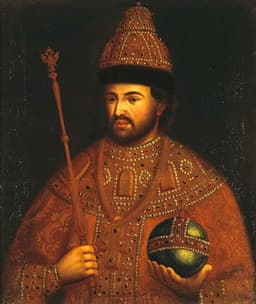
Ivan V
Emperor · Modern
46.0Total

Julius Caesar
General · Ancient
82.8Total
Basic Information
Born
1666
-100
Died
1696
-44
Era
Modern
Ancient
Nationality
Russia
Roman Republic
Occupation
Emperor
General
Civilization
Western
Western
Score Comparison
Military (10%)
10.6
88.0
Political (20%)
68.0
78.0
Influence (20%)
60.0
85.0
Legacy (20%)
35.0
82.0
Leadership (15%)
33.6
80.0
Strategy (15%)
60.0
85.0
TOTAL
46.0
82.8
Ivan V — Complete Timeline
1682 AD
Coronation as Co-Tsar with Peter IPolitical Action◆ Major
Following the death of Feodor III, Ivan V was crowned co-tsar alongside his half-brother Peter I, with his sister Sophia Alekseyevna acting as regent. This arrangement was forced by the Streltsy uprising and aimed to prevent a succession crisis, but Ivan's mental disabilities left him as a figurehead.
SuccessionRegencyStreltsy Uprising
Impact: national
Streltsy Uprising of 1682Political Action◆ Major
The Moscow Streltsy (musketeers) revolted, demanding that Ivan V be crowned tsar alongside Peter I. The uprising resulted in the massacre of several Naryshkin family members and the installation of Sophia as regent. Ivan's role was passive, but the event defined his reign.
RebellionRegencyViolence
Impact: nationaldestructive
Reign as Figurehead Co-TsarPolitical Action
From 1682 to 1696, Ivan V served as co-tsar with Peter I, but due to his mental and physical disabilities, he took no part in governance. Real power was held by his sister Sophia until 1689, and then by Peter. Ivan's reign was nominal, and he remained a ceremonial figure.
FigureheadCo-RulerCeremonial
Impact: national
Julius Caesar — Complete Timeline
58 BC
Gallic WarsWar◆ Major
Caesar, as proconsul of Gaul, launched a series of campaigns that conquered all of Gaul (modern France, Belgium, and parts of Switzerland). He fought numerous battles, including against the Helvetii, the Belgae, and the Gallic chieftain Vercingetorix. The wars brought immense wealth and a loyal army to Caesar.
Gallic WarsConquestRoman Expansion
Impact: regional
49 BC
Crossing the RubiconPolitical Action◆ Major
Caesar led Legio XIII across the Rubicon River into Italy, defying the Roman Senate's order to disband his army. This act triggered a civil war against Pompey and the Optimates, ultimately leading to Caesar's dictatorship and the end of the Roman Republic.
Roman Civil WarEnd of RepublicPower Struggle
Impact: global
48 BC
Battle of PharsalusWar◆ Major
Caesar's outnumbered army defeated the larger forces of Pompey the Great at Pharsalus in Greece. Caesar's tactical use of a reserve line to counter Pompey's cavalry charge proved decisive. Pompey fled to Egypt, where he was assassinated, leaving Caesar as the undisputed master of the Roman world.
Roman Civil WarBattleDecisive Victory
Impact: regional
44 BC
Appointment as Dictator for LifePolitical Action◆ Major
The Roman Senate appointed Caesar dictator perpetuo (dictator for life), granting him unprecedented personal power. This move concentrated military, legislative, and judicial authority in one person, effectively ending the Roman Republic's traditional system of checks and balances and alarming many senators.
DictatorshipEnd of RepublicPower Consolidation
Impact: regionaldestructive
Assassination on the Ides of MarchPolitical Action◆ Major
A group of Roman senators, led by Marcus Junius Brutus and Gaius Cassius Longinus, stabbed Caesar to death at a meeting of the Senate in the Theatre of Pompey. The assassination was intended to restore the Republic, but instead triggered another civil war that led to the rise of the Roman Empire.
AssassinationRoman PoliticsEnd of Republic
Impact: globaldestructive
Expert Analysis
ivan-v-vs-julius-caesar
# The Shadow and the Sun: Ivan V and Julius Caesar
In June 1682, a frail boy of sixteen sat trembling on a double throne in Moscow's Cathedral of the Assumption, his younger half-brother fidgeting beside him. The boy could barely see or speak clearly, his body wracked by ailments that left him a perpetual child. Across the centuries and half a continent, another scene unfolds: on a winter day in 49 BCE, a man in his fifties stands at the banks of the Rubicon, a small river separating Gaul from Italy. He knows that crossing means civil war, death, or glory. He crosses. One is Ivan V, co-tsar of Russia, a figure so passive that history barely remembers his breath. The other is Gaius Julius Caesar, whose every breath seemed to shake the world. How can two men, both crowned with supreme authority, leave such staggeringly different marks on time?
Origins
Julius Caesar was born into the patrician Julian clan in 100 BCE, a family claiming descent from the goddess Venus. Yet his Rome was a Republic in decay—corrupt, violent, and hungry for a strongman. Caesar’s father died when he was sixteen, leaving him to navigate a world of political factions, debt, and ambition. He learned early that survival meant audacity. He was captured by pirates as a young man, laughed at their ransom demand, raised it himself, and later crucified them all. Every moment of his youth was a rehearsal for power.
Ivan V was born in 1666 into the Romanov dynasty, but his inheritance was cruel. He suffered from scurvy, poor eyesight, and what contemporaries described as “mental weakness”—likely a developmental disability. His Russia was vast, backward, and torn between old Orthodox traditions and the creeping influence of the West. While Caesar’s Rome demanded action, Ivan’s Moscow expected piety and submission. His body and mind simply could not meet the moment.
Rise to Power
Caesar’s path was a ladder he built himself. He served as a military tribune, then quaestor, aedile, and pontifex maximus—each step funded by borrowed money and secured by ruthless alliances. His real breakthrough came when he formed the First Triumvirate with Pompey and Crassus in 60 BCE, then secured command in Gaul. The Gallic Wars (58–50 BCE) were not just conquests; they were a personal empire-building machine. He wrote his own commentaries, controlled his own narrative, and returned to Rome with an army that loved him more than the Senate.
Ivan V rose to power through accident and manipulation. When Tsar Feodor III died childless in 1682, the succession fell to Ivan and his half-brother Peter. The powerful Miloslavsky family, allied with Ivan’s sister Sophia, incited the Streltsy Uprising—a bloody revolt by Moscow’s musketeers that demanded Ivan be crowned alongside Peter. Terrified, the boyars complied. On June 25, 1682, Ivan was crowned co-tsar, but he was a prop. Sophia became regent, and Peter, though young, soon began to overshadow Ivan entirely.
Leadership & Governance
Caesar governed like a storm. As dictator, he reformed the calendar (the Julian calendar we still use), expanded citizenship to provincials, launched public works, and centralized tax collection. He was a military genius who won battles against impossible odds—Alesia, Pharsalus, Zela—and a political innovator who understood that popularity was power. He pardoned his enemies, but only to bind them to his will. His reforms were radical: land redistribution, debt relief, and the reorganization of local government. He ruled not by tradition but by sheer force of personality.
Ivan V governed not at all. From 1682 to 1696, he was a figurehead. He attended ceremonies, signed documents prepared by others, and watched as his half-brother Peter—soon to be Peter the Great—dragged Russia into modernity. Ivan had no military command, no political vision, no reforms. His only “achievement” was surviving. When Sophia attempted to seize full power, Peter crushed her; Ivan remained silent. He was a placeholder, a ghost in a crown.
Triumph & Tragedy
Caesar’s greatest triumph was also his greatest tragedy. He defeated Pompey, conquered Egypt (and Cleopatra), and returned to Rome as dictator for life in 44 BCE. He had remade the world in his image. But his arrogance blinded him. He refused a bodyguard, dismissed warnings, and on the Ides of March—March 15, 44 BCE—he was stabbed twenty-three times by senators he had pardoned. His last words, according to tradition, were “Et tu, Brute?” He fell at the foot of a statue of Pompey, his old enemy.
Ivan V experienced no such drama. His life was a slow fade. He married, fathered five daughters, and watched from the shadows as Peter grew into a giant. His only moment of significance came in 1689, when Peter overthrew Sophia and asked Ivan to confirm his sole authority. Ivan agreed. He died quietly in 1696 at age twenty-nine, perhaps of natural causes, perhaps of neglect. His tragedy was not betrayal but irrelevance.
Character & Destiny
Caesar was restless, brilliant, and incapable of contentment. He gambled everything because he believed he deserved everything. His character was his engine and his flaw: the same daring that conquered Gaul also provoked his assassination. He once said, “It is easier to find men who will volunteer to die than to find those who are willing to endure pain with patience.” He chose death over patience.
Ivan V was patient by necessity. He endured pain daily—physical, mental, emotional. He was a gentle soul in a brutal age, and his character was shaped by incapacity. He never chose power; power chose him, then ignored him. His destiny was to be a footnote in Peter the Great’s story. Where Caesar’s personality bent history, Ivan’s personality was bent by it.
Legacy
Caesar’s legacy is the Roman Empire itself. His name became a title—Kaiser, Tsar—and his writings remain classics. He transformed the Republic into an autocracy, for better or worse. His reforms outlived him, and his assassination triggered a civil war that ended the Republic forever. Today, he is remembered as a genius, a tyrant, and a warning.
Ivan V’s legacy is almost invisible. He is a footnote in Russian history, remembered only as the co-tsar who did nothing. The Romanov dynasty continued through Peter, not Ivan. His daughters married into German nobility, but his bloodline faded. He is a lesson in what happens when history has no use for a man.
Conclusion
Standing on the banks of the Rubicon, Julius Caesar saw a river that would carry him to immortality. Sitting on the double throne of Moscow, Ivan V saw a ceiling he could never reach. One man seized history by the throat; the other was carried along by its currents. Their differences are not merely of talent but of opportunity, body, and will. Caesar proved that a single man can redirect the course of civilization. Ivan V proved that even a crown cannot make a king. In the end, both died—one in a pool of blood, the other in a quiet bed—but only one of them left a world that remembered his name. The other remains what he always was: a shadow, waiting for the sun to set.
Rankings
🥇
Julius CaesarLeader
Mil: 88.0Pol: 78.0Inf: 85.0
82.8
🥈
Ivan V
Mil: 10.6Pol: 68.0Inf: 60.0
46.0
+36.8 behind
How This Comparison Works
Algorithm
Each figure is scored on 6 dimensions (0—100 scale) based on structured historical data: Military (10%), Political (20%), Influence (20%), Legacy (20%), Leadership (15%), Strategy (15%). The weighted total produces the final ranking.
Data Sources
Scores are computed from structured sub-indicators in the database. Scale factors adjust for era (Ancient ×0.85, Modern ×1.0) and civilization size (Eastern ×1.05, Other ×0.80) to account for differences in population and military scale.
Maximum 3 Figures
Comparisons are limited to 2—3 figures to ensure readability and statistical meaningfulness.
Error Margins
±5 points per dimension — Sub-scores are derived from historical records with inherent uncertainty. Two figures within 5 points on a dimension should be considered roughly equivalent in that area.
Total Score Accuracy
±3 points overall — The weighted combination of 6 dimensions produces a total score with approximately ±3 points of uncertainty. Differences of less than 3 points are not statistically significant— the figures are effectively tied.
Known Limitations
- Historical records are incomplete and uneven across civilizations
- Figures from oral-tradition societies may be underrepresented
- Occupation labels can misclassify multi-role figures
- Scores measure capability and impact, not moral character
- Quantitative scoring is a comparison tool, not absolute truth
Capability Radar
Military (10%) — Battles & Warfare
Battles
39
95
Win Rate
39
92
Expansion
42
97
Political (20%) — Governance & Reform
Reform
0
90
Diplomacy
0
85
Economy
0
82
Influence (20%) — Cultural & Global Reach
Cultural
0
88
Global
0
94
Legacy (20%) — Historical Impact
Historical
5
95
Longevity
5
96
Leadership (15%) — Power & Stability
Tenure
5
75
Stability
5
60
Strategy (15%) — Tactics & Innovation
Strategy
48
94
Tactics
48
96
Reform
53
88
Similar Comparisons
Comments & Discussion
No comments yet. Be the first to share your thoughts!