Loading...
This comparison has not been analyzed yet.
One-time AI generation (~1 minute). Scores and timeline are already available below.
Ivan the Terrible vs Sawai Ram Singh II
Ivan the Terrible leads by 16.0 pts · 2 figures compared
…
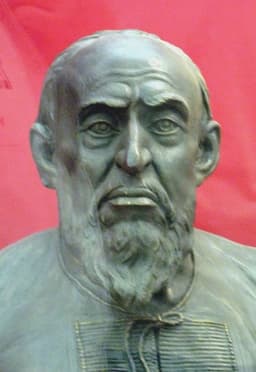
Ivan the Terrible
Emperor · Modern
65.0Total

Sawai Ram Singh II
Emperor · Modern
49.0Total
Basic Information
Born
1530
1835
Died
1584
1880
Era
Modern
Modern
Nationality
Russia
India
Occupation
Emperor
Emperor
Civilization
Western
Indian
Score Comparison
Military (10%)
74.7
20.0
Political (20%)
60.0
59.3
Influence (20%)
72.0
54.1
Legacy (20%)
55.0
44.2
Leadership (15%)
68.0
66.0
Strategy (15%)
66.3
36.8
TOTAL
65.0
49.0
Ivan the Terrible — Complete Timeline
1547 AD
Coronation as First Tsar of RussiaPolitical Action
Ivan IV was crowned as the first Tsar of All Russia, adopting the title of Caesar. This coronation asserted Russia's independence from Mongol influence and claimed imperial status. It marked the beginning of centralized autocratic rule in Russia.
CoronationTsarAutocracy
Impact: national
1552 AD
Conquest of KazanWar◆ Major
Ivan IV led a Russian army to conquer the Khanate of Kazan, ending Tatar rule in the Volga region. The siege lasted several weeks and resulted in the annexation of the khanate. This victory opened the way for Russian expansion into Siberia and the Caspian region.
ConquestKazanExpansion
Impact: regional
1558 AD
Livonian WarWar◆ Major
Ivan IV launched a war against the Livonian Confederation to gain access to the Baltic Sea. The war lasted 25 years and involved Poland-Lithuania, Sweden, and Denmark. It ended in Russian defeat, with Ivan failing to secure a Baltic port.
WarBalticDefeat
Impact: regionaldestructive
1565 AD
Establishment of the OprichninaReform
Ivan IV created the Oprichnina, a separate territory and state apparatus under his direct control. He used the Oprichniki, a corps of secret police, to eliminate his political opponents. This policy led to widespread terror, executions, and confiscation of lands.
TerrorOprichninaRepression
Impact: nationaldestructive
1570 AD
Massacre of NovgorodWar◆ Major
Ivan IV led the Oprichniki in a brutal campaign against the city of Novgorod, suspected of treason. Thousands of inhabitants were killed, and the city was looted and destroyed. This massacre broke the power of Novgorod and terrorized the Russian population.
MassacreNovgorodTerror
Impact: regionaldestructive
1581 AD
Killing of His Son IvanOther◆ Major
Ivan IV struck and killed his eldest son and heir, Ivan Ivanovich, during an argument. The tsarevich died from his injuries days later. This event left Russia without a capable successor and contributed to the Time of Troubles after Ivan's death.
PatricideSuccessionTragedy
Impact: nationaltragic
Sawai Ram Singh II — Complete Timeline
1868 AD
Construction of Ram Niwas GardenCultural
Sawai Ram Singh II built the Ram Niwas Garden in Jaipur, a public park with fountains, a museum, and a zoo. The garden was designed as a recreational space for the public. It became a popular landmark in the city.
Public ParkUrban DevelopmentRecreation
constructive
1870 AD
Introduction of modern reforms in JaipurReform◆ Major
Sawai Ram Singh II implemented modern reforms in Jaipur, including the establishment of a municipal council, a police force, and a postal system. He also promoted education and infrastructure development. These reforms modernized the administration of the princely state.
Administrative ReformModernizationInfrastructure
Impact: regionalconstructive
1875 AD
Establishment of Mayo CollegeCultural◆ Major
Sawai Ram Singh II supported the establishment of Mayo College in Ajmer, a school for the sons of Indian princes. The college was modeled on British public schools and aimed to modernize education for royalty. It became a prestigious institution.
EducationModernizationBritish Raj
Impact: nationalconstructive
1876 AD
Painting of Jaipur pinkCultural◆ Major
Sawai Ram Singh II ordered the painting of Jaipur's buildings in pink to welcome the Prince of Wales, later King Edward VII. The pink color symbolized hospitality and became the city's trademark. Jaipur earned the nickname 'Pink City' from this event.
Urban AestheticsRoyal VisitCity Identity
Impact: regionalconstructive
This comparison has not been analyzed yet.
One-time AI generation (~1 minute). Scores and timeline are already available below.
Rankings
🥇
Ivan the TerribleLeader
Mil: 74.7Pol: 60.0Inf: 72.0
65.0
🥈
Sawai Ram Singh II
Mil: 20.0Pol: 59.3Inf: 54.1
49.0
+16.0 behind
How This Comparison Works
Algorithm
Each figure is scored on 6 dimensions (0—100 scale) based on structured historical data: Military (10%), Political (20%), Influence (20%), Legacy (20%), Leadership (15%), Strategy (15%). The weighted total produces the final ranking.
Data Sources
Scores are computed from structured sub-indicators in the database. Scale factors adjust for era (Ancient ×0.85, Modern ×1.0) and civilization size (Eastern ×1.05, Other ×0.80) to account for differences in population and military scale.
Maximum 3 Figures
Comparisons are limited to 2—3 figures to ensure readability and statistical meaningfulness.
Error Margins
±5 points per dimension — Sub-scores are derived from historical records with inherent uncertainty. Two figures within 5 points on a dimension should be considered roughly equivalent in that area.
Total Score Accuracy
±3 points overall — The weighted combination of 6 dimensions produces a total score with approximately ±3 points of uncertainty. Differences of less than 3 points are not statistically significant— the figures are effectively tied.
Known Limitations
- Historical records are incomplete and uneven across civilizations
- Figures from oral-tradition societies may be underrepresented
- Occupation labels can misclassify multi-role figures
- Scores measure capability and impact, not moral character
- Quantitative scoring is a comparison tool, not absolute truth
Capability Radar
Military (10%) — Battles & Warfare
Battles
75
5
Win Rate
65
5
Expansion
80
5
Political (20%) — Governance & Reform
Reform
90
70
Diplomacy
40
60
Economy
50
65
Influence (20%) — Cultural & Global Reach
Cultural
60
45
Global
65
20
Legacy (20%) — Historical Impact
Historical
75
40
Longevity
70
35
Leadership (15%) — Power & Stability
Tenure
85
55
Stability
20
60
Strategy (15%) — Tactics & Innovation
Strategy
70
10
Tactics
60
10
Reform
85
25
Similar Comparisons
Comments & Discussion
No comments yet. Be the first to share your thoughts!