Loading...
Ivan the Terrible vs Julius Caesar
Julius Caesar leads by 17.8 pts · 2 figures compared
…
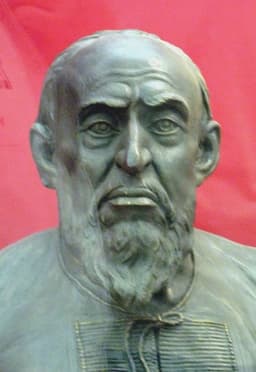
Ivan the Terrible
Emperor · Modern
65.0Total

Julius Caesar
General · Ancient
82.8Total
Basic Information
Born
1530
-100
Died
1584
-44
Era
Modern
Ancient
Nationality
Russia
Roman Republic
Occupation
Emperor
General
Civilization
Western
Western
Score Comparison
Military (10%)
74.7
88.0
Political (20%)
60.0
78.0
Influence (20%)
72.0
85.0
Legacy (20%)
55.0
82.0
Leadership (15%)
68.0
80.0
Strategy (15%)
66.3
85.0
TOTAL
65.0
82.8
Ivan the Terrible — Complete Timeline
1547 AD
Coronation as First Tsar of RussiaPolitical Action
Ivan IV was crowned as the first Tsar of All Russia, adopting the title of Caesar. This coronation asserted Russia's independence from Mongol influence and claimed imperial status. It marked the beginning of centralized autocratic rule in Russia.
CoronationTsarAutocracy
Impact: national
1552 AD
Conquest of KazanWar◆ Major
Ivan IV led a Russian army to conquer the Khanate of Kazan, ending Tatar rule in the Volga region. The siege lasted several weeks and resulted in the annexation of the khanate. This victory opened the way for Russian expansion into Siberia and the Caspian region.
ConquestKazanExpansion
Impact: regional
1558 AD
Livonian WarWar◆ Major
Ivan IV launched a war against the Livonian Confederation to gain access to the Baltic Sea. The war lasted 25 years and involved Poland-Lithuania, Sweden, and Denmark. It ended in Russian defeat, with Ivan failing to secure a Baltic port.
WarBalticDefeat
Impact: regionaldestructive
1565 AD
Establishment of the OprichninaReform
Ivan IV created the Oprichnina, a separate territory and state apparatus under his direct control. He used the Oprichniki, a corps of secret police, to eliminate his political opponents. This policy led to widespread terror, executions, and confiscation of lands.
TerrorOprichninaRepression
Impact: nationaldestructive
1570 AD
Massacre of NovgorodWar◆ Major
Ivan IV led the Oprichniki in a brutal campaign against the city of Novgorod, suspected of treason. Thousands of inhabitants were killed, and the city was looted and destroyed. This massacre broke the power of Novgorod and terrorized the Russian population.
MassacreNovgorodTerror
Impact: regionaldestructive
1581 AD
Killing of His Son IvanOther◆ Major
Ivan IV struck and killed his eldest son and heir, Ivan Ivanovich, during an argument. The tsarevich died from his injuries days later. This event left Russia without a capable successor and contributed to the Time of Troubles after Ivan's death.
PatricideSuccessionTragedy
Impact: nationaltragic
Julius Caesar — Complete Timeline
58 BC
Gallic WarsWar◆ Major
Caesar, as proconsul of Gaul, launched a series of campaigns that conquered all of Gaul (modern France, Belgium, and parts of Switzerland). He fought numerous battles, including against the Helvetii, the Belgae, and the Gallic chieftain Vercingetorix. The wars brought immense wealth and a loyal army to Caesar.
Gallic WarsConquestRoman Expansion
Impact: regional
49 BC
Crossing the RubiconPolitical Action◆ Major
Caesar led Legio XIII across the Rubicon River into Italy, defying the Roman Senate's order to disband his army. This act triggered a civil war against Pompey and the Optimates, ultimately leading to Caesar's dictatorship and the end of the Roman Republic.
Roman Civil WarEnd of RepublicPower Struggle
Impact: global
48 BC
Battle of PharsalusWar◆ Major
Caesar's outnumbered army defeated the larger forces of Pompey the Great at Pharsalus in Greece. Caesar's tactical use of a reserve line to counter Pompey's cavalry charge proved decisive. Pompey fled to Egypt, where he was assassinated, leaving Caesar as the undisputed master of the Roman world.
Roman Civil WarBattleDecisive Victory
Impact: regional
44 BC
Appointment as Dictator for LifePolitical Action◆ Major
The Roman Senate appointed Caesar dictator perpetuo (dictator for life), granting him unprecedented personal power. This move concentrated military, legislative, and judicial authority in one person, effectively ending the Roman Republic's traditional system of checks and balances and alarming many senators.
DictatorshipEnd of RepublicPower Consolidation
Impact: regionaldestructive
Assassination on the Ides of MarchPolitical Action◆ Major
A group of Roman senators, led by Marcus Junius Brutus and Gaius Cassius Longinus, stabbed Caesar to death at a meeting of the Senate in the Theatre of Pompey. The assassination was intended to restore the Republic, but instead triggered another civil war that led to the rise of the Roman Empire.
AssassinationRoman PoliticsEnd of Republic
Impact: globaldestructive
Expert Analysis
ivan-the-terrible-vs-julius-caesar
# The Dictator’s Mirror: Caesar and Ivan the Terrible
On the Ides of March in 44 BCE, a Roman dictator fell bleeding on the Senate floor, his body pierced by dozens of daggers wielded by men he had once called friends. More than sixteen centuries later, in a darkened chamber of the Moscow Kremlin, the first Tsar of All Russia struck his own son dead with a single, furious blow of his iron-tipped staff. Two rulers, separated by time and geography, yet bound by a terrifying question: what happens when absolute power meets an absolute will?
Origins
Gaius Julius Caesar was born into the twilight of the Roman Republic, a world of senatorial ambition, civil strife, and shifting alliances. His family, the Julii, claimed descent from the goddess Venus, but their political fortunes had faded. Caesar’s youth was marked by danger—he fled Rome during the proscriptions of Sulla, who had ordered his execution for refusing to divorce his wife. This early brush with death forged a man who understood that survival required both charm and steel.
Ivan IV came into the world in 1530, a child of chaos. His father, Grand Prince Vasily III, died when Ivan was three, and his mother Elena Glinskaya ruled as regent until her sudden death—likely by poison—when Ivan was eight. The boy grew up in a court of boyars who treated him with contempt, stealing lands and ignoring his authority. He later wrote that he was “not allowed to eat or sleep in peace.” Where Caesar learned to navigate politics through persuasion, Ivan learned that trust was a luxury for fools.
Rise to Power
Caesar’s ascent was a masterclass in calculated risk. He climbed the *cursus honorum*—the ladder of Roman magistracies—with relentless energy, borrowing vast sums to fund games and bribes. His military command in Hispania and his conquest of Gaul (58–50 BCE) turned him into a legend. The Gallic Wars, which he chronicled in elegant Latin, brought him wealth, loyal legions, and a reputation that eclipsed his rivals. When the Senate ordered him to disband his army and return to Rome as a private citizen, Caesar made his choice: in 49 BCE, he crossed the Rubicon River, declaring, *“Alea iacta est”*—the die is cast.
Ivan’s path was different. At sixteen, in 1547, he shocked the boyars by demanding the title of Tsar—a Slavic rendering of “Caesar.” His coronation was a political assertion that Russia was no longer a collection of squabbling principalities but an empire. Early in his reign, Ivan showed promise: he summoned the first Zemsky Sobor (national assembly), reformed the legal code, and modernized the army. Then, in 1552, he conquered the Khanate of Kazan, ending centuries of Tatar dominance over the Volga region. The victory was intoxicating—and it awakened something darker.
Leadership & Governance
Caesar governed as a pragmatist. As dictator, he reformed the calendar (giving us the Julian calendar we still use), granted citizenship to provincials, initiated public works, and curbed the power of corrupt aristocrats. He was generous to former enemies—he pardoned many of his senatorial opponents, a clemency that would cost him his life. His military genius lay in speed and logistics: at the Battle of Alesia (52 BCE), he built a double ring of fortifications to besiege the Gallic fortress while simultaneously repelling a massive relief army. It was a feat of engineering and discipline that remains a textbook example of siege warfare.
Ivan’s governance was the mirror image. Where Caesar built, Ivan destroyed. In 1565, he established the Oprichnina—a separate state within Russia, ruled by a personal guard of black-robed horsemen called the Oprichniki. They rode with severed dogs’ heads and brooms tied to their saddles, symbols of their mission to sniff out treason and sweep it away. Ivan used this secret police to confiscate boyar lands, execute rivals, and terrorize entire cities. The Livonian War, which he launched in 1558 to gain a Baltic port, dragged on for 25 years and bled Russia dry. His strategic score of 66.4 reflects a ruler who could win battles but not wars.
Triumph & Tragedy
Caesar’s greatest triumph was his own survival—until it wasn’t. He defeated his rival Pompey at Pharsalus in 48 BCE, crushed the last holdouts of the senatorial faction, and returned to Rome as dictator for life in 44 BCE. He was at the height of his power, planning a campaign against Parthia, when the conspiracy of Brutus and Cassius struck him down. His tragedy was that his clemency bred contempt: the men he spared believed he had become a tyrant.
Ivan’s triumphs were pyrrhic. The conquest of Kazan was real, but it was followed by the Livonian disaster and the Massacre of Novgorod in 1570, where Ivan personally led his Oprichniki in a reign of terror that killed thousands of inhabitants—men, women, and children—on suspicion of betrayal. The worst blow came in 1581, when during an argument, Ivan struck his eldest son and heir, Ivan Ivanovich, with his staff. The tsarevich died days later. The Tsar had killed his own future.
Character & Destiny
Caesar was a gambler who understood odds. He was ruthless when necessary—he ordered the massacre of 53,000 Gauls at Avaricum—but he also knew that mercy could win allies. His personality was magnetic: soldiers adored him, women desired him, and his writings reveal a man who saw himself as a force of history. His assassination was a failure of his own political judgment: he ignored warnings, dismissed the soothsayer’s prophecy about the Ides of March, and walked into the Senate unarmed.
Ivan was a paranoid autocrat who saw betrayal everywhere because he had experienced it as a child. His intelligence was genuine—he wrote theological treatises and corresponded with Queen Elizabeth I—but it was consumed by rage. The Oprichnina was not a policy; it was an expression of his soul. His killing of his son was not an accident but a culmination: a man who had destroyed everything around him finally destroyed his own bloodline.
Legacy
Caesar’s legacy is foundational. His name became a title—Kaiser, Tsar—and his reforms outlived him. The Roman Empire that followed was his creation, even if he never wore the crown. His writings are still read, his battles still studied, and his assassination remains the most famous political murder in history. His legacy score of 82.0 reflects a man who changed the world.
Ivan’s legacy is a warning. He is remembered as “the Terrible”—from the Russian *grozny*, meaning “awe-inspiring” or “formidable,” but history has weighted it with terror. His reign broke the boyars but left Russia exhausted, isolated, and leaderless after his death. His legacy score of 55.0 is the lowest of all his metrics, a judgment that even Russia itself has struggled to reconcile. He is a figure of morbid fascination, not emulation.
Conclusion
Caesar and Ivan both reached for absolute power, but they held it in different hands. Caesar used it to create; Ivan used it to consume. One was killed by his enemies; the other killed his own son. Their stories remind us that dictatorship is not a single phenomenon—it is a mirror that reflects the character of the man who stares into it. Caesar’s tragedy was that he believed his mercy would save him. Ivan’s tragedy was that he believed his terror would protect him. Neither was right.
Rankings
🥇
Julius CaesarLeader
Mil: 88.0Pol: 78.0Inf: 85.0
82.8
🥈
Ivan the Terrible
Mil: 74.7Pol: 60.0Inf: 72.0
65.0
+17.8 behind
How This Comparison Works
Algorithm
Each figure is scored on 6 dimensions (0—100 scale) based on structured historical data: Military (10%), Political (20%), Influence (20%), Legacy (20%), Leadership (15%), Strategy (15%). The weighted total produces the final ranking.
Data Sources
Scores are computed from structured sub-indicators in the database. Scale factors adjust for era (Ancient ×0.85, Modern ×1.0) and civilization size (Eastern ×1.05, Other ×0.80) to account for differences in population and military scale.
Maximum 3 Figures
Comparisons are limited to 2—3 figures to ensure readability and statistical meaningfulness.
Error Margins
±5 points per dimension — Sub-scores are derived from historical records with inherent uncertainty. Two figures within 5 points on a dimension should be considered roughly equivalent in that area.
Total Score Accuracy
±3 points overall — The weighted combination of 6 dimensions produces a total score with approximately ±3 points of uncertainty. Differences of less than 3 points are not statistically significant— the figures are effectively tied.
Known Limitations
- Historical records are incomplete and uneven across civilizations
- Figures from oral-tradition societies may be underrepresented
- Occupation labels can misclassify multi-role figures
- Scores measure capability and impact, not moral character
- Quantitative scoring is a comparison tool, not absolute truth
Capability Radar
Military (10%) — Battles & Warfare
Battles
75
95
Win Rate
65
92
Expansion
80
97
Political (20%) — Governance & Reform
Reform
90
90
Diplomacy
40
85
Economy
50
82
Influence (20%) — Cultural & Global Reach
Cultural
60
88
Global
65
94
Legacy (20%) — Historical Impact
Historical
75
95
Longevity
70
96
Leadership (15%) — Power & Stability
Tenure
85
75
Stability
20
60
Strategy (15%) — Tactics & Innovation
Strategy
70
94
Tactics
60
96
Reform
85
88
Similar Comparisons
Comments & Discussion
KremlinAutocrat6/17/2026
Caesar was a political genius who built coalitions; Ivan was a paranoid autocrat who destroyed everyone around him. Caesar crossed the Rubicon knowing the Senate would fold—he understood power dynamics with surgical precision. Ivan created the Oprichnina, a secret police force that terrorized his own people, massacring Novgorod for phantom treason. One man expanded Rome’s empire through calculated risk; the other turned Russia into a blood-soaked estate. Don’t conflate state terror with statecra
IronSceptic6/17/2026
把凯撒和伊凡放在一起比较,简直是侮辱历史。凯撒在高卢打了八场战役,写了《高卢战记》自己marketing;伊凡四世呢?利沃尼亚战争打了25年,俄国输得一塌糊涂,地盘没拿到,经济崩了。一个扩张领土,一个把国家带进坑里。别拿暴君当战略家,数据不会说谎。
ClassicalCutthroat6/17/2026
Here’s the brutal truth: Caesar was assassinated by his peers because he was competent enough to threaten their power. Ivan died in bed after personally beating his son to death. Caesar’s civil wars ended with him as a reluctant dictator who actually reformed governance—provincial administration, calendar, debt relief. Ivan’s legacy is a dynasty collapse and a population halved by terror. One built an empire; the other hollowed one out. History’s verdict isn’t ambiguous.
东方刀笔吏6/17/2026
你们都在谈政治手腕,我来谈文化屠杀。凯撒征服高卢后推行罗马法,建立城市,给当地人公民权;伊凡洗劫诺夫哥罗德,烧毁大量古斯拉夫手稿,破坏了自己文明的知识遗产。一个在整合文明,一个在内部绞杀。暴君有层次,伊凡是更黑暗的那种——他连自己文明的根都要刨掉。
VeniVidiVici6/17/2026
Ivan’s nickname “Terrible” translates more accurately as “Awe-Inspiring,” and that’s the key difference. Caesar inspired loyalty—even his assassins had to convince themselves he was a tyrant. His legions adored him; Cleopatra bore his child. Ivan inspired only terror: his own guards, the Oprichniki, feared him; his son died at his hand. Awe without love isn’t power—it’s just fear management. Caesar didn’t need terror to rule; Ivan didn’t know any other way.