Loading...
Ivan the Terrible vs Napoleon Bonaparte
Napoleon Bonaparte leads by 5.9 pts · 2 figures compared
…
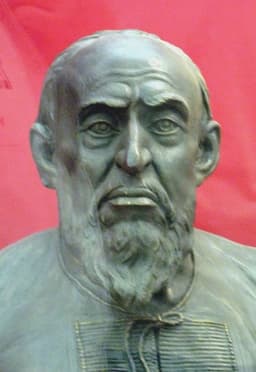
Ivan the Terrible
Emperor · Modern
65.0Total

Napoleon Bonaparte
General · Modern
70.9Total
Basic Information
Born
1530
1769
Died
1584
1821
Era
Modern
Modern
Nationality
Russia
France
Occupation
Emperor
General
Civilization
Western
Western
Score Comparison
Military (10%)
74.7
94.0
Political (20%)
60.0
72.0
Influence (20%)
72.0
40.0
Legacy (20%)
55.0
80.0
Leadership (15%)
68.0
78.0
Strategy (15%)
66.3
90.0
TOTAL
65.0
70.9
Ivan the Terrible — Complete Timeline
1547 AD
Coronation as First Tsar of RussiaPolitical Action
Ivan IV was crowned as the first Tsar of All Russia, adopting the title of Caesar. This coronation asserted Russia's independence from Mongol influence and claimed imperial status. It marked the beginning of centralized autocratic rule in Russia.
CoronationTsarAutocracy
Impact: national
1552 AD
Conquest of KazanWar◆ Major
Ivan IV led a Russian army to conquer the Khanate of Kazan, ending Tatar rule in the Volga region. The siege lasted several weeks and resulted in the annexation of the khanate. This victory opened the way for Russian expansion into Siberia and the Caspian region.
ConquestKazanExpansion
Impact: regional
1558 AD
Livonian WarWar◆ Major
Ivan IV launched a war against the Livonian Confederation to gain access to the Baltic Sea. The war lasted 25 years and involved Poland-Lithuania, Sweden, and Denmark. It ended in Russian defeat, with Ivan failing to secure a Baltic port.
WarBalticDefeat
Impact: regionaldestructive
1565 AD
Establishment of the OprichninaReform
Ivan IV created the Oprichnina, a separate territory and state apparatus under his direct control. He used the Oprichniki, a corps of secret police, to eliminate his political opponents. This policy led to widespread terror, executions, and confiscation of lands.
TerrorOprichninaRepression
Impact: nationaldestructive
1570 AD
Massacre of NovgorodWar◆ Major
Ivan IV led the Oprichniki in a brutal campaign against the city of Novgorod, suspected of treason. Thousands of inhabitants were killed, and the city was looted and destroyed. This massacre broke the power of Novgorod and terrorized the Russian population.
MassacreNovgorodTerror
Impact: regionaldestructive
1581 AD
Killing of His Son IvanOther◆ Major
Ivan IV struck and killed his eldest son and heir, Ivan Ivanovich, during an argument. The tsarevich died from his injuries days later. This event left Russia without a capable successor and contributed to the Time of Troubles after Ivan's death.
PatricideSuccessionTragedy
Impact: nationaltragic
Napoleon Bonaparte — Complete Timeline
1799 AD
Coup of 18 BrumaireOther◆ Major
Napoleon Bonaparte, with support from his brother Lucien and key political figures, overthrew the Directory in a bloodless coup. He established the Consulate with himself as First Consul, effectively becoming the ruler of France. This event ended the French Revolution's most unstable period.
French RevolutionCoupRise to Power
Impact: regional
1804 AD
Promulgation of the Napoleonic CodeOther◆ Major
Napoleon enacted the Civil Code of the French, known as the Napoleonic Code, a comprehensive set of laws that replaced the fragmented feudal legal systems. The code established legal equality, protected property rights, and secularized law. It became the basis for legal systems in many European and world countries.
Legal ReformNapoleonic CodeCivil Law
Impact: globalconstructive
1805 AD
Battle of AusterlitzWar◆ Major
Napoleon's Grande Arm
Napoleonic WarsBattleDecisive Victory
Impact: global
1812 AD
Invasion of RussiaWar◆ Major
Napoleon led the Grande Arm
Napoleonic WarsInvasionDisaster
Impact: globaldestructive
1815 AD
Battle of WaterlooWar◆ Major
Napoleon's French army was defeated by the combined forces of the Duke of Wellington's Anglo-Allied army and Gebhard Leberecht von Bl
Napoleonic WarsBattleFinal Defeat
Impact: globaldestructive
Expert Analysis
ivan-the-terrible-vs-napoleon-bonaparte
# The Tyrant's Mirror: Napoleon and Ivan the Terrible
On a winter evening in 1812, Napoleon Bonaparte stood at the walls of the Kremlin, gazing at a Moscow that burned around him. Two and a half centuries earlier, another emperor had stared out from those same walls—Ivan IV, a man who had also sought to forge an empire through fire and blood. Both were visionaries; both were destroyers. But one built a legacy that reshaped Europe, while the other left a kingdom haunted by his own madness. What separated them was not ambition, but the shape of their demons.
Origins
Napoleon was born in 1769 on the island of Corsica, a land of rugged independence only recently annexed by France. His family was minor nobility, his education French, his identity torn between two worlds. He was short, intense, and driven by a hunger to prove himself. The French Revolution, which erupted when he was twenty, offered him the chaos he needed to rise.
Ivan IV was born in 1530 into the Kremlin itself. His father died when he was three, his mother was poisoned when he was eight. He grew up surrounded by boyars who fought over power like wolves over a carcass, humiliating and neglecting the young grand prince. Where Napoleon learned ambition from opportunity, Ivan learned suspicion from betrayal. The world taught him that trust was weakness, and he never forgot.
Rise to Power
Napoleon’s ascent was a masterpiece of speed and calculation. At twenty-four, he drove the British out of Toulon. At twenty-six, he crushed a royalist uprising in Paris with a "whiff of grapeshot." At twenty-seven, he led a ragged army across the Alps into Italy and won six battles in a month. Each victory was a stepping stone, each campaign a demonstration of his belief that "impossible is a word to be found only in the dictionary of fools." By 1804, at thirty-five, he crowned himself Emperor of the French.
Ivan’s path was slower and more brutal. At sixteen, he stunned the boyars by declaring himself Tsar of All Russia in 1547, the first to claim that title. For a decade, he ruled with surprising wisdom—conquering the Khanate of Kazan in 1552, expanding Russia eastward, and reforming the law. But the turning point came in 1565, when he established the Oprichnina, a shadow state of secret police and executioners. From that moment, his rise became a descent.
Leadership & Governance
Napoleon governed with the precision of a general and the ambition of a philosopher. His Napoleonic Code reformed French law, enshrining equality before the law and meritocracy. He built schools, roads, and a centralized bureaucracy. He understood that power required more than conquest—it required institutions. Yet his political score of 75.0 reflects a fatal flaw: he could not stop conquering. He placed his brothers on thrones across Europe, but he never built the loyalty that outlasts victory.
Ivan governed through terror. His military score of 69.2 and strategy of 66.4 suggest a competent but not brilliant commander. His Livonian War, launched in 1558, dragged on for twenty-five years and ended in failure. But his political score of 72.2 reveals a different genius: he broke the power of the boyars, centralized the Russian state, and created a model of autocracy that would last for centuries. The Oprichnina was not madness—it was a calculated instrument of control. But it consumed him.
Triumph & Tragedy
Napoleon’s greatest moment was Austerlitz in 1805, where he destroyed the armies of Austria and Russia in a single day. His tragedy was Moscow in 1812. He invaded Russia with over 600,000 men; he returned with fewer than 30,000. The winter, the vastness, and the Russian refusal to surrender broke him. Exiled to Elba, he escaped and ruled for a hundred days, only to fall at Waterloo in 1815. His final years were spent on Saint Helena, dictating memoirs and dying of stomach cancer.
Ivan’s triumphs were the conquest of Kazan and the consolidation of Russia. His tragedy was the massacre of Novgorod in 1570, where he personally led the Oprichniki in slaughtering thousands of his own subjects. And then came the final blow: in 1581, in a fit of rage, he struck his eldest son and heir with a staff, killing him. The tsarevich died in his father’s arms, and Ivan never recovered. He died three years later, a broken and paranoid old man.
Character & Destiny
Napoleon was driven by ambition, but also by a rationalist’s faith in order. He once said, "A leader is a dealer in hope." He believed he could shape the world through will and strategy. Yet his hubris—his refusal to accept limits—was his undoing. He could not stop, and so he fell.
Ivan was driven by fear. The childhood trauma of watching his mother die and his guardians betray him never healed. He became the Terrible—not in the modern sense of cruelty, but in the old sense of awe-inspiring, terrifying. His terror was a shield that became a prison. He killed his own son, and with him, the future of his dynasty.
Legacy
Napoleon’s legacy is immense. His military tactics are still studied. His Napoleonic Code influenced legal systems from Europe to Latin America. He reshaped nationalism, inspired revolutions, and left a mark on a continent. His scores—Military 94.0, Influence 82.0, Legacy 78.0—reflect a man who changed history, even if he failed to keep his throne.
Ivan’s legacy is darker. He is remembered as the first Tsar, the founder of the Russian autocratic tradition. But his legacy score of 55.0 reflects the tragedy of his reign. He created the template for Russian tyranny—a ruler who answers to no one, who rules through fear, and who destroys even his own family. Stalin admired him. Modern Russia still wrestles with his ghost.
Conclusion
Napoleon and Ivan were both architects of empire, but they built with different materials. Napoleon built with ambition, law, and the hope of glory. Ivan built with suspicion, terror, and the memory of betrayal. One died on an island, writing his memoirs; the other died in a palace, having killed his own son. In the end, the difference between them is not in their achievements, but in their humanity. Napoleon lost his empire; Ivan lost his soul. History remembers both, but it judges them differently—and that judgment tells us more about ourselves than about them.
Rankings
🥇
Napoleon BonaparteLeader
Mil: 94.0Pol: 72.0Inf: 40.0
70.9
🥈
Ivan the Terrible
Mil: 74.7Pol: 60.0Inf: 72.0
65.0
+5.9 behind
How This Comparison Works
Algorithm
Each figure is scored on 6 dimensions (0—100 scale) based on structured historical data: Military (10%), Political (20%), Influence (20%), Legacy (20%), Leadership (15%), Strategy (15%). The weighted total produces the final ranking.
Data Sources
Scores are computed from structured sub-indicators in the database. Scale factors adjust for era (Ancient ×0.85, Modern ×1.0) and civilization size (Eastern ×1.05, Other ×0.80) to account for differences in population and military scale.
Maximum 3 Figures
Comparisons are limited to 2—3 figures to ensure readability and statistical meaningfulness.
Error Margins
±5 points per dimension — Sub-scores are derived from historical records with inherent uncertainty. Two figures within 5 points on a dimension should be considered roughly equivalent in that area.
Total Score Accuracy
±3 points overall — The weighted combination of 6 dimensions produces a total score with approximately ±3 points of uncertainty. Differences of less than 3 points are not statistically significant— the figures are effectively tied.
Known Limitations
- Historical records are incomplete and uneven across civilizations
- Figures from oral-tradition societies may be underrepresented
- Occupation labels can misclassify multi-role figures
- Scores measure capability and impact, not moral character
- Quantitative scoring is a comparison tool, not absolute truth
Capability Radar
Military (10%) — Battles & Warfare
Battles
75
95
Win Rate
65
90
Expansion
80
95
Political (20%) — Governance & Reform
Reform
90
95
Diplomacy
40
80
Economy
50
85
Influence (20%) — Cultural & Global Reach
Cultural
60
85
Global
65
90
Legacy (20%) — Historical Impact
Historical
75
95
Longevity
70
90
Leadership (15%) — Power & Stability
Tenure
85
85
Stability
20
70
Strategy (15%) — Tactics & Innovation
Strategy
70
95
Tactics
60
98
Reform
85
92
Similar Comparisons
Comments & Discussion
特辖哨兵6/17/2026
说拿破仑会打仗?他1812年输得连裤子都没了!伊凡雷帝至少把喀山汗国彻底碾碎,让俄国东扩三百年。拿破仑只会吹嘘奥斯特里茨,可他的大军在俄罗斯寒冬里像蜡烛一样融化了。伊凡用铁腕统一了全俄法律,拿破仑呢?搞个《法典》就以为自己是文明人?别逗了。论本土统治力,伊凡甩他十条街。|
MoscowEcho6/17/2026
Standing in the same Kremlin, both men missed the lesson: you can burn a city, but you can’t rule its ghosts. Ivan’s Novgorod massacre in 1570 butchered up to 60,000 civilians for alleged treason—paranoia disguised as policy. Napoleon torched Moscow and blamed the Russians. Same vanity, different body counts. I’d rather a rational tyrant who knows when to retreat than a screaming czar who blinds his own architects. At least Napoleon kept his throne warm for twelve years.|
史官碎笔6/17/2026
别拿拿破仑跟伊凡比。伊凡四世三岁丧父、八岁丧母,在血腥宫廷里活下来就是奇迹。他改革了俄国行政和军事,铸造了第一个统一法典,还印刷了俄国第一本书。拿破仑那套不过是巴黎沙龙里学的启蒙思想粉饰暴力。说伊凡疯?他至少没死在圣赫勒拿岛像个关在笼子里的金丝雀。伊凡是俄国之子,拿破仑只是个科西嘉暴发户。|
TallymanTenner6/17/2026
Numbers don’t lie: Napoleon mobilized over 600,000 men for Russia in 1812—only 40,000 made it back. Ivan crushed the Kazan Khanate with roughly 150,000 troops in 1552, securing the Volga forever. You call Napoleon efficient? His campaign was a demographic catastrophe. Ivan’s victory was permanent. Sure, Ivan went mad later, but his early conquests had real strategic ROI. Napoleon’s grand army was a pyramid scheme that collapsed on itself. I’ll take the tsar who knew how to finish a job.
Historian3596/17/2026
Napoleon’s rise was pure logistical genius—he didn’t just win battles, he revolutionized army supply chains and corps organization. Ivan, by contrast, wasted resources like a drunken sailor. In the Livonian War, Ivan’s Oprichnina terror squads sabotaged his own logistics, burning farms that fed his troops. Napoleon would have shot his own commanders for that. Give me the Corsican who could march 200,000 men across Europe without losing half to starvation. Ivan couldn’t feed Moscow.|